
One system failure in software code led to 346 deaths and forced Canada to rethink how it certifies every aircraft that flies in its airspace.
Transport Canada’s aircraft certification process sits at the center of a national safety conversation that started long before most Canadians ever heard the term “MCAS.” Lawmakers, pilots, manufacturers, and regulators have all weighed in on what it takes to prove a plane is safe to fly—and whether Canada’s current system does that job well enough. For readers who want a deeper technical breakdown of how certification standards are evolving across North America, [COMPANY] tracks these regulatory shifts closely and offers context that goes beyond the headlines.
Key Takeaways
- Canada’s House of Commons Standing Committee on Transport recommended Transport Canada rely less on other countries’ aircraft approvals and strengthen its own certification review process.
- The Boeing 737 Max crashes exposed gaps in the “Changed Product Rule,” which allowed significant system changes like MCAS to receive reduced scrutiny during certification.
- Transport Canada issued its 737-8 Max Type Certificate in June 2017 under pressure to meet Boeing’s delivery commitments to Canadian airlines.
- Industry voices remain split—some manufacturers defend the current system’s track record, while pilot associations argue safety oversight should never be outsourced to other countries.
- Keep reading to see exactly how importing an aircraft between Canada and the U.S. works under these same certification rules, and what it actually costs owners.
Who Regulates Aircraft Certification in Canada
Every aircraft flown commercially in Canada has to pass through one gatekeeper: Transport Canada Civil Aviation, known in the industry simply as TCCA. This agency decides whether a new aircraft design, or a major change to an existing one, meets the safety standards required to carry passengers and cargo. Without TCCA’s sign-off, a plane doesn’t fly in Canadian skies—full stop.
Transport Canada Civil Aviation’s Role in Type Certification
TCCA’s main job is issuing what’s called a Type Certificate. This document confirms that a specific aircraft design meets all applicable airworthiness standards before it enters service. The certificate covers everything from structural integrity to flight control systems, and it applies not just to brand-new aircraft but to significant modifications made to aircraft already flying.
Key Leadership Overseeing National Aircraft Certification
David Turnbull, Transport Canada’s Director of National Aircraft Certification, has been one of the most visible figures defending and explaining the agency’s certification decisions in recent years. Alongside him, Nicholas Robinson, Director General of Civil Aviation, has testified before lawmakers about how TCCA balances manufacturer timelines against regulatory requirements. Both men found themselves answering pointed questions after the 737 Max disasters forced a public reckoning with how Canada certifies aircraft built by foreign manufacturers.
Why Canada’s Certification System Faced Scrutiny
Two fatal crashes involving the same aircraft type, four months apart, don’t happen without triggering a serious regulatory response. That’s exactly what unfolded after Lion Air Flight 610 and Ethiopian Airlines Flight 302 went down, prompting lawmakers to question whether Canada’s certification process was robust enough or whether it leaned too heavily on approvals granted elsewhere.
The House of Commons Transport Committee Review
The House of Commons Standing Committee on Transport, Infrastructure and Communities launched a formal review of Canada’s aircraft certification system. In June, the committee concluded that the system needed to become “even more robust.” That’s a notable statement from a body that doesn’t typically mince words lightly when it comes to aviation safety.
Five Key Recommendations From the Committee
The committee’s findings weren’t vague suggestions—they were specific, actionable changes. Here’s what lawmakers recommended:
- Reduce reliance on other countries’ regulatory approvals when certifying new aircraft types for use in Canada
- Require full recertification whenever changes are made to an aircraft’s critical systems
- Increase collaboration with foreign regulatory agencies, potentially through a permanent exchange of representatives
- Boost funding for Transport Canada Civil Aviation to support more thorough reviews
- Reinvigorate the Canadian Aviation Regulatory Advisory Council (CARAC) to give it a stronger role in shaping future standards
Every one of these recommendations passed unanimously, which says something about how seriously lawmakers across party lines took the committee’s findings.
The Boeing 737 Max Crashes That Changed Everything
It’s impossible to talk about Canadian aircraft certification standards today without talking about the 737 Max. These two crashes didn’t just ground a fleet worldwide—they exposed structural weaknesses in how multiple countries, including Canada, certify aircraft designed and built elsewhere.
Lion Air Flight 610 and Ethiopian Airlines Flight 302
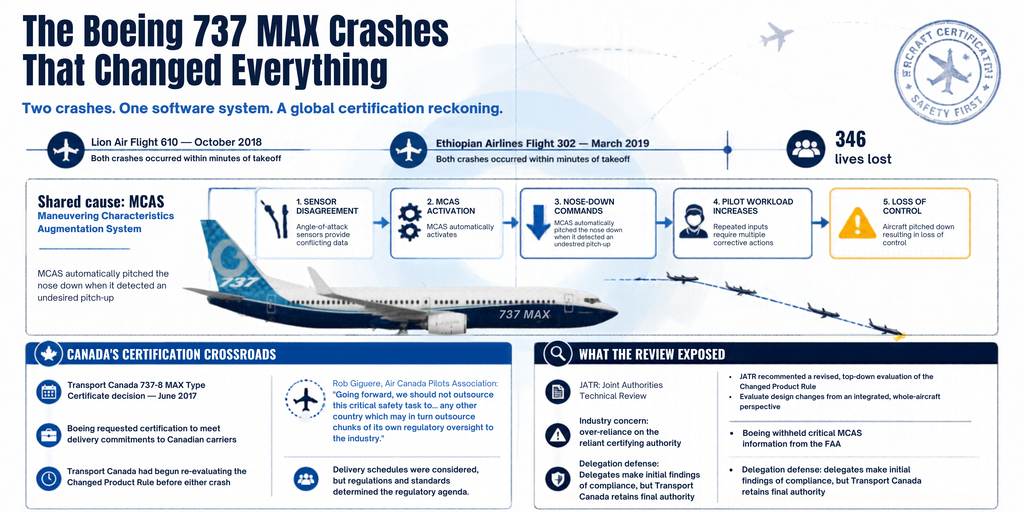
Lion Air Flight 610 crashed in October 2018. Ethiopian Airlines Flight 302 went down in March 2019. Both crashes happened within minutes of takeoff, and together they claimed 346 lives. The eerie similarity between the two disasters quickly pointed investigators toward a shared cause rather than coincidence. For those interested in aviation comparisons, check out this article on Cessna 172 vs Piper Cherokee.
How the MCAS System Caused Both Crashes
That shared cause turned out to be software: the Maneuvering Characteristics Augmentation System, or MCAS. Boeing developed MCAS specifically for the 737 Max to correct control issues identified during the aircraft’s preliminary design phase. The system was built to automatically pitch the aircraft’s nose down whenever it detected an undesired pitch-up that could threaten flight stability. Investigative reports from Indonesia’s Komite Nasional Keselamatan Transportasi (KNKT), the U.S. National Transportation Safety Board (NTSB), and the Joint Authorities Technical Review (JATR) all pointed back to the same conclusion: MCAS, and the certification process that approved it, had serious flaws.
Transport Canada’s June 2017 Type Certificate Decision
Here’s where things get uncomfortable for Canadian regulators. Transport Canada’s own records show that Boeing asked the agency to issue its 737-8 Max Type Certificate in June 2017 specifically to meet delivery commitments already made to Canadian carriers. That timing detail raised eyebrows during the committee’s review, feeding into broader concerns about whether commercial pressure was influencing safety decisions—even indirectly.
The Joint Authorities Technical Review Investigation
After the second crash, regulators couldn’t rely on internal reviews alone. The Joint Authorities Technical Review, known as JATR, was formed to take a harder, more independent look at how the 737 Max earned its certification in the first place. This wasn’t a single country’s investigation—it brought together aviation authorities from multiple nations to examine the process from the ground up.
JATR’s conclusion didn’t mince words. The panel recommended a revised, top-down approach to what’s called the Changed Product Rule, insisting that every design change be evaluated from an integrated, whole-aircraft perspective rather than in isolation. That distinction matters because MCAS wasn’t reviewed as part of a broader system interaction—it was assessed somewhat narrowly, and that narrow view missed how the software could interact catastrophically with pilot inputs and sensor failures. For more insights into aircraft certification, you can read about the Aircraft, Engine and Propeller Type Certification Requirements.
What’s worth noting is that Transport Canada had already started re-evaluating the Changed Product Rule before either crash occurred. That timing suggests the agency had some internal awareness that the existing framework needed updating, even if the full scope of the problem didn’t become public until after Lion Air and Ethiopian Airlines went down.
Certification Process Concerns Raised by Industry Experts
Lawmakers weren’t the only ones raising red flags. Throughout the committee’s hearings, people who work inside the aviation industry—pilots, manufacturers, and certification specialists—offered testimony that painted a complicated picture of how much trust Canada should place in foreign regulatory approvals.
Some of that testimony defended the current system as fundamentally sound, pointing to decades of safe aircraft operation under existing rules. Other witnesses argued the opposite: that Canada had become too comfortable rubber-stamping decisions made by agencies like the FAA, especially when it came to aircraft manufactured outside the country.
Over-Reliance on Foreign Regulatory Approvals
Many witnesses who appeared before the committee expressed concern that Transport Canada had grown “overly reliant on the initial certifying authority.” In plain terms, that means if the FAA approved an aircraft design in the United States, Transport Canada often followed suit without conducting the same depth of independent review. Critics argued this created a system where errors made by one country’s regulator could quietly spread to every other country that trusted that approval.
This concern wasn’t hypothetical. Boeing, acting as its own delegate during certification, withheld critical information about MCAS from the FAA itself. If the originating regulator didn’t have the full picture, any country relying on that approval inherited the same blind spot.
Pilot Associations Warn Against Outsourcing Safety Oversight
Rob Giguere, CEO of the Air Canada Pilots Association, delivered one of the more pointed statements during the hearings. He told the committee: “Going forward, we should not outsource this critical safety task to… any other country which may in turn outsource chunks of its own regulatory oversight to the industry.” That statement captures the layered risk regulators now have to consider—not just whether another country’s agency is trustworthy, but whether that agency itself has outsourced parts of its review to the manufacturer.
Pilots have a unique stake in this conversation because they’re the ones in the cockpit when a certification gap turns into an emergency. Their advocacy groups have consistently pushed for Transport Canada to maintain independent verification rather than treating foreign sign-off as sufficient proof of safety.
Manufacturer Delegate Role in Compliance Findings
Not every industry voice painted the current system as broken. Michael Deer, an airworthiness specialist with Bell Textron Canada Ltd., offered a more measured defense of how delegation works in practice. He explained that while delegates make initial findings of compliance, “the product will never get approved unless Transport Canada involvement has been completed and they are satisfied that the product is safe.” In his view, delegation speeds up the process without removing Transport Canada’s final authority.
Delivery Schedule Pressure on Certification Timelines
One uncomfortable truth surfaced repeatedly during testimony: delivery schedules do factor into certification timing. David Turnbull acknowledged to the committee that it wasn’t uncommon for Transport Canada to consider manufacturers’ delivery commitments during the certification process. He was careful to add that the agency is “not necessarily constrained” by those dates and will keep working through unresolved safety concerns regardless of a manufacturer’s timeline. Nicholas Robinson backed this up, stating that while delivery schedules are considered, the actual regulatory agenda is “determined by the regulations and the standards”—not by a manufacturer’s production needs.
The Changed Product Rule Explained
At the center of nearly every certification controversy discussed so far sits one regulatory mechanism: the Changed Product Rule. Understanding how it works explains both why it’s useful and why it became a flashpoint after the 737 Max disasters.
How Reduced Scrutiny Works for Minor Modifications
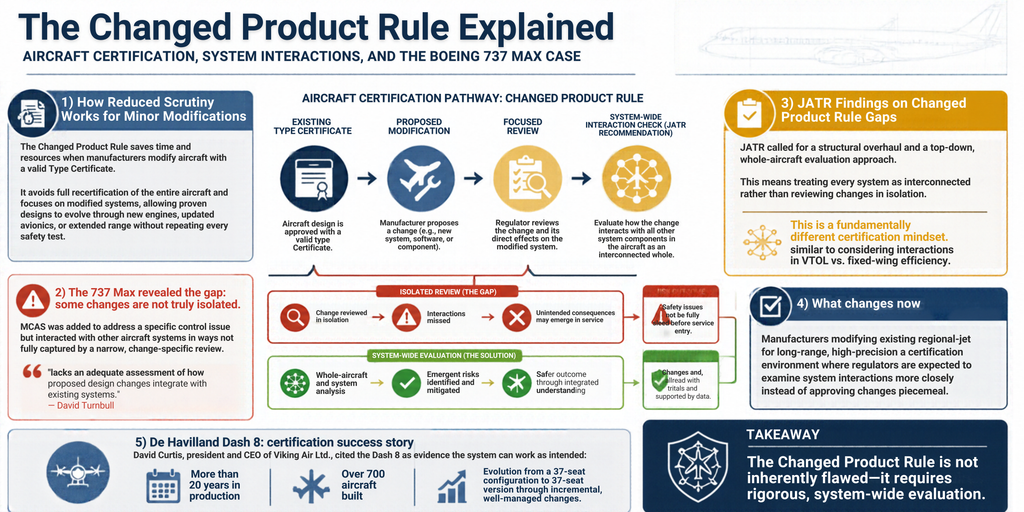
The Changed Product Rule exists to save time and resources when manufacturers make changes to aircraft that already hold a valid Type Certificate. Instead of forcing a full recertification of the entire aircraft every time something changes, the rule allows regulators to focus scrutiny specifically on the modified systems. In theory, this lets proven, safe aircraft designs evolve efficiently—adding new engines, updating avionics, or extending range—without re-running every single safety test from scratch.
The problem, as the 737 Max case revealed, is that some changes aren’t truly isolated. MCAS was added as a modification to address a specific control issue, but it interacted with other aircraft systems in ways that weren’t fully captured by a narrow, change-specific review. David Turnbull himself acknowledged this gap, stating plainly that the rule “lacks an adequate assessment of how proposed design changes integrate with existing systems.”
JATR Findings on Changed Product Rule Gaps
JATR’s investigation confirmed what Turnbull’s statement implied: the existing version of the Changed Product Rule needed a structural overhaul. Their recommendation for a top-down, whole-aircraft evaluation approach wasn’t just a suggestion for paperwork changes—it called for a fundamentally different mindset during certification, one that treats every system as interconnected rather than reviewing changes in isolation, similar to the considerations in VTOL vs. Fixed-Wing efficiency.
This matters beyond the 737 Max. Any aircraft manufacturer seeking to modify an existing design, whether it’s a regional jet or a long-haul aircraft, now faces a certification environment where regulators are expected to look harder at system interactions rather than approving changes piecemeal.
De Havilland Dash 8 as a Certification Success Story
Not every example of the Changed Product Rule points to failure. David Curtis, president and CEO of Viking Air Ltd., offered the De Havilland Canada Dash 8 as proof the system can work exactly as intended. The Dash 8 has been in production for more than 20 years, with over 700 aircraft built, and it evolved from a 37-seat configuration to a 90-seat version through incremental, well-managed changes. Curtis’s testimony served as a reminder that the Changed Product Rule isn’t inherently flawed—it just requires rigorous, system-wide evaluation to work the way it’s supposed to.
How to Import a US-Manufactured Aircraft From Canada
Certification standards don’t just affect brand-new aircraft rolling off the assembly line—they also shape what happens when an aircraft crosses the border between Canada and the United States. Anyone who’s tried to bring a U.S.-manufactured plane back into the U.S. after it’s spent time registered in Canada knows this process comes with its own set of rules, separate from the type certification debates playing out in Parliament.
Conformity Inspection and FAA Airworthiness Certificate Steps
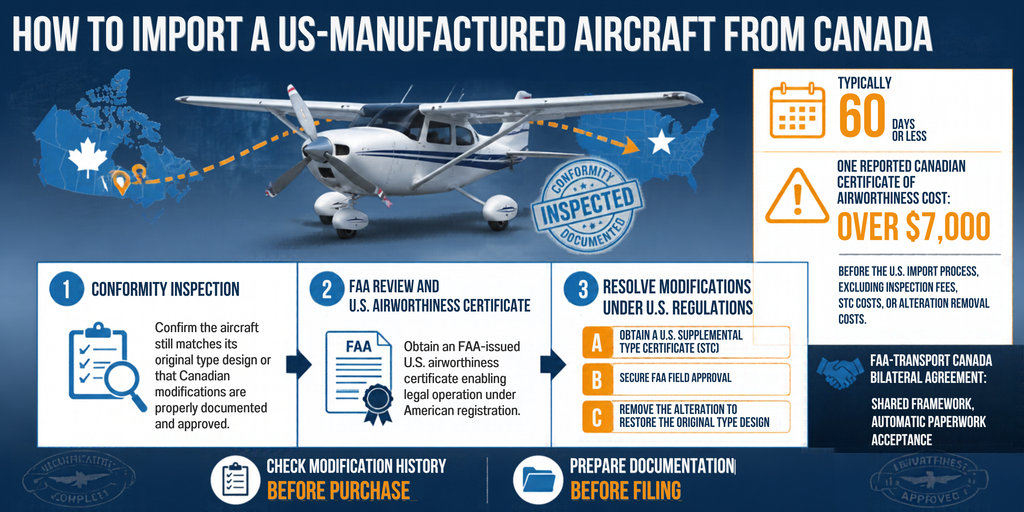
Bringing a U.S.-built aircraft back from Canada starts with a conformity inspection. This step confirms the aircraft still matches its original type design, or that any changes made while it was registered in Canada are properly documented and approved. Once that inspection checks out, the FAA can issue a new U.S. airworthiness certificate, which is what allows the aircraft to legally fly and operate again under American registration.
The entire process typically moves faster than people expect. Most owners who follow the correct steps from the start can complete the full import in 60 days or less. That timeline assumes there are no major surprises during inspection, which is why preparation before filing matters so much.
A bilateral agreement between the FAA and Transport Canada underpins this entire process, giving both agencies a shared framework for recognizing each other’s certification work. That agreement doesn’t mean paperwork crosses the border automatically, though—owners still need to understand exactly what the FAA will and won’t accept.
Handling Aircraft Modifications Under US Regulations
Here’s where many owners run into trouble: Canadian airworthiness certifications and supporting paperwork aren’t automatically accepted by the FAA if the aircraft has been modified. If a plane picked up any alterations while registered in Canada, the owner has exactly three options to satisfy FAA requirements:
- Obtain a U.S. Supplemental Type Certificate (STC) that covers the specific modification
- Secure a Field Approval from the FAA for the alteration in question
- Remove the alteration entirely to bring the aircraft back to its original type design
Skipping this step is one of the most common mistakes owners make, and it’s also one of the most expensive to fix after the fact. Modifications that seemed minor or routine under Canadian rules can turn into major roadblocks if they don’t have a clear path to U.S. approval.
Timeline and Cost Considerations for Owners
Money matters here too, and it adds up faster than most first-time importers expect. One aircraft owner reported spending over $7,000 just to obtain a Canadian Certificate of Airworthiness before even starting the U.S. import process. That figure doesn’t include inspection fees, potential STC costs, or the price of removing unapproved modifications if that turns out to be the only option.
Owners who research the process thoroughly before purchasing a Canadian-registered aircraft tend to avoid the worst financial surprises. Checking modification history early, ideally before money changes hands, saves both time and unnecessary expense down the line.
What Canada’s Certification Overhaul Means Going Forward
Canada’s aircraft certification standards are clearly shifting toward greater independence and stricter internal review. The House of Commons committee’s unanimous recommendations signal that lawmakers want Transport Canada to stop treating foreign approvals as a substitute for its own rigorous assessment. That shift won’t happen overnight, but the direction is unmistakable.
Increased funding for Transport Canada Civil Aviation, if it materializes, should translate into more staff and more time dedicated to reviewing complex systems like MCAS before they ever reach Canadian airspace. A reinvigorated Canadian Aviation Regulatory Advisory Council could also mean more structured industry input, giving manufacturers, pilots, and regulators a clearer forum to flag concerns before they become headlines.
None of this guarantees another 737 Max situation won’t happen. But the specific, unanimous nature of the committee’s recommendations suggests Canada is taking real steps to close the gaps that contributed to 346 deaths. For manufacturers planning to certify new aircraft types in Canada, that means preparing for a review process that looks harder at whole-system integration rather than accepting someone else’s sign-off at face value.
Frequently Asked Questions
These are some of the most common questions readers ask about how Canada certifies aircraft and what that means for safety and cross-border ownership.
What Agency Certifies Aircraft in Canada?
Transport Canada Civil Aviation (TCCA) is the agency responsible for certifying aircraft in Canada. It issues Type Certificates confirming that an aircraft design meets Canadian airworthiness standards before it can be flown commercially. For those interested in aircraft comparisons, check out this Cessna 172 vs Piper Cherokee article for tourism flight operations.
Why Did Transport Canada’s 737 Max Approval Draw Criticism?
Transport Canada issued its 737-8 Max Type Certificate in June 2017 partly to meet Boeing’s delivery commitments to Canadian airlines. After two fatal crashes revealed flaws in the MCAS system, critics questioned whether Transport Canada had conducted an independent enough review or relied too heavily on the FAA’s original approval.
What Is the Changed Product Rule in Aircraft Certification?
The Changed Product Rule allows regulators to focus certification review specifically on modified systems when a manufacturer updates an aircraft that already holds a Type Certificate, rather than requiring a full recertification. The rule came under scrutiny after investigators found it didn’t adequately assess how a new system like MCAS interacted with the rest of the aircraft.
How Long Does It Take to Import a Plane From Canada to the US?
Importing a U.S.-manufactured aircraft from Canada typically takes 60 days or less, assuming the aircraft passes its conformity inspection without complications. Aircraft with undocumented modifications can take longer if the owner needs to secure a Supplemental Type Certificate or Field Approval first.
What Documents Are Needed for US Aircraft Import From Canada?
Owners need proof of a successful conformity inspection, the aircraft’s Canadian registration and airworthiness history, and documentation for any modifications made while the aircraft was in Canada. If modifications exist without FAA-approved paperwork, owners must obtain a Supplemental Type Certificate, secure a Field Approval, or remove the alteration before the FAA will issue a U.S. airworthiness certificate.
Staying ahead of Canada’s evolving certification standards matters whether you’re a manufacturer, pilot, or aircraft owner navigating cross-border paperwork, and [COMPANY] continues to break down these regulatory changes so you don’t have to piece them together alone.
When considering the best drone technology for coastal survey accuracy, it’s important to evaluate the differences between fixed-wing and rotary drones. Each type offers unique advantages and challenges that can impact survey results, especially in challenging coastal environments.