

- The Diamond DA40 is one of the most advanced single-engine training aircraft available today, featuring the Garmin G1000 glass cockpit that prepares student pilots for modern professional aviation from day one.
- Its composite airframe, Garmin ESP stability protection, and airbag seatbelts give it one of the strongest safety records in general aviation training.
- Flight schools operating the DA40 benefit from significantly lower fuel and maintenance costs — particularly models equipped with the Austro Engine AE300 running on Jet-A1 fuel instead of traditional AvGas.
- Diamond Aircraft’s Smart Aircraft Experience program offers dedicated CBT e-learning courses for the DA40 NG and DA40 TDI, giving flight schools a complete ground-to-air training ecosystem.
- Keep reading to find out why the DA40’s handling characteristics may be the single most important factor in how quickly student pilots build real confidence in the air.
The Diamond DA40 doesn’t just train pilots — it builds them from the ground up with technology, safety, and efficiency that few training aircraft can match.
Flight schools worldwide have gravitated toward the DA40 not simply because it looks impressive on the ramp, but because it solves real problems: high operating costs, outdated avionics, and training aircraft that leave students underprepared for modern cockpits. Aerocity Group, a recognized voice in aviation training, highlights the DA40’s combination of durable composite construction, ultra-low fuel burn, and superior handling as key reasons it excels in both training and cross-country travel alike.
The Diamond DA40 Is Changing How Flight Schools Train Pilots
Most training aircraft are compromises — cheap to buy, expensive to run, and packed with analog gauges that bear little resemblance to the glass cockpits students will encounter in their professional careers. The DA40 breaks that mold entirely.
Diamond Aircraft engineered the DA40 from the outset as a complete training platform. Its composite airframe keeps weight down and structural integrity up. Its Garmin G1000 avionics suite mirrors what pilots find in turboprops and regional jets. And its Austro Engine AE300 — a diesel-cycle powerplant running on Jet-A1 fuel — dramatically reduces the operating cost per flight hour that has historically made flight training an expensive proposition for schools and students alike.
Modern Avionics That Mirror Real-World Flying
Avionics training is no longer optional — it’s the foundation of modern piloting. The DA40 equips students with real glass cockpit experience from their very first lesson, not something they have to learn after the fact when transitioning to professional aircraft. Discover how Indra is redefining aviation training with realistic scenarios using AR and VR technology.
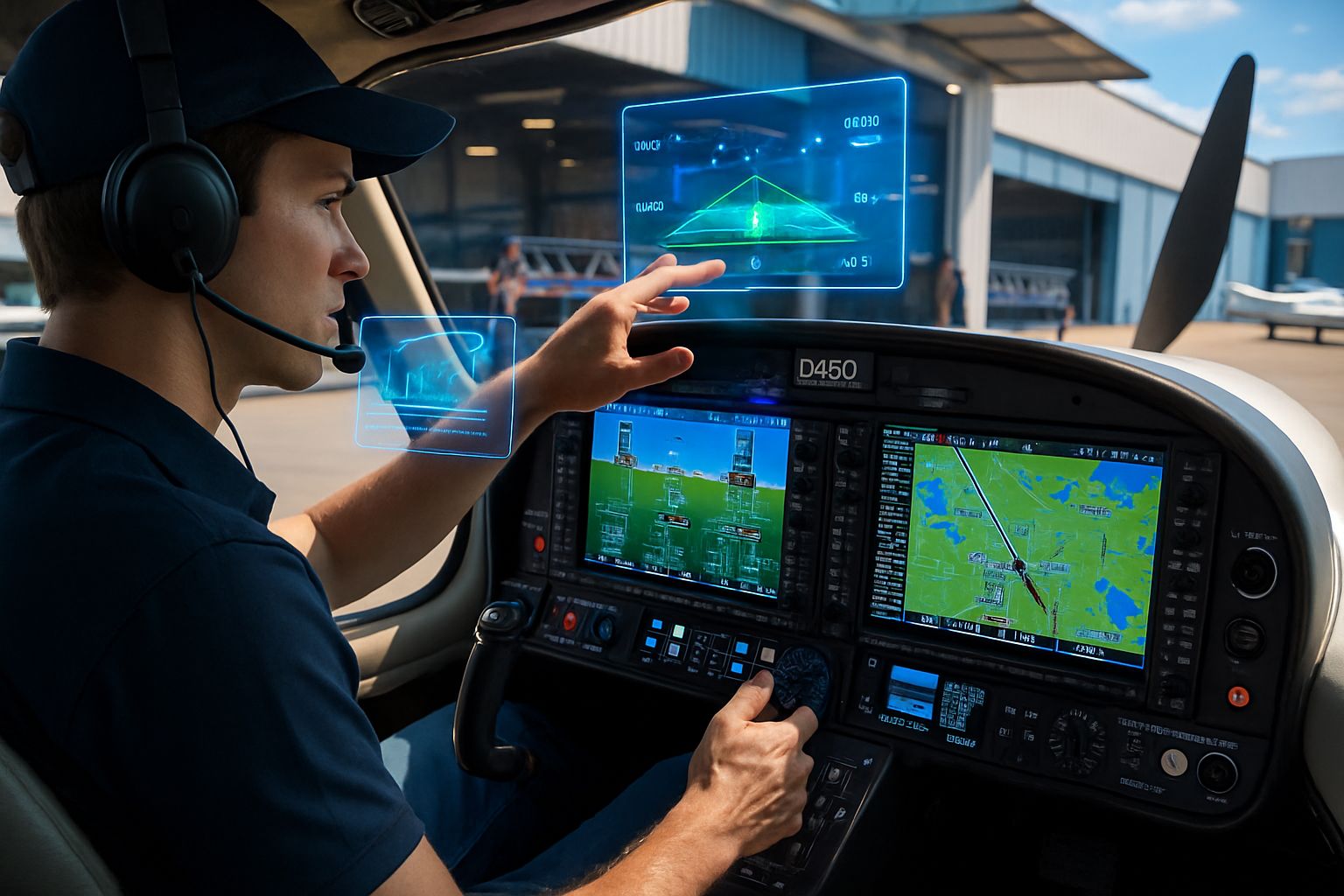
Garmin G1000 Glass Cockpit: What It Teaches Student Pilots
The Garmin G1000 is a fully integrated flight deck system that consolidates primary flight instruments, navigation, engine monitoring, and communication into two large high-resolution displays. For student pilots, this means learning to scan a modern instrument layout — one that rewards disciplined cross-checking and situational awareness — rather than hunting across a panel of individual analog gauges.
What the G1000 specifically teaches is prioritization. Students learn to read airspeed, altitude, attitude, and navigation data simultaneously from a single field of view. The moving map display builds spatial awareness early, and the system’s alerting functions teach students to respond to data rather than react to surprises. These are exactly the habits that commercial aviation demands.
How Integrated Avionics Reduce the Gap Between Training and Professional Flying
One of the most expensive and frustrating transitions in a pilot’s career is moving from a steam-gauge trainer to a glass cockpit airliner or corporate aircraft. The DA40 effectively eliminates that transition cost. Students who train on the G1000 from the beginning arrive at airline or charter operators already fluent in the interface, the logic, and the discipline that glass cockpit flying requires. Flight schools that invest in DA40 fleets are investing in graduate outcomes, not just flight hours.
Safety Features That Set the DA40 Apart
Safety in a training aircraft isn’t just about how it handles a stall — it’s about every system, every structure, and every layer of protection working together to give students the margin they need to learn without catastrophic consequence.
Composite Airframe: Stronger and Lighter Than Traditional Aluminum
The DA40’s airframe is constructed entirely from composite materials — carbon fiber and fiberglass reinforced structures that are both lighter and more impact-resistant than traditional aluminum designs. This isn’t a cosmetic choice. Composite construction allows Diamond to engineer energy-absorbing crumple zones into the fuselage, directing crash forces away from the occupants in a manner that riveted aluminum simply cannot replicate. Learn how Diehl Aviation is enhancing comfort and functionality by transforming aircraft interiors.
The landing gear on the DA40 is also composite, functioning as a leaf spring that absorbs hard landings — the kind that student pilots inevitably deliver during training. This reduces stress on the airframe and dramatically lowers the maintenance cycle that metal gear aircraft require after rough
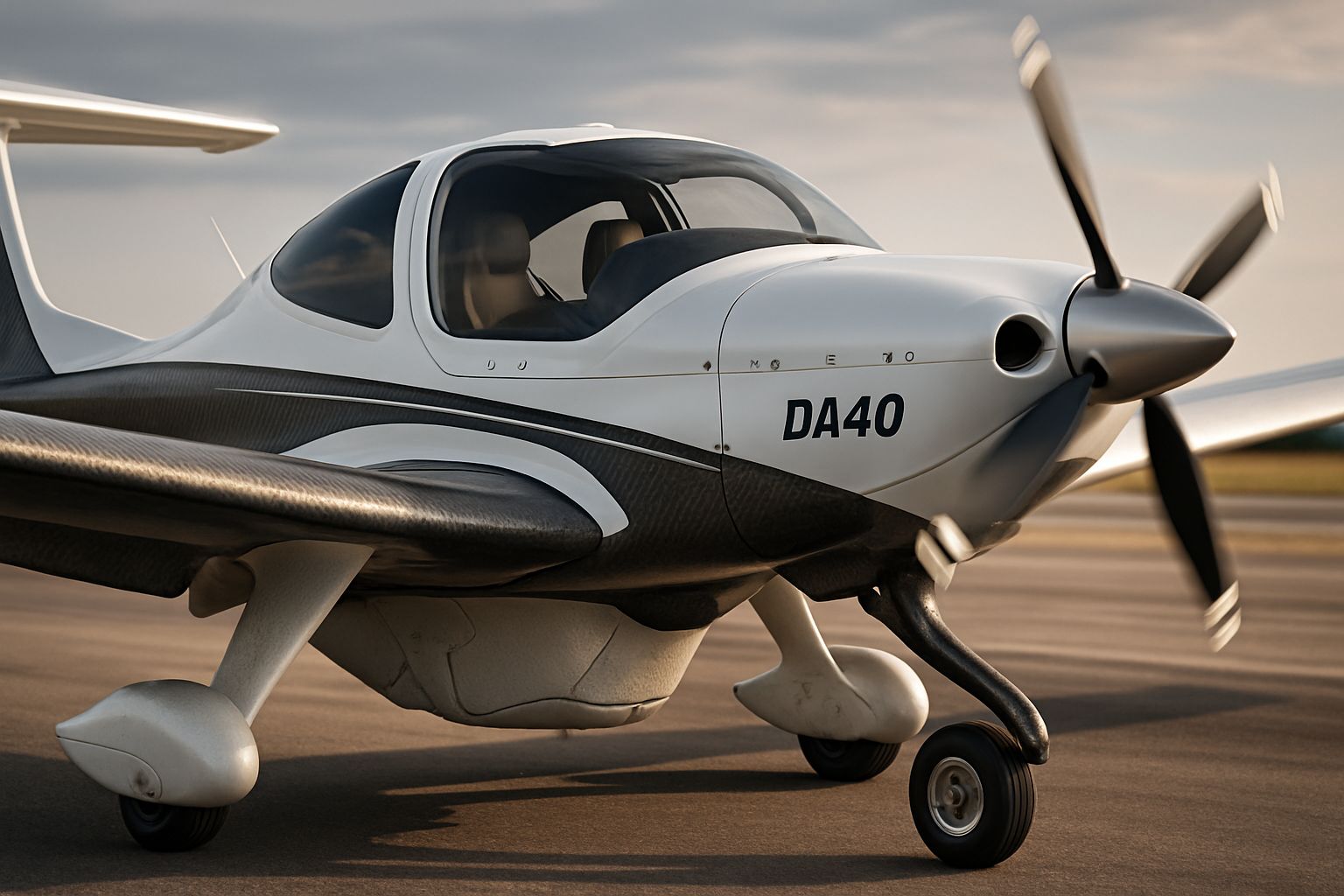
contact with the runway.
DA40 Composite Airframe vs. Traditional Aluminum Training Aircraft
Feature
DA40 Composite
Traditional Aluminum
Impact Resistance
Energy-absorbing composite structure
Rigid aluminum — less energy absorption
Hard Landing Tolerance
Composite spring gear absorbs impact
Metal gear transfers stress to airframe
Corrosion Risk
None — composites don’t corrode
High — requires ongoing corrosion treatment
Weight
Lighter — improves fuel efficiency
Heavier — higher fuel consumption
Maintenance After Hard Landings
Lower — gear absorbs most energy
Higher — inspection and repair more frequent
For flight schools, that difference in maintenance frequency translates directly to aircraft availability and revenue per aircraft per year.
Garmin ESP: The Electronic Co-Pilot That Prevents Accidents
Garmin ESP — Electronic Stability and Protection — is a system embedded in the G1000 that monitors the aircraft’s attitude and automatically applies control inputs if the aircraft approaches dangerous parameters. If a student pilot allows excessive bank angle, unusual pitch, or an overspeed condition to develop, ESP gently but firmly nudges the controls back toward safe flight. It doesn’t override the pilot — it assists, making it an ideal safety net during the critical early phases of training when spatial disorientation and target fixation are most likely. For more information on how the Diamond DA40 integrates these systems, visit the manufacturer’s site.
Airbag Seatbelts and IFR Capability in a Training Aircraft
The DA40 is equipped with airbag seatbelts — a feature rarely seen in single-engine training aircraft — that deploy during sudden deceleration events to protect occupants from striking the instrument panel. Combined with its certified IFR capability, the DA40 gives flight schools an aircraft that can train students in actual instrument meteorological conditions, not just simulated ones, dramatically expanding the operational utility and training value of every aircraft in the fleet.
Fuel Efficiency That Makes Flight Schools More Profitable
Operating costs are the silent killer of flight school profitability, and the aircraft you choose determines whether your margins work or don’t. The DA40 was engineered with this reality in mind.
Austro Engine vs. Lycoming: Which Powers the DA40 Best for Training
The DA40 is available in two primary engine configurations for training fleets: the Austro Engine AE300 — a turbocharged diesel-cycle engine running on Jet-A1 fuel — and the Lycoming IO-360-M1A, a traditional AvGas-burning four-cylinder powerplant found in the DA40-180 variant. Both are reliable, but they serve different fleet strategies. The Lycoming is a known quantity with a vast network of mechanics and parts availability, making it attractive for smaller schools in regions where Jet-A1 access is limited. The Austro Engine AE300, however, is purpose-built for efficiency and longevity, with a longer time between overhaul and a fuel burn profile that fundamentally changes the economics of flight training at scale.
How Jet-A1 Fuel Cuts Operating Costs Compared to AvGas Fleets
Jet-A1 fuel is significantly cheaper per gallon than 100LL AvGas in most global markets, and the Austro Engine AE300 burns approximately 6.5 gallons per hour at cruise — a figure that competes favorably against AvGas trainers burning 8 to 10 gallons per hour. For a flight school running five aircraft at 800 hours per year each, that difference in fuel consumption and fuel cost compounds into substantial savings annually. Those savings either go directly to the school’s bottom line or get passed to students as lower hourly rates, making the school more competitive in attracting new enrollments.
Beyond the pump price difference, Jet-A1 is also more widely available internationally than 100LL AvGas, which has become increasingly difficult to source in parts of Europe and Australia as the general aviation industry moves away from leaded fuel. Flight schools operating DA40 NG fleets are future-proofing their operations against AvGas supply disruptions that are already affecting competitors flying older AvGas-only aircraft.
Lower Maintenance Costs and What That Means for Student Pricing
The DA40’s composite airframe doesn’t corrode, which eliminates one of the most time-consuming and expensive maintenance requirements of aluminum aircraft operating in humid coastal environments. The composite spring landing gear absorbs hard student landings without transferring stress to the fuselage structure, reducing post-landing inspection requirements significantly compared to metal gear aircraft.
The Austro Engine AE300 also features a longer Time Between Overhaul (TBO) than many comparable piston engines, meaning schools go further between expensive engine overhauls. When you stack lower fuel costs, reduced airframe maintenance, and extended engine TBO together, the per-hour operating cost of a DA40 fleet becomes one of the strongest financial arguments any flight school administrator can make to a board or investor.
A Cockpit Built for Learning
A training cockpit needs to do two things simultaneously: give the instructor clear oversight and give the student enough space to think. The DA40 delivers both without compromise.
Spacious Dual-Occupant Design and Instructor Visibility
The DA40’s side-by-side seating configuration places instructor and student at the same eye level with identical access to the controls and instrument panel. This layout is fundamentally superior for training compared to tandem-seat designs, where the instructor’s view of student inputs and instrument scan patterns is limited. In the DA40, the instructor sees exactly what the student sees, can monitor hand position on the controls, and can intervene instantly — all without verbal instruction creating lag in a critical moment. The cockpit width is generous enough that neither occupant feels cramped during long cross-country training flights, which matters when building the endurance and focus that real-world flying demands.
Panoramic Windows and the Role of Situational Awareness in Early Training
The DA40 features an expansive bubble canopy with panoramic visibility that gives both occupants an unobstructed view of the surrounding airspace. For student pilots still developing their see-and-avoid instincts and traffic scanning habits, this visibility advantage is not a luxury — it’s a genuine safety and learning asset. Situational awareness begins with what you can physically see, and the DA40’s canopy design ensures students are building that awareness from their very first hour in the aircraft rather than working around structural blind spots.
Handling Qualities That Build Pilot Confidence Fast
The DA40 is widely praised by flight instructors for its honest, predictable handling — an aircraft that responds precisely to inputs without requiring constant correction or fighting student mistakes with aggressive departure characteristics. Its stall behavior is straightforward and well-telegraphed, giving students clear aerodynamic feedback before the break rather than surprising them. The light control forces make basic maneuver training accessible early, while the aircraft’s inherent stability means students can focus on learning procedures and developing scan patterns rather than wrestling with the controls. That stability is not a crutch — it’s a platform. Students build real confidence quickly because the aircraft rewards good technique immediately and visibly, creating a positive feedback loop that accelerates the learning curve in ways that less forgiving trainers simply don’t.
E-Learning Integration With the DA40 Training Program
Ground school and flight training have historically existed in separate silos, but Diamond Aircraft has worked to close that gap with a dedicated digital learning ecosystem built specifically around the DA40 platform.
Diamond Aircraft Smart Aircraft Experience and CBT Courses
Diamond Aircraft’s Smart Aircraft Experience program is a structured digital training ecosystem designed to complement in-aircraft instruction with rigorous, regulation-compliant ground school content. The program connects flight schools to Computer-Based Training (CBT) courses that cover aircraft systems, avionics operation, and emergency procedures in a format students can access anywhere — before they ever step onto the ramp. For flight school operators, this means students arrive at the aircraft with foundational systems knowledge already in place, allowing instructors to focus flight time on skill development rather than explaining how the fuel system works on the ground.
DA40 NG and DA40 TDI Online Courses Built for Flight Schools
Evionica, a proud partner of Diamond Aircraft’s Smart Aircraft Experience program, developed dedicated CBT courses for both the DA40 NG and DA40 TDI variants. These courses are built to be 100% regulation-compliant and cover every major aircraft system in a structured, user-friendly format that works across devices. A separate DA40-180 CBT course is also available through Evionica’s platform, ensuring that flight schools operating any variant of the DA40 family have access to standardized ground training content that matches their specific aircraft.
The practical impact of this integration is significant. Flight schools that pair CBT ground training with in-aircraft instruction report more consistent student progression because every student enters each flight lesson with the same baseline of systems knowledge. There’s no variation in what the ground instructor covered last week versus what a different instructor covered the week before. The CBT content is standardized, sequenced, and current — which is exactly what a professional training program requires to produce consistently competent graduates.
The DA40 Is the Smartest Investment a Flight School Can Make
When you add up the Garmin G1000 avionics training value, the composite airframe durability, the Austro Engine AE300 fuel economy, the ESP safety system, the panoramic cockpit visibility, and the integrated CBT e-learning ecosystem, the DA40 stops being just a training aircraft and becomes a complete training solution. Flight schools that choose the DA40 aren’t just buying an airplane — they’re buying a platform that reduces operating costs, improves student outcomes, future-proofs their fleet against AvGas availability issues, and positions their graduates ahead of peers who trained on older, less capable aircraft. For any flight school serious about competing in the next decade of aviation training, the DA40 is not a luxury choice. It’s the logical one.
Frequently Asked Questions
Below are answers to the most common questions flight schools and aspiring pilots ask about the Diamond DA40 as a training aircraft. Whether you’re evaluating the DA40 for a fleet purchase or choosing a flight school based on the aircraft they operate, these answers give you the information you need to make a confident decision. If you’re interested in other training aircraft, you might want to explore the Cessna 172 Skyhawk for its stability and performance.
Diamond DA40 Quick Reference: Key Training Specs
Specification
Detail
Primary Avionics
Garmin G1000 Integrated Flight Deck
Engine Options
Austro Engine AE300 (Jet-A1) / Lycoming IO-360-M1A (AvGas)
Fuel Burn (AE300)
~6.5 gallons per hour at cruise
Airframe Construction
Full composite (carbon fiber and fiberglass)
IFR Certified
Yes
Safety Systems
Garmin ESP, airbag seatbelts, composite spring gear
Seating Configuration
Side-by-side dual occupant
E-Learning Support
DA40 NG, DA40 TDI, DA40-180 CBT courses via Evionica
What avionics system does the Diamond DA40 use for flight training?
The Diamond DA40 uses the Garmin G1000 integrated flight deck — a fully glass cockpit system that consolidates primary flight instruments, navigation, engine monitoring, and communications into two large high-resolution displays. It is the same avionics family used in many turboprops and light jets, making DA40 training directly transferable to professional aviation environments.
Is the Diamond DA40 suitable for IFR training?
Yes. The DA40 is fully IFR certified, meaning it can be flown legally in actual instrument meteorological conditions — not just simulated ones under a view-limiting device. This makes it one of the most capable single-engine training aircraft available for instrument rating coursework, giving students real-world IMC exposure that builds genuine instrument proficiency rather than hood-only simulation.
How does the DA40 compare in fuel efficiency to other training aircraft?
The DA40 NG equipped with the Austro Engine AE300 burns approximately 6.5 gallons of Jet-A1 per hour at cruise, compared to 8 to 10 gallons per hour for many AvGas-powered single-engine trainers. Combined with the lower cost of Jet-A1 fuel relative to 100LL AvGas in most markets, the DA40 NG delivers a meaningful reduction in fuel costs per flight hour — a difference that compounds significantly across a multi-aircraft flight school fleet operating at high annual utilization rates.
What makes the DA40 composite airframe safer for student pilots?
The DA40’s full composite construction offers two distinct safety advantages over traditional aluminum aircraft. First, the composite structure is engineered with energy-absorbing properties that direct crash forces away from the occupant cell during impact events. Second, the composite spring landing gear acts as a natural shock absorber during hard landings — the kind that are inevitable during student training — reducing both structural stress and the frequency of post-landing maintenance inspections. For those interested in other aircraft with notable stability and performance, the Cessna 172 Skyhawk is another excellent choice.
Composite materials also do not corrode, which eliminates a significant long-term structural degradation risk in aircraft operating in coastal or humid environments. Over the service life of a training fleet, this corrosion immunity reduces both maintenance hours and the risk of undetected structural compromise that corrosion can cause in aging aluminum airframes.
Does Diamond Aircraft offer e-learning support for DA40 flight schools?
Yes. Diamond Aircraft’s Smart Aircraft Experience program provides flight schools with access to structured, regulation-compliant CBT e-learning courses covering DA40 aircraft systems and operations. The program is delivered in partnership with Evionica, which has developed specific CBT courses for the DA40 NG, DA40 TDI, and DA40-180 variants.
These courses cover all major aircraft systems, avionics operation, and procedures in a format accessible on any device, allowing students to complete ground training independently before arriving at the flight school for in-aircraft instruction. The content is sequenced to align with flight training syllabi, making it a practical tool for standardizing student preparation across large training cohorts.
For flight schools, the availability of aircraft-specific CBT content means less instructor time is spent on ground briefings and more flight time is used for actual skill development. This improves training efficiency, reduces total hours to certification for prepared students, and supports a more consistent graduate outcome — which ultimately strengthens the reputation and enrollment appeal of the school itself.
The Diamond DA40 is a popular choice among flight schools due to its innovative design and advanced technology. Its sleek aerodynamics and efficient engine make it an ideal training aircraft for aspiring pilots. The DA40 is equipped with state-of-the-art avionics, providing students with a modern cockpit experience. This aligns with the trend of flight schools embracing cutting-edge technology, much like how Indra is redefining aviation training with realistic scenarios using AR and VR technology.