
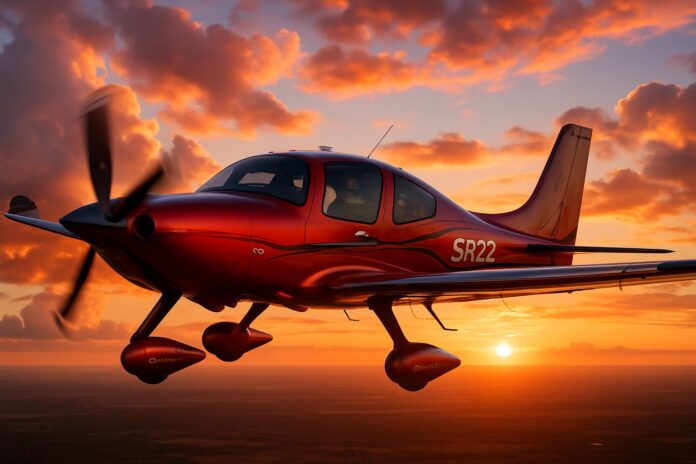

SR22 Pilot Training: At a Glance
- The Cirrus SR22 is the world’s best-selling high-performance single-engine piston aircraft, and its structured training program is specifically designed to make pilots safer from day one.
- The Cirrus Airframe Parachute System (CAPS) has saved over 200 lives since its introduction — but proper training is what determines whether a pilot actually uses it correctly in an emergency.
- The 2026 SR22 G7+ is the first FAA-certified piston aircraft to include Safe Return Emergency Autoland as standard equipment, fundamentally changing the risk calculus for owner-pilots and their families.
- NTSB accident data from 2023 to 2026 reveals that pilot decision-making, not aircraft failure, remains the dominant accident factor in SR22 incidents — making quality training non-negotiable.
- Cirrus offers a structured Private Pilot Program taught exclusively by Cirrus Standardized Instructor Pilots (CSIPs), with simulator training built in to reduce real-world risk before you ever leave the ground.
Most pilots don’t realize the SR22 isn’t just an aircraft — it’s a complete safety ecosystem that only works as well as the pilot flying it.
The Cirrus SR22 has earned its reputation as the gold standard in personal aviation, combining cutting-edge avionics, redundant safety systems, and a purpose-built training curriculum that no other piston aircraft manufacturer comes close to matching. Whether you’re a student pilot exploring your first high-performance aircraft or an experienced aviator transitioning to the Cirrus platform, understanding how the SR22’s training ecosystem works is essential to flying it safely.
The SR22’s trajectory from capable cross-country machine to the best-selling high-performance single-engine piston aircraft is one of general aviation’s most compelling stories — and the training infrastructure built around it is a big reason why.
The Cirrus SR22 Has Redefined What Safe Pilot Training Looks Like
When Cirrus introduced the SR22, the goal wasn’t just to build a faster, more capable aircraft. The goal was to build a safer one — and then train pilots to use every tool available to stay alive. That philosophy runs through everything, from the Garmin-based Cirrus Perspective flight deck to the integrated Cirrus Airframe Parachute System (CAPS) that deploys a full-airframe parachute in a genuine emergency.
Cirrus CEO Zean Nielsen on the 2026 SR Series G7+:
“The 2026 SR Series G7+ provides our customers with more choice, more connectivity and more pilot convenience combined with revolutionary safety systems, such as the Cirrus Airframe Parachute System (CAPS) and Safe Return Emergency Autoland.”
What makes Cirrus training different from standard FAA-required curricula is the emphasis on system mastery. Flying an SR22 well means understanding the GFC 700 digital autopilot, the Electronic Stability and Protection system, and precisely when to activate CAPS. That level of aircraft-specific knowledge doesn’t come from a generic flight school — it comes from a structured Cirrus training program taught by instructors who know this platform inside and out. For those interested in exploring the Cirrus community further, consider joining COPA, the premier community for Cirrus aircraft enthusiasts.
The integration of the GFC 700 digital autopilot into the Garmin-based Cirrus Perspective flight deck fundamentally redefined the SR22’s operating environment. It eliminated the workload spikes associated with older autopilot systems, but it also introduced a new requirement: pilots need to understand automation management at a level that wasn’t previously expected of piston aircraft pilots. This is exactly why Cirrus developed its own standardized training pathway, similar to how Indra is redefining aviation training with realistic scenarios using AR and VR technology.
The Safety Systems That Set the SR22 Apart
No other production piston aircraft packs this much redundant safety technology into a single airframe. The SR22’s safety architecture operates on a layered principle — multiple independent systems designed to give pilots options when things go wrong, rather than leaving them with none. For enthusiasts looking to connect with others who appreciate these innovations, consider joining COPA, the premier community for Cirrus Aircraft enthusiasts.
Cirrus Airframe Parachute System (CAPS): A Last-Resort Life Saver
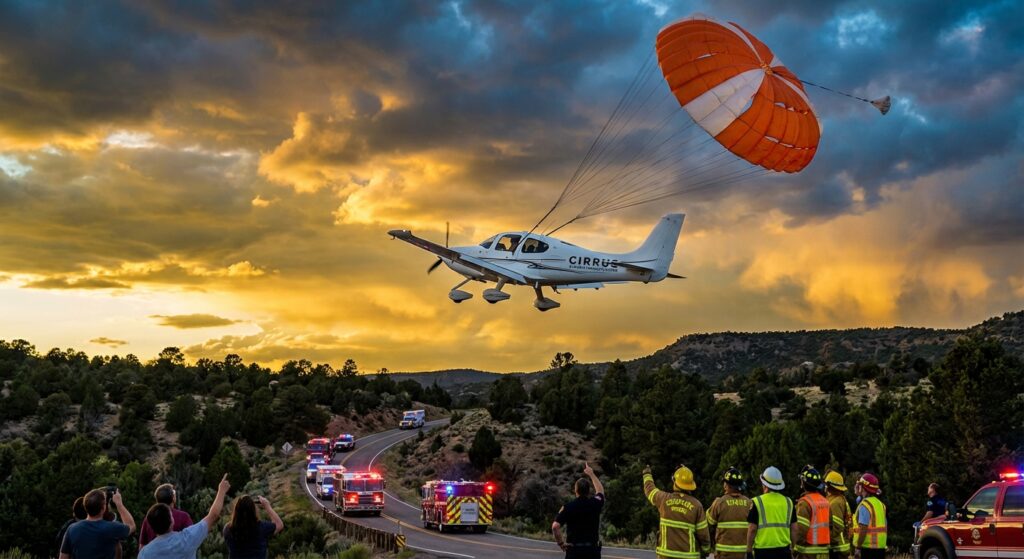
CAPS is the system that put Cirrus on the map, and it remains the most recognizable safety feature on any piston aircraft in production today. When activated, CAPS deploys a ballistic rocket-propelled parachute that lowers the entire aircraft to the ground at a survivable descent rate. It is not an ejection seat — it saves the aircraft and everyone in it.
Since its introduction, CAPS has saved over 200 lives. That number doesn’t happen by accident. It happens because Cirrus built the system, trained pilots to use it without hesitation, and removed the psychological barrier of pulling a handle that feels counterintuitive in a crisis. Accident records now confirm that when trained and used properly, CAPS is a net positive for pilot survival rates.
- CAPS is designed for use when normal aircraft control is lost or insufficient
- Activation requires a deliberate pull handle located above the pilot’s head
- The system deploys in less than one second via a solid-rocket motor
- It is effective from as low as 400 feet AGL under certain conditions
- Training covers specific scenarios where CAPS is the correct — and only — choice
What matters most is that CAPS is not a crutch — it’s a last resort. Proper SR22 training drills this distinction repeatedly, ensuring pilots develop real stick-and-rudder skills while also knowing exactly when the parachute handle is the right answer. For those interested in exceptional sightseeing experiences, there are other aircraft options available as well.
Safe Return Emergency Autoland: The SR22 G7+’s Game-Changing Feature
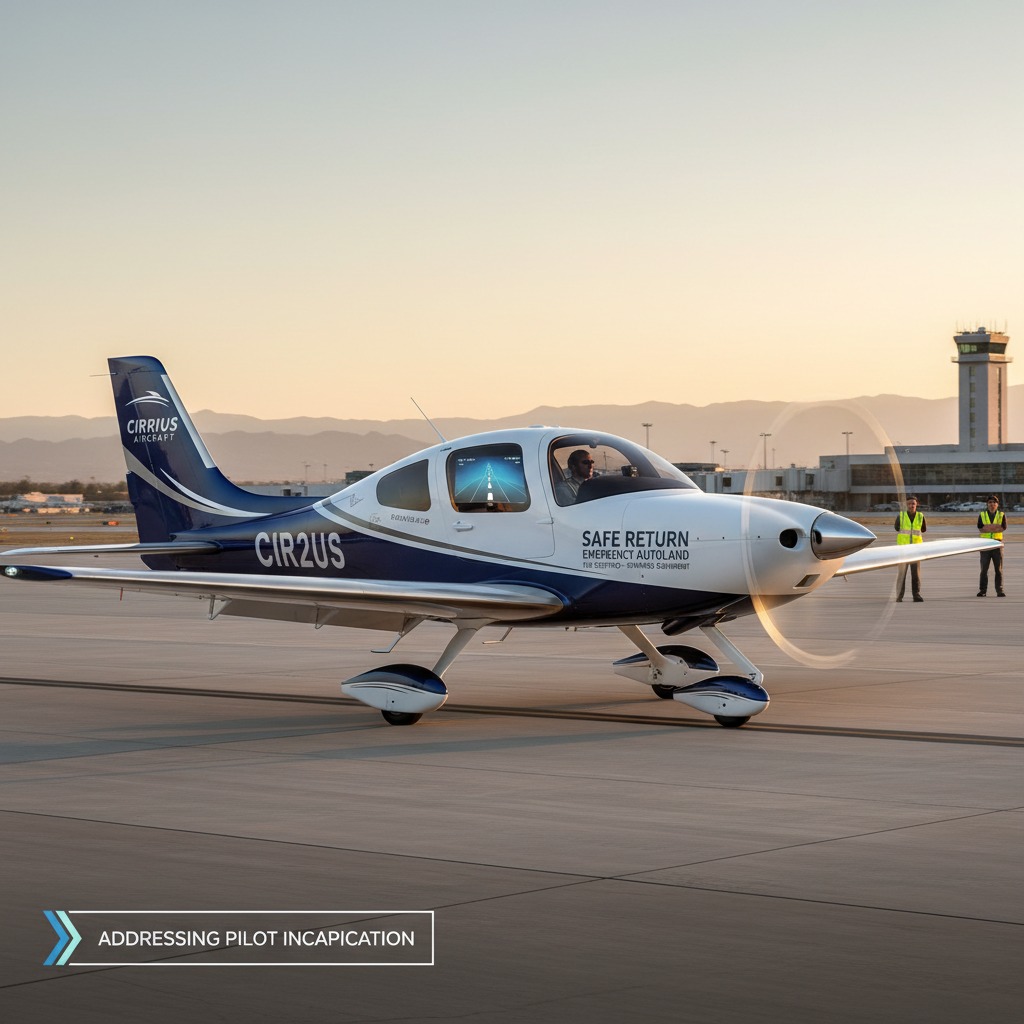
The 2026 SR22 G7+ became the first FAA-certified piston aircraft in history to include Safe Return Emergency Autoland as standard equipment. When activated — either by the pilot or a passenger — Safe Return takes complete control of the aircraft, identifies the nearest suitable airport, flies the approach, lands the aircraft, stops on the runway, and shuts down the engine. It directly addresses one of general aviation’s most insidious threats: subtle pilot incapacitation.
How These Systems Work Together in Real Emergencies
CAPS and Safe Return don’t compete — they complement each other in a layered safety architecture that Cirrus describes as a “total safety solution.” Safe Return handles incapacitation scenarios where the pilot can no longer fly but the aircraft is still controllable. CAPS handles catastrophic loss of control scenarios where no automated system can help. Together, they cover the two most survivable categories of would-be fatal accidents.
How the SR22 G7+ Safety Stack Works:
Layer 1 — Electronic Stability & Protection (ESP): Automatically corrects unusual attitudes and prevents loss of control in normal flight.
Layer 2 — GFC 700 Autopilot: Reduces pilot workload during high-demand phases of flight, including instrument approaches.
Layer 3 — Safe Return Emergency Autoland: Activatable by pilot or passenger; flies, lands, and stops the aircraft autonomously at the nearest suitable airport.
Layer 4 — CAPS: Full-airframe ballistic parachute system; last-resort option for catastrophic loss of control. Has saved over 200 lives.
This is the architecture that makes the SR22 G7+ the most comprehensively protected piston aircraft ever certified. But here’s the critical point every prospective Cirrus pilot needs to understand: none of these systems replace pilot skill and judgment. They augment it. The NTSB data from 2023 to 2026 makes that unmistakably clear.
What the NTSB Data Actually Says About SR22 Accidents
The SR22 has one of the most thoroughly analyzed accident records in general aviation, partly because of how popular the aircraft is and partly because every incident involving a parachute-equipped aircraft draws significant attention. When you strip away the noise and look at what the NTSB data actually shows from 2023 to 2026, one pattern dominates: pilot decision-making is the predominant accident factor, not aircraft systems failure.
The Most Common Accident Categories From 2023 to 2026
Across the NTSB accident data covering the 2023 to 2026 period, the accidents that claimed lives and destroyed airframes consistently trace back to a handful of recurring pilot-driven factors. Weather-related decision-making errors lead the list, followed by loss of control during approach and landing, and failures to activate CAPS when the situation clearly called for it. In nearly every case, the aircraft performed exactly as designed. The gap was in pilot preparation and judgment — the precise gap that structured Cirrus training is built to close.
Why Pilot Error, Not the Aircraft, Is Still the Biggest Risk
The SR22’s safety systems are extraordinary, but they are not a substitute for sound aeronautical decision-making. When you examine the NTSB findings closely, the aircraft almost never fails — pilots do. Continued VFR flight into instrument meteorological conditions, unstabilized approaches, and delayed CAPS activation in loss-of-control scenarios account for the overwhelming majority of fatal SR22 accidents. The aircraft gave pilots every tool they needed. The training gaps determined the outcome, highlighting the importance of comprehensive training programs like those using AR and VR technology to improve pilot skills.
This is not a criticism of the SR22 — it’s an argument for taking its training program seriously. The very features that make the SR22 so capable also raise the stakes for pilots who aren’t properly prepared. A high-performance aircraft with a sophisticated autopilot and glass cockpit demands a higher level of systems knowledge and decision-making discipline than a basic Cessna 172. That’s the reality, and it’s exactly why Cirrus invested in building one of the most structured manufacturer-led training programs in general aviation.
The Cirrus Private Pilot Program Builds Safer Pilots From Day One
The Cirrus Personal Pilot Program (PPP) isn’t a standard flight school curriculum with a Cirrus aircraft substituted in. It’s a ground-up training pathway built specifically around the SR Series aircraft, the Cirrus Perspective avionics suite, and the unique decision-making demands that come with flying one of the most capable piston aircraft ever produced. From your very first lesson, you’re learning to fly the Cirrus way — which means safety isn’t an afterthought, it’s the foundation.
During the program, students primarily fly the Cirrus SR Series, giving them direct hands-on experience with the aircraft they’ll ultimately own or operate. Depending on your training location, you may also get exposure to other Cirrus models, broadening your familiarity with the platform’s range of capabilities. Study materials are developed by Cirrus flight training experts and kept current with the latest aircraft updates — so when the G7+ introduces Safe Return as standard, the curriculum reflects that immediately. For those interested in the broader community, consider joining COPA, the premier community for Cirrus enthusiasts.
What Makes the Cirrus Training Curriculum Different
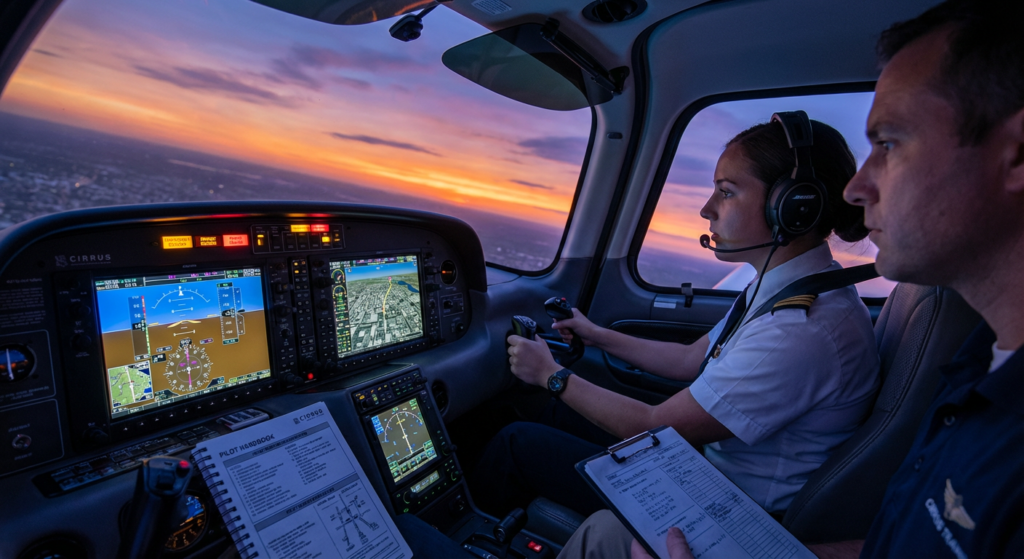
Most pilot training programs teach you to fly an aircraft. The Cirrus PPP teaches you to operate a complete safety ecosystem. There’s a meaningful difference. Students don’t just learn how to take off and land — they learn how to use the GFC 700 autopilot to manage workload during high-pressure situations, how to interpret the Garmin-based Perspective flight deck under real instrument conditions, and critically, how to make the decision to pull the CAPS handle without hesitation when the moment demands it.
The curriculum is structured around building confident, decisive pilots rather than technically adequate ones. Every phase of training is calibrated to the SR22’s actual operating environment — cross-country performance flying, weather management, go-around procedures, and instrument flying proficiency all receive dedicated attention. The aircraft’s safety systems, CAPS and Safe Return, are taught as complements to piloting skill, not replacements for it. That distinction is what separates Cirrus-trained pilots from everyone else.
The Role of Cirrus Standardized Instructor Pilots (CSIPs)
Every instructor in the Cirrus training ecosystem holds a Cirrus Standardized Instructor Pilot (CSIP) designation. This isn’t a generic flight instructor certificate with a Cirrus endorsement stamped on top — it’s a specialized qualification that requires instructors to demonstrate deep, platform-specific knowledge of Cirrus aircraft systems, avionics, and safety technologies before they ever sit in the right seat with a student. For enthusiasts looking to connect with others who share a passion for Cirrus aircraft, joining the premier community for Cirrus Aircraft enthusiasts can be a great opportunity.
The CSIP designation exists because Cirrus recognized early on that the SR22’s capabilities demanded a higher standard of instruction. A CSIP understands the nuances of the Perspective avionics suite, can teach CAPS deployment with the authority that comes from genuine system mastery, and structures each lesson to align with Cirrus’s safety-first training philosophy. When you train with a CSIP, you’re not just getting flight hours — you’re getting calibrated, aircraft-specific guidance that directly improves your decision-making under pressure.
- CSIPs complete Cirrus-specific qualification training before instructing students
- They maintain current knowledge of all SR Series aircraft updates and system changes
- CSIP instruction covers emergency procedures including CAPS activation and Safe Return operation
- Instructors adapt training pace to each student’s learning goals and prior experience
- All study materials used in CSIP-led training are developed and updated by Cirrus flight training experts
The consistency the CSIP program creates across training locations is one of its most underappreciated strengths. Whether you’re training at a Cirrus authorized location in the Midwest or on the West Coast, you’re receiving instruction built on the same standardized foundation — the same emergency procedures, the same systems knowledge benchmarks, the same safety philosophy. For those passionate about Cirrus Aircraft, joining COPA can enhance your learning experience.
How Simulator Training Reduces Real-World Risk
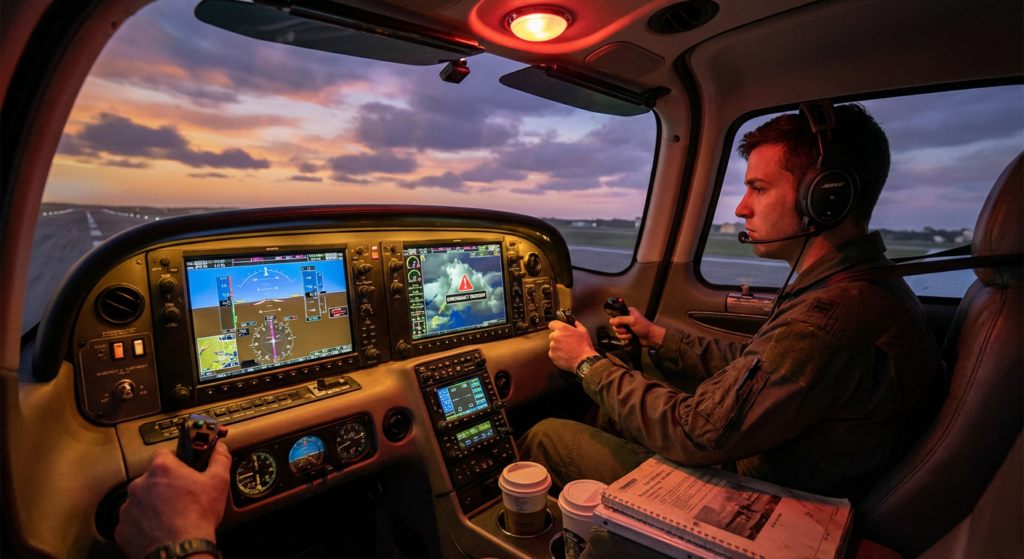
- Simulators allow students to practice emergency procedures — including CAPS activation scenarios — without real-world consequences
- The cockpit layout in Cirrus simulators closely replicates the actual SR Series flight deck, building genuine muscle memory
- Instrument flying proficiency can be developed in the simulator before students encounter actual IMC conditions
- Automation management skills — managing the GFC 700 autopilot and Perspective avionics — are rehearsed in a low-pressure environment
- Simulator hours count toward overall training time while compressing the learning curve significantly
Simulator training inside the Cirrus PPP isn’t treated as a supplementary add-on — it’s a core component of the curriculum. The reason is straightforward: the scenarios that kill pilots in real aircraft are the same scenarios you can practice repeatedly in a simulator until your responses become instinctive. An unstabilized approach at night, inadvertent IMC entry, engine anomalies on departure — these are the situations where training either pays off or doesn’t, and the simulator is where that training gets built.
Incorporating simulator sessions early in training also reduces the cognitive overload new SR22 pilots often experience when they first encounter the Perspective avionics suite in a real aircraft. Learning to manage the Garmin-based flight deck in a stationary simulator — before also managing airspeed, altitude, traffic, and weather — allows students to build avionics fluency without splitting their attention across too many simultaneous demands. The result is a more capable, less saturated pilot when they step into the actual aircraft.
The practical impact of this approach shows up in training outcomes. Students who complete simulator phases before advancing to flight maneuvers consistently demonstrate faster proficiency gains and more confident emergency procedure responses than those who learn purely through in-aircraft instruction. It’s not a theory — it’s a repeatable result embedded in how the Cirrus training program is sequenced.
The ALSIM Simulator vs. the Vision Jet Simulator
Cirrus training centers utilize advanced simulators that closely replicate the cockpits of their aircraft, with the level of simulator sophistication scaling with the aircraft type being trained. The Vision Jet simulator delivers a high-fidelity replication of the SF50 Vision Jet flight deck for pilots transitioning into turbine operations, while SR Series-focused simulator training uses platforms specifically configured to mirror the Perspective avionics layout and handling characteristics of the SR22. Both options give students a controlled, realistic environment to develop the system fluency that makes the difference between a confident SR22 pilot and an overwhelmed one.
How to Find a Cirrus Training Center Near You
Cirrus maintains an extensive global network of authorized training centers, each staffed by CSIP-qualified instructors operating under the same standardized curriculum. Finding a location near you starts at the Cirrus Aircraft website, where the training center locator gives you access to every authorized training partner by region. When evaluating a training center, look specifically for CSIP designation on the instructing staff, confirmed access to Cirrus-specific simulator equipment, and a structured curriculum that follows the Cirrus Personal Pilot Program framework rather than a generic syllabus with Cirrus aircraft substituted in.
The SR22 G7+ Is the Safest Piston Training Aircraft Available Today
The 2026 SR22 G7+ doesn’t just raise the bar for piston aircraft safety — it redefines what that bar even looks like. As the first FAA-certified piston aircraft with Safe Return Emergency Autoland as standard equipment, it addresses the most dangerous scenario in general aviation: a pilot who can no longer fly the aircraft. Combined with CAPS, the GFC 700 autopilot, Electronic Stability and Protection, and the Garmin Perspective+ flight deck, the G7+ gives pilots more redundant safety options than any other piston aircraft ever built.
What makes this particularly significant for training is that every safety system on the G7+ is taught, practiced, and internalized through the Cirrus PPP curriculum before a student pilot ever faces a real emergency. The aircraft’s new Cirrus Global Connect system and USB-C Starlink connectivity also expand situational awareness capabilities considerably, giving pilots access to real-time weather and communication tools that directly support better in-flight decision-making. When the aircraft, the avionics, and the training program all point in the same direction, the result is a pilot who is genuinely better prepared than what conventional flight training produces. Discover more about the Cirrus community by joining COPA.
Frequently Asked Questions
If you’re considering Cirrus SR22 pilot training, you likely have specific questions about the aircraft, the program structure, and what to expect before you commit. The questions below cover the topics that come up most consistently among prospective Cirrus pilots — answered directly, without the marketing language.
- Is the SR22 appropriate for student pilots with no prior flight experience?
- What exactly does CAPS do and when should it be used?
- How does Safe Return Emergency Autoland actually work in practice?
- What qualifies a Cirrus Standardized Instructor Pilot (CSIP)?
- How many flight hours does the Cirrus Private Pilot Program require?
Is the Cirrus SR22 a Good Aircraft for Student Pilots?
The SR22 is absolutely a suitable aircraft for student pilots when training is delivered through the Cirrus Personal Pilot Program with a CSIP-qualified instructor. The aircraft is known for its stability, responsive handling, and a flight deck that — once learned — reduces workload rather than adding to it. The key is structured, aircraft-specific instruction. Students who attempt to learn the SR22 through a generic flight school curriculum without Cirrus-specific guidance face a steeper and riskier learning curve.
SR22 Training Readiness: What to Expect at Each Stage
Ground School Phase: Systems knowledge, Perspective avionics familiarization, CAPS and Safe Return procedures, weather decision-making frameworks.
Simulator Phase: Cockpit familiarization, emergency procedure practice, instrument flying basics, automation management with the GFC 700 autopilot.
Early Flight Training: Basic maneuvers, traffic pattern work, normal and crosswind landings, introduction to the Perspective flight deck in actual flight conditions.
Advanced Flight Training: Cross-country navigation, instrument approaches, go-around procedures, emergency scenario application including CAPS decision-making.
Check Ride Preparation: Comprehensive review of all maneuvers, systems knowledge verification, and aeronautical decision-making assessment with CSIP instructor.
The SR22’s safety systems — particularly CAPS — also provide a meaningful additional layer of protection during student training that simply doesn’t exist in conventional training aircraft. A Cessna 172 gives you no option beyond the pilot’s skill when things go catastrophically wrong. The SR22 gives you CAPS. For students in the early phases of training when judgment is still developing, that additional margin matters.
The aircraft is genuinely forgiving within its normal operating envelope. It’s the edges of that envelope — high-performance speeds, complex avionics management, weather decision-making — where proper training makes all the difference. Students who complete the full Cirrus PPP with a qualified CSIP consistently demonstrate stronger systems knowledge and emergency procedure confidence than those trained on the platform through non-standardized methods.
What Is the Cirrus Airframe Parachute System and How Does It Work?
The Cirrus Airframe Parachute System (CAPS) is a ballistic rocket-deployed parachute that lowers the entire aircraft — not just the occupants — to the ground at a survivable descent rate. It is activated by pulling a red handle located above the pilot’s head in the cockpit. A solid-rocket motor fires in under one second, deploying the parachute and arresting the aircraft’s descent. CAPS is rated for use down to approximately 400 feet AGL under certain conditions and has saved over 200 lives since Cirrus introduced it.
CAPS is specifically designed for scenarios where continued flight is not possible — mid-air collisions, catastrophic mechanical failures, spatial disorientation leading to unrecoverable loss of control, or pilot incapacitation in situations where Safe Return is not available. Training through the Cirrus PPP dedicates significant time to CAPS decision-making: not just how to activate it, but when activating it is the correct choice. That distinction — developing the judgment to pull the handle without hesitation at the right moment — is one of the most important things the Cirrus training program teaches.
How Does Safe Return Emergency Autoland Work on the SR22 G7+?
Safe Return is activated by pressing a clearly marked button in the cockpit — accessible to both the pilot and any passenger on board. Once activated, the system takes complete autonomous control of the aircraft with no further pilot input required. It then executes the following sequence automatically, showcasing the advanced technology found in Cirrus Aircraft.
- Identifies the nearest suitable airport based on current position, weather, and runway length
- Plots and flies the optimal route to that airport, including obstacle and terrain avoidance
- Manages all radio communications, including automatic ATC notification
- Executes the full instrument approach procedure to the selected runway
- Lands the aircraft, applies brakes, and shuts down the engine on the runway
Safe Return is designed specifically for incapacitation scenarios — a pilot who suffers a sudden medical event, a passenger flying alone in an emergency, or any situation where the person at the controls is no longer capable of flying. The system was developed by Garmin and has been FAA-certified on the SR22 G7+ as standard equipment beginning with the 2026 model year, making the SR22 the first production piston aircraft in history to include this capability as a base feature rather than an optional upgrade.
It’s worth being explicit about what Safe Return is not: it is not an autopilot you use for routine flight management, and it is not a substitute for pilot training. It is an emergency system — a last resort for scenarios where a human pilot would otherwise have no path to survival. Within the Cirrus training curriculum, students learn how Safe Return integrates with CAPS to create the layered safety architecture that defines the G7+, and they develop the judgment to understand which system applies in which emergency scenario.
What Is a Cirrus Standardized Instructor Pilot (CSIP)?
A Cirrus Standardized Instructor Pilot (CSIP) is a flight instructor who has completed Cirrus-specific qualification training that goes well beyond a standard FAA Certified Flight Instructor (CFI) certificate. CSIPs demonstrate verified proficiency in Cirrus aircraft systems, Perspective avionics operation, CAPS and Safe Return emergency procedures, and the structured Cirrus PPP curriculum before they instruct students. The CSIP designation ensures that every student training within the Cirrus ecosystem receives the same standard of aircraft-specific, safety-focused instruction regardless of which authorized training location they attend. When you’re learning to fly an aircraft this capable, the quality and specialization of your instructor is not a minor detail — it’s central to the safety outcome.
How Many Hours Does It Take to Complete the Cirrus Private Pilot Program?
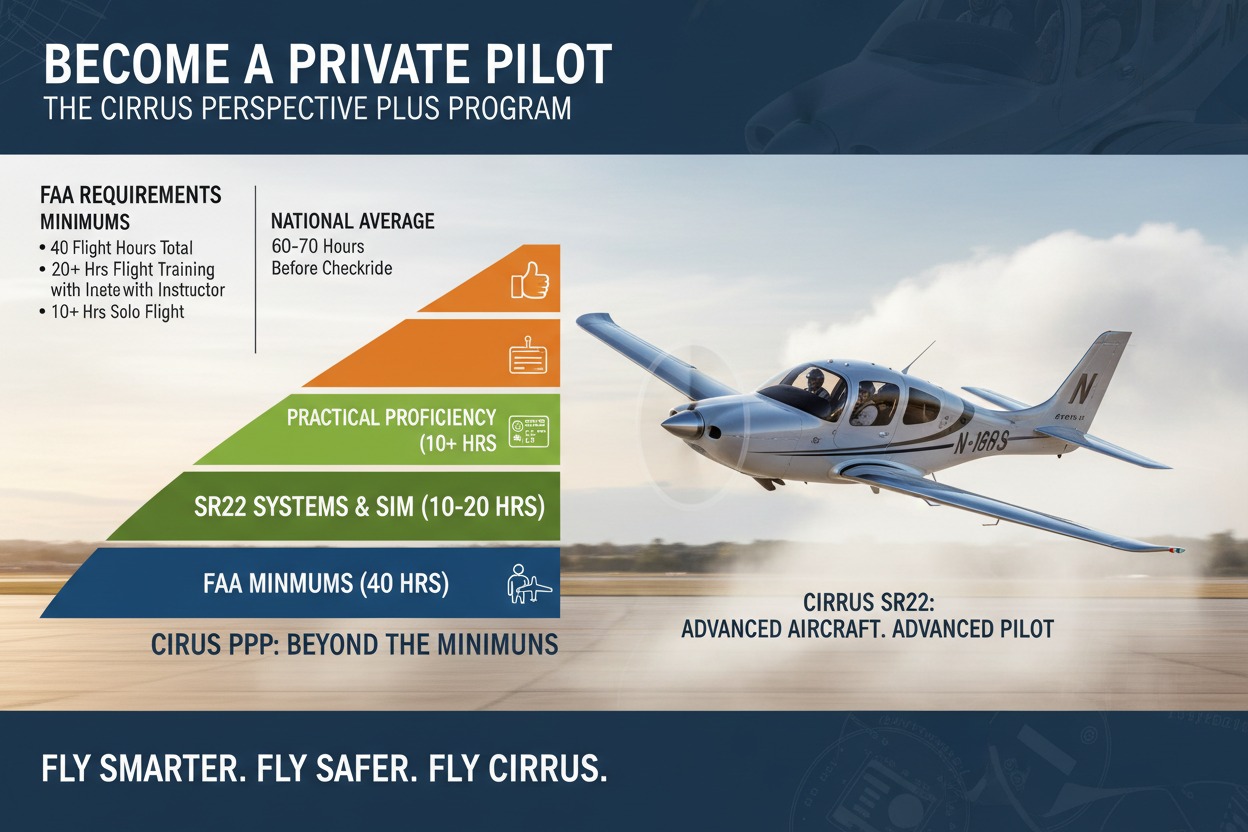
The FAA requires a minimum of 40 flight hours to be eligible for a Private Pilot Certificate, with at least 20 hours of flight training with an instructor and 10 hours of solo flight time. In practice, the national average is closer to 60 to 70 hours before most students are check ride ready. The Cirrus PPP is structured around these FAA minimums while adding the aircraft-specific systems training and simulator hours that make SR22 pilots genuinely proficient — not just technically eligible.
The inclusion of simulator training within the Cirrus PPP can meaningfully compress the total hours required to reach check ride readiness. Because students arrive at their first actual flight lessons with cockpit familiarity, emergency procedure muscle memory, and avionics fluency already built through simulator work, they spend less of their expensive in-aircraft training time on foundational orientation tasks. The result is more efficient use of flight hours and a higher baseline of competency when those hours are completed. For those interested in learning more about the aircraft, check out the Cirrus SR22 Buyer’s Guide.
Training pace varies significantly based on how frequently you fly, your prior aviation experience, and your individual learning curve. Students who fly multiple times per week consistently reach proficiency faster than those who fly once every week or two — the recency of practice matters enormously in flight training. Your CSIP will structure your training timeline around your specific goals and schedule, ensuring that each phase builds logically on the one before it rather than pushing you toward an artificial completion date.
The Cirrus PPP also builds in periodic knowledge assessments throughout the curriculum, not just at the end. These checkpoints ensure that systems knowledge — particularly emergency procedures and avionics management — is retained and reinforced as training progresses rather than crammed immediately before the check ride. That ongoing reinforcement structure is one of the reasons Cirrus-trained pilots consistently demonstrate stronger post-certificate proficiency than those trained through less structured programs.
If you’re ready to experience what genuinely safety-focused pilot training looks like, Cirrus Aircraft offers a complete pilot training ecosystem — from first flight to advanced ratings — built on the most comprehensively protected piston aircraft platform available today.
Experience safety like never before with the Cirrus SR22 in pilot training. The advanced safety features of this aircraft make it a top choice for flight schools worldwide. For those interested in learning more about the Cirrus community and its enthusiasts, consider joining COPA, the premier community for Cirrus aircraft enthusiasts.