
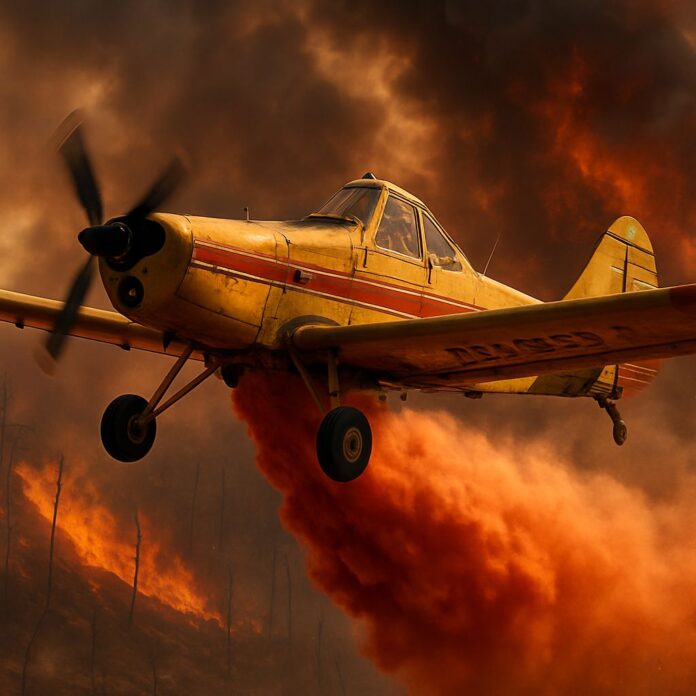

Article-At-A-Glance
- The Piper PA-25 Pawnee, originally designed for agricultural spraying, became a reliable tool in aerial wildfire suppression due to its low-speed handling and robust hopper capacity.
- First produced in 1959, the Pawnee went through several key upgrades — including engine boosts up to 235 hp — that directly improved its firefighting payload and performance.
- The PA-25 can carry up to 145 gallons of liquid retardant, making it ideal for initial attack operations in rugged, hard-to-reach terrain.
- Despite being discontinued in 1982, many Pawnees remain in active service today as cost-effective single-engine air tankers (SEATs).
- There’s one often-overlooked limitation of the PA-25 Pawnee in wildfire operations that every aerial firefighting professional should know — covered in detail below.
The Piper PA-25 Pawnee wasn’t built to fight fires — but it turned out to be surprisingly good at it.
When wildfire managers needed a nimble, affordable, low-flying aircraft capable of dropping retardant on fast-moving fires in tight terrain, the Pawnee kept showing up as the answer. Its agricultural DNA — built to fly slow, fly low, and deliver payloads with precision — translated almost directly into an effective firefighting platform. For wildfire professionals looking to understand the aircraft still showing up on initial attack rosters decades after production ended, this breakdown covers everything that matters.
For deeper coverage of aerial firefighting operations and equipment, Ag Air Update is a leading resource tracking the tools and aircraft keeping wildfire crews ahead of the flame front.
A Brief History of the PA-25 Pawnee
The PA-25 Pawnee’s story begins not in a fire camp, but in the agricultural fields of Texas. Engineer Fred Weick, working through the Agricultural and Mechanical College of Texas, developed a series of experimental agricultural aircraft in the early 1950s. His goal was straightforward: design an aircraft optimized for crop dusting that prioritized pilot safety, low-speed stability, and efficient payload delivery. That design philosophy would prove far more durable than anyone anticipated.
From Agricultural Roots to Aerial Firefighting
Weick’s AG-1 prototype led directly to the AG-3, which Piper Aircraft recognized as the foundation of something commercially viable. Piper hired Weick, relocated development to Vero Beach, and by May 1959 was producing the PA-25 Pawnee at their Lock Haven facility. The aircraft’s first type certificate was issued at a gross weight of 2,300 pounds, powered by a 150 hp Lycoming O-320-A1A engine. It was a working aircraft from day one — purpose-built to fly hard in demanding conditions.
The jump from crop fields to fire lines wasn’t dramatic. Both environments demand the same core capabilities: precise low-altitude flight, reliable slow-speed handling, and the ability to deliver a liquid payload accurately over a defined target. Aerial firefighting agencies quickly recognized that the Pawnee’s design characteristics were a natural fit for initial attack operations, particularly in areas where larger air tankers couldn’t safely operate.
Key Design Milestones From 1959 to 1982
Over its 23-year production run, the Pawnee evolved through several significant upgrades. The original 150 hp model gave way to progressively more powerful variants, each improving useful load and operational range. The most significant leap came in 1965 with the introduction of the PA-25-235, fitted with a Lycoming O-540 producing 235 hp. That engine upgrade didn’t just add speed — it meaningfully increased the aircraft’s ability to carry heavier retardant loads out of short, high-elevation strips common in wildfire terrain. Priced at a $4,000 premium over its predecessor, the PA-25-235 was selling roughly one unit per day for three consecutive years after its debut.
How Fred Weick’s AG-1 Prototype Shaped the Pawnee
Weick’s design principles were embedded in every production Pawnee. The high-mounted cockpit positioned the pilot above and behind the hopper, providing exceptional forward visibility — critical for both crop application and fire retardant drops. The downward-sloping forward fuselage, strut-braced Super Cub wings, and conventional landing gear created an aircraft that was inherently stable at low speeds and forgiving in the hands of a working pilot. The hopper itself held 20 cubic feet of capacity — 145 gallons of liquid or up to 800 pounds of dry material — numbers that remain operationally relevant for single-engine air tanker (SEAT) missions today.
Technical Specs That Make the Pawnee Effective in Firefighting
Understanding why the Pawnee works in wildfire suppression means looking closely at the numbers. This isn’t a high-performance aircraft by modern standards, but its specifications align precisely with what initial attack firefighting actually requires.
Engine Power and Performance Across Model Variants
The Pawnee’s engine progression tells the story of its expanding capability, much like how the Piper PA-28 Cherokee offers exceptional sightseeing experiences with its own set of powerful engines.
| Model | Engine | Horsepower | Gross Weight |
|---|---|---|---|
| PA-25-150 | Lycoming O-320-A1A | 150 hp | 2,300 lbs |
| PA-25-235 | Lycoming O-540 | 235 hp | Increased useful load |
| PA-36 Pawnee Brave | Continental Tiara 6-285 / 6-320 | 285–320 hp | Significantly expanded |
Each engine upgrade directly improved the aircraft’s ability to operate from shorter runways at higher density altitudes — a practical necessity when forward air bases are carved out of mountainous terrain close to active fire perimeters.
Hopper Capacity and Retardant Load Capabilities
The PA-25’s hopper is the heart of its firefighting capability. The standard configuration holds 20 cubic feet — translating to 145 gallons of liquid retardant or 800 pounds of dry material. That’s not a massive payload by modern air tanker standards, but for initial attack operations where speed of response and precision of delivery matter more than sheer volume, it’s enough to make a real difference. The Pawnee’s hopper gate system allowed pilots to control drop spread and coverage density, giving ground crews a more predictable retardant line to work with.
Low-Speed Handling and Maneuverability in Rugged Terrain
This is where the Pawnee genuinely earns its place on the flight line. Derived from Weick’s agricultural safety research, the aircraft’s low-speed stability was engineered specifically to keep pilots safe during slow, low-altitude passes — exactly what wildfire retardant drops demand. The strut-braced wing design and conventional landing gear give the Pawnee predictable stall characteristics, and its tight turn radius allows pilots to navigate canyon systems and ridgelines that would force larger aircraft to break off and reposition. In wildfire suppression, that maneuverability is the difference between a precise drop on the fire’s head and a wasted load.
How the PA-25 Pawnee Operates in Wildfire Suppression
- Dispatched as a first-response aircraft to rapidly developing fires before larger tankers arrive
- Operates from short, unimproved forward air bases positioned close to active fire perimeters
- Delivers fire retardant or suppressant directly ahead of the fire’s leading edge to slow spread
- Works in coordination with ground crews, with drop zones directed by an aerial supervisor or lead plane
- Capable of multiple reload cycles per operational period due to fast turnaround and simple systems
The Pawnee’s operational model in wildfire suppression is built around speed and repetition. Unlike large air tankers that require substantial infrastructure and long turnaround times, a SEAT like the Pawnee can reload, take off, and be back over the fire in minutes when positioned at a forward base. That cycle efficiency is what makes single-engine air tankers disproportionately valuable in the early minutes of a wildfire — the window when aerial attack has the highest probability of suppression success.
Coordination is everything in aerial firefighting, and the Pawnee fits cleanly into established command structures. Pilots typically operate under the direction of an Air Tactical Group Supervisor (ATGS), who communicates drop priorities and sequencing from an observation aircraft above the fire. The Pawnee’s reliable radio systems and straightforward cockpit layout mean pilots can focus on flying the aircraft and executing precise drops rather than managing complex avionics — a practical advantage in high-stress fire environments.
Terrain is often the deciding factor in whether aerial suppression works at all. The Pawnee’s ability to fly safely at speeds as low as 80 mph during drop runs, combined with its tight maneuvering capability, allows it to operate effectively in the broken, forested landscapes where wildfires most frequently ignite and spread. Larger fixed-wing tankers often can’t safely execute drops in steep drainages or narrow canyons — terrain the Pawnee handles with relative ease.
The Role of Single-Engine Air Tankers in Wildfire Operations
Single-engine air tankers occupy a specific and irreplaceable niche in the aerial firefighting ecosystem. They are the rapid response layer — deployed fast, positioned forward, and capable of delivering retardant to a new ignition before it becomes an uncontrollable run. The U.S. Forest Service and state-level agencies have long relied on SEATs precisely because their operating costs and infrastructure requirements are a fraction of those associated with multi-engine tankers. The PA-25 Pawnee, particularly the 235 hp variant, became one of the defining SEAT platforms of the 1960s and 1970s, establishing operational templates that still inform how modern SEATs are deployed today.
Drop Techniques Used in Active Fire Zones
Retardant drop technique in the Pawnee requires a combination of precise airspeed management, altitude judgment, and real-time wind assessment. A standard drop run typically begins with the pilot establishing a consistent approach path aligned with the desired retardant line, adjusting for crosswind drift that can significantly affect where the retardant actually lands relative to the fire edge. For pilots looking to enhance their flight experience, ForeFlight is the ultimate EFB to assist with navigation and planning.
Drop altitude is critical. Too high, and the retardant disperses in the wind before reaching the ground with useful coverage density. Too low, and the pilot risks controlled flight into terrain — one of the leading causes of aerial firefighting fatalities. Experienced Pawnee pilots typically execute drops between 150 and 300 feet above ground level, a window that balances retardant effectiveness with a survivable safety margin. For more insights on aerial firefighting, read about the aircraft helping crews battle wildfires.
- Parallel drops: Retardant line laid parallel to the fire’s edge to slow lateral spread
- Anchor point drops: Retardant applied at a natural firebreak to establish a starting point for containment lines
- Progressive drops: Sequential loads applied in overlapping passes to build a continuous retardant line ahead of the fire
- Spot fire suppression: Targeted drops on isolated ignitions ahead of the main fire front to prevent junction fires
Wind reading is a skill that separates effective SEAT pilots from average ones. Retardant released at 80 mph in a 15 mph crosswind will drift significantly from the intended target line. Pawnee pilots develop an intuitive sense for adjusting release point and approach angle to compensate — a skill built through repetition and close observation of previous drop results.
Communication with ground crews during and after drops provides immediate feedback on coverage effectiveness. Experienced crews will report back on retardant line continuity, coverage level, and whether repositioning of subsequent loads is needed — turning each drop into a data point that improves the next one.
PA-25 Pawnee Variants and Their Firefighting Relevance
Not all Pawnees are equal in a firefighting context. The aircraft evolved meaningfully across its production run, and the variant on the flight line has direct implications for what a pilot can realistically accomplish during a fire assignment. Understanding the differences matters for both operators selecting aircraft and pilots stepping into an unfamiliar Pawnee for the first time. For more detailed insights, you can explore the Piper PA-25 Pawnees article.
The core airframe remained consistent across variants, but engine power, gross weight limits, and equipment options changed in ways that directly affected useful load — the number that ultimately determines how much retardant gets to the fire per sortie.
Pawnee B and C: Incremental Upgrades That Improved Payload
The PA-25-150 that rolled out of Lock Haven in 1959 was a capable aircraft for its time, but its 150 hp Lycoming O-320-A1A had real limitations when it came to operating from high-elevation strips with a full hopper. The Pawnee B introduced refinements to the airframe and systems that improved reliability and reduced pilot workload, while the Pawnee C continued that incremental development trajectory.
The most operationally significant upgrade came with the PA-25-235 in 1965. The Lycoming O-540 engine’s 235 hp output gave pilots meaningfully better climb performance with a loaded hopper — critical when a forward air base sits at 5,000 feet and the drop zone is on a ridge another 2,000 feet above that. This wasn’t just a performance improvement on paper; it expanded the geographic envelope within which the Pawnee could realistically operate as a firefighting asset.
The 235 hp variant’s market reception confirmed that operators understood exactly what the engine upgrade meant in practical terms. Selling approximately one unit per day for three consecutive years after its 1965 introduction, the PA-25-235 became the definitive production Pawnee — the variant most likely to show up on a wildfire contract today when an older Pawnee is on the line.
How the PA-36 Pawnee Brave Expanded Aerial Firefighting Capacity
When Piper introduced the PA-36 Pawnee Brave in 1974, it was a substantially different aircraft despite sharing a lineage with the PA-25. The Brave was longer, wider, higher, and structurally stronger than any previous Pawnee. Its 39-foot wingspan generated a wider effective swath, and its hopper options — 30 or 38 square feet — were 50 to 190 percent larger than previous models, capable of holding 225 gallons of liquid or up to 1,900 pounds of dry material. For wildfire operations, that capacity jump was significant.
Powered initially by Continental’s Tiara 6-285 at 285 hp, with a 320 hp Tiara 6-320 variant also planned, the Brave was designed to compete directly with Cessna’s 188 AGwagon at a nearly identical price point of around $30,000. The first prototype flew on November 17, 1969, and the production aircraft that emerged represented the ceiling of what the Pawnee design concept could deliver. For aerial firefighting agencies needing more payload without stepping up to a multi-engine platform, the PA-36 offered a compelling middle ground that the PA-25 simply couldn’t reach.
Limitations of the PA-25 Pawnee in Wildfire Operations
The Pawnee’s strengths are real, but so are its constraints. The 145-gallon hopper capacity that makes it nimble and cost-effective also means it can’t match the suppression impact of a multi-engine tanker dropping 1,000+ gallons in a single pass. On fast-moving fires in open terrain, where sheer retardant volume is the primary suppression strategy, the Pawnee’s payload ceiling becomes a genuine operational limitation. Managers relying exclusively on SEAT assets in those conditions are fighting the fire with one hand tied behind their backs.
Age is the other unavoidable reality. Production ended in 1982, which means the youngest PA-25 Pawnee still flying is over four decades old. Maintenance costs increase as airframes accumulate hours and calendar time, and replacement parts for Pawnee-specific components grow progressively harder to source. Pilots transitioning into older Pawnees should expect to invest time in understanding aircraft-specific quirks that won’t appear in any flight manual — worn control systems, non-standard modifications, and fatigue points that vary by individual airframe history. For operators, the economics of maintaining an aging fleet against contract revenue requires honest, ongoing assessment.
The PA-25 Pawnee Remains a Proven Firefighting Tool Despite Its Age
- Decades of operational history have proven the Pawnee’s airframe reliability in demanding low-altitude conditions
- Low acquisition and operating costs make it accessible to small and mid-size aerial firefighting contractors
- Its precise low-speed handling remains competitive with newer SEAT platforms in rugged terrain operations
- The PA-25-235 variant’s Lycoming O-540 engine has an outstanding long-term reliability record in working aircraft roles
- Established type certificate data and a well-documented maintenance history reduce regulatory complexity for operators
- Strong pilot familiarity across the aviation community means qualified Pawnee pilots are easier to find than those rated on newer, more obscure platforms
What keeps the Pawnee on active wildfire contracts isn’t nostalgia — it’s a straightforward cost-benefit calculation that continues to favor the aircraft in specific operational niches. For initial attack on new ignitions, particularly in mountainous terrain with limited infrastructure, few aircraft deliver comparable capability at comparable cost. The Pawnee’s operating expenses are well understood, its performance envelope is predictable, and its mechanical simplicity means that a qualified A&P mechanic can keep one airworthy without specialized factory support.
The aircraft’s continued presence in South America, Eastern Europe, and other international markets where agricultural aviation and aerial firefighting overlap tells the same story. Operators around the world keep flying Pawnees because the economics work and the aircraft performs. That’s a more meaningful endorsement than any specification sheet.
For wildfire management professionals evaluating SEAT assets, the Pawnee deserves serious consideration within its operational envelope. Assign it to initial attack on new starts in terrain where its maneuverability is an advantage, position it at forward bases close to high-risk areas during peak fire weather, and pair it with larger tanker assets for extended attack. Used strategically, it remains one of the most cost-effective aerial firefighting tools available — a 60-year-old design that still earns its place on the flight line every fire season.
Frequently Asked Questions
The PA-25 Pawnee generates consistent questions from both wildfire management professionals and aviation enthusiasts encountering the aircraft on the flight line for the first time. The answers below draw directly from the aircraft’s operational history and technical specifications.
These are the questions that matter most for anyone making operational or procurement decisions involving the Pawnee in a firefighting context:
- What retardants are compatible with the Pawnee’s hopper system?
- How does actual retardant capacity compare across variants?
- Where is the aircraft currently deployed in active firefighting roles?
- How does it stack up against modern SEAT platforms?
- What qualifications does a pilot need before flying wildfire contracts in a Pawnee?
Each question reflects a real decision point in the field. Here’s the direct answer to each one.
What Type of Retardant Does the PA-25 Pawnee Drop on Wildfires?
The PA-25 Pawnee is compatible with both short-term retardants — primarily water mixed with foam concentrate — and long-term phosphate-based retardants such as Phos-Chek, which remain visible on vegetation after the water carrier evaporates. The choice of retardant depends on the tactical objective: short-term suppressants are used for direct attack close to the fire edge where immediate knockdown is the priority, while long-term retardants are applied ahead of the fire to slow spread and give ground crews time to construct containment lines. The Pawnee’s hopper gate system allows pilots to control flow rate and coverage level, which affects how the retardant is distributed across the target area regardless of which product is being used.
How Many Gallons Can the PA-25 Pawnee Carry for Firefighting Missions?
The standard PA-25 Pawnee hopper holds 20 cubic feet, which translates to a maximum liquid capacity of 145 gallons. In wildfire suppression operations, this is typically filled with water-based retardant or foam solution. The PA-36 Pawnee Brave, the enlarged successor, offered hopper options of 30 or 38 square feet capable of holding up to 225 gallons of liquid — a significant improvement for operators needing more payload without moving to a multi-engine platform. For context, modern large air tankers carry anywhere from 800 to over 19,000 gallons, which illustrates the PA-25’s role as a precision initial attack tool rather than a mass-suppression asset. For those interested in other Piper models, the Piper PA-28 Cherokee offers exceptional sightseeing experiences.
Is the PA-25 Pawnee Still in Active Use for Wildfire Suppression?
Yes — despite production ending in 1982, PA-25 Pawnees continue to fly wildfire suppression missions in multiple countries. In the United States, older Pawnees appear on SEAT contracts with smaller regional operators, particularly in the western states where initial attack demand peaks during summer fire season. Internationally, the aircraft remains active in South America and parts of Eastern Europe, where its low operating costs and agricultural heritage create a natural overlap with aerial firefighting operations.
Operational Reality Check: A PA-25 Pawnee operating at a forward air base 20 minutes from a high-risk ignition zone can deliver its first retardant load before a large air tanker has finished its pre-flight checks at a distant base. In initial attack, proximity and cycle time often matter more than payload volume.
The aircraft’s longevity in active service is a function of economics and performance alignment. Operators who have amortized their acquisition costs over decades can offer competitive contract rates while maintaining profitability — making the Pawnee a persistent presence on bid lists where larger, more expensive platforms struggle to pencil out financially.
Maintenance availability is the primary factor limiting the Pawnee’s continued operational life. As the pool of airframes shrinks through attrition and parts become harder to source, some operators are transitioning to newer SEAT platforms. However, the aircraft’s well-documented type certificate and widespread A&P familiarity with Lycoming engines mean that mechanically sound Pawnees will continue flying wildfire contracts for the foreseeable future.
How Does the PA-25 Pawnee Compare to Modern Air Tankers?
| Aircraft | Type | Retardant Capacity | Engine | Primary Role |
|---|---|---|---|---|
| PA-25 Pawnee (235) | SEAT | 145 gallons | 235 hp Lycoming O-540 | Initial attack, rugged terrain |
| Air Tractor AT-802 | SEAT | 800 gallons | 1,350 shp turboprop | Initial & extended attack |
| Bombardier Q400AT | Large air tanker | 2,500 gallons | Turboprop | Extended attack, large fires |
| Lockheed C-130 MAFFS | Very large air tanker | 3,000 gallons | Multi-engine turboprop | Large fire suppression |
The comparison makes the Pawnee’s niche clear. It isn’t competing with the Air Tractor AT-802 or the Bombardier Q400AT for extended attack assignments — it’s filling a specific initial attack role where its low operating cost, terrain maneuverability, and fast reload cycle create genuine operational value. The aircraft that replaced the Pawnee in many SEAT fleets, particularly the AT-802, carries more than five times the retardant load and moves considerably faster between the base and the fire. That performance gap is real and significant for large fire operations.
Where the Pawnee holds its ground is in cost-per-operational-hour and infrastructure flexibility. An AT-802 is a substantially more expensive asset to acquire, insure, and maintain. In regions where wildfire budgets are constrained and initial attack is the primary suppression strategy, a well-maintained Pawnee operated by an experienced crew can deliver results that justify its continued presence in the fleet mix, similar to how the Piper PA-28 Cherokee offers exceptional sightseeing experiences.
The honest assessment is that the Pawnee belongs at the front of the response chain on new ignitions in complex terrain, supported by larger assets as fires grow. Misassigning it to extended attack on a large, established fire plays to none of its strengths and exposes all of its limitations. Operational success with the Pawnee is fundamentally a question of matching the aircraft to the right mission profile.
What Pilot Training Is Required to Fly the PA-25 Pawnee in Firefighting Operations?
Flying the PA-25 Pawnee in a wildfire suppression role requires a commercial pilot certificate with appropriate ratings, but the regulatory minimum is only the starting point. Agencies contracting SEAT services — including the U.S. Forest Service and Bureau of Land Management — impose additional experience and currency requirements that go well beyond what’s needed to hold a commercial certificate. Pilots typically need documented low-level flight experience, agricultural or aerial application hours, and demonstrated proficiency in the specific aircraft type before being approved for wildfire contracts.
The transition from general aviation to aerial firefighting in a Pawnee involves developing skills that standard flight training doesn’t address. Terrain flying at 150 to 300 feet AGL, precise drop run execution in turbulent fire-affected air, and the ability to maintain accurate radio communication while managing a demanding flight environment all require dedicated practice and mentorship. Most experienced SEAT pilots in the Pawnee accumulated their foundational skills through agricultural spraying operations before transitioning to fire contracts — a pathway that develops exactly the low-altitude precision and systems management that wildfire flying demands.
Currency matters as much as initial qualification. Pilots returning to Pawnee fire operations after an extended absence typically complete recurrency flights and demonstrate proficiency before being cleared for contract assignments. In a high-stakes environment where a poorly executed drop can endanger ground crews or a moment of spatial disorientation can be fatal, agencies and operators alike treat pilot currency as a non-negotiable safety requirement — not an administrative formality.
For professionals and enthusiasts who want to stay current with the aircraft, operators, and missions shaping aerial wildfire suppression, Ag Air Update provides the industry-level coverage that keeps you informed at the intersection of agricultural aviation and aerial firefighting.