
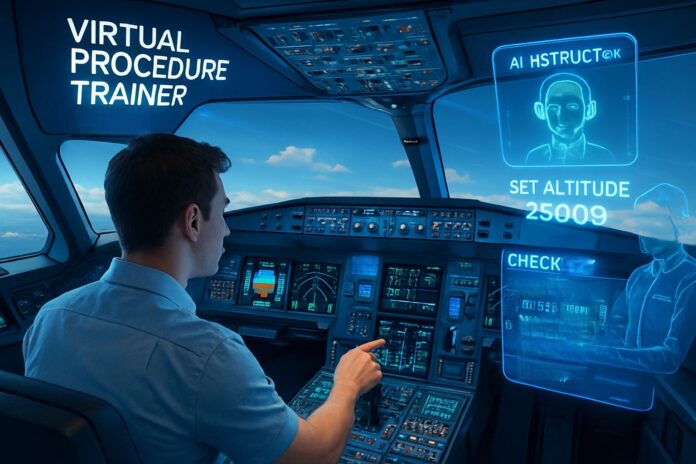

Article At A Glance: Airbus VR Pilot Training
- Airbus launched the Virtual Procedure Trainer (VPT) in November 2022, allowing pilots to train on Standard Operating Procedures entirely inside a virtual cockpit — no physical simulator required.
- Lufthansa Group became the first airline to deploy the VPT, using it across VR headsets, PCs, and iPads for A320 procedure training across its group airlines.
- The VPT is not just about convenience — it actively builds pilot muscle memory through repeated, fully interactive cockpit drills that mirror real-world switch and lever sequencing.
- VR training does not replace full flight simulators, but fills a critical gap for remote preparation, home study, and procedure rehearsal that traditional simulators cannot cost-effectively cover.
- Keep reading to find out how Airbus plans to expand VPT beyond the A320 and what AI-supported debriefing tools are changing the way pilot performance is measured after every session.
Airbus Is Changing Pilot Training Forever
The way pilots learn to fly Airbus aircraft is undergoing a fundamental shift — and it started the moment a pilot put on a VR headset and stepped into a fully interactive virtual A320 cockpit without leaving the ground.
For decades, procedure training meant booking time in an expensive full flight simulator, traveling to a training center, and working through checklists with an instructor physically present in the room. That model still has its place, but it is no longer the only option. Airbus has built a technology-driven alternative that lets pilots rehearse critical procedures on their own schedule, on their own device, from virtually anywhere in the world. The implications for airline training departments — and for pilot readiness — are significant.
For those looking to understand how aviation training technology is evolving, resources covering the latest developments in AR and VR pilot training are increasingly important for staying current in a fast-moving field. The gap between what traditional simulators offer and what modern VR platforms can deliver is closing fast, and the airlines that adapt earliest will have a measurable edge in training efficiency and pilot performance.
What the Virtual Procedure Trainer Actually Does
The Airbus Virtual Procedure Trainer is a software solution that places a trainee pilot inside a photorealistic virtual cockpit and walks them through Airbus Standard Operating Procedures step by step. It is not a passive video experience. Every switch, lever, and control panel in the virtual cockpit is fully interactive, meaning pilots physically reach out — in VR — and manipulate the controls in the correct sequence. The system coaches them through each procedure, providing real-time feedback on whether they followed the right steps in the right order.
What separates the VPT from a basic e-learning module or a flat-screen procedure trainer is the level of immersion. When a pilot is inside the VR environment, their brain processes the experience much closer to reality than watching a video or clicking through a slideshow. That immersion is exactly what makes the tool effective for building procedural accuracy and confidence before a pilot ever steps into a full flight simulator, similar to how the Cirrus SR22 enhances pilot training.
Why Lufthansa Group Signed On First
Lufthansa Group’s decision to become the launch customer for the Airbus VPT was not accidental. Lufthansa Aviation Training is one of the largest and most respected pilot training organizations in the world, and its endorsement signals serious confidence in the technology. The partnership delivers state-of-the-art A320 procedure training across Lufthansa Group airlines using all three available device formats — VR headsets, PCs, and iPads — giving the group flexibility to deploy the tool across different training environments and pilot populations.
What Is the Airbus Virtual Procedure Trainer (VPT)?
The Airbus VPT is a software-based procedure training solution introduced at the European Airline Training Symposium (EATS) in Berlin in November 2022. It was designed specifically to remove the dependency on physical simulators and on-site procedure trainers for the procedure learning phase of pilot training. Instead of requiring a pilot to be physically present at a training facility, the VPT brings the cockpit to the pilot.
The platform supports two primary device categories. First, PC-tethered Virtual Reality devices, which deliver the full immersive VR experience using a headset connected to a computer. Second, flat-screen devices including laptops and iPads, which allow pilots to access the same procedural content in a non-VR format. This dual-mode approach gives airlines genuine flexibility in how they roll out the tool across their pilot workforce — not every pilot needs a VR headset to benefit from the training content.
The VPT can be purchased as a standalone product or bundled with the MATe Suite, which is Airbus’s broader training solution covering aircraft systems knowledge. Together, the two products create a comprehensive digital training package that covers both systems understanding and hands-on procedural practice — two of the most time-intensive elements of any pilot type rating or recurrent training program.
- Device compatibility: PC-tethered VR headsets, laptops, iPads
- Training content: Airbus Standard Operating Procedures (SOPs)
- Cockpit environment: Fully interactive virtual A320 cockpit
- Purchase options: Standalone or bundled with MATe Suite
- Launch customer: Lufthansa Group (announced November 2022)
- Training modes: Solo AI-guided and online co-pilot collaborative mode
How Pilots Train Inside a Virtual Cockpit
Inside the VPT environment, pilots are not just observers — they are active participants in every procedure they rehearse. The virtual cockpit is built to replicate the A320 flight deck in precise detail, and every control surface responds to the pilot’s input the way it would in a real aircraft. When a checklist calls for a specific switch to be activated, the pilot reaches for it, toggles it, and the system confirms whether the action was correct, performed in the right sequence, and executed with the appropriate technique.
The coaching layer built into the VPT is what makes it more than just a virtual cockpit tour. The system actively guides trainees through procedures, highlighting errors, reinforcing correct sequences, and allowing pilots to repeat any procedure as many times as needed until the execution becomes automatic. That repetition loop is critical — it is the same principle that makes physical simulator training effective, but now accessible outside of the simulator environment, similar to how the Piper PA-28 is the top choice for flight training schools.
Building Muscle Memory Without a Real Aircraft
One of the most compelling arguments for VR-based procedure training is its ability to build genuine muscle memory. This is not a marketing claim — it reflects how the brain processes repeated physical actions. When a pilot reaches for a lever in VR and their hand moves through the correct arc to the correct position, the motor pathways involved are nearly identical to those engaged during the same action in a physical cockpit.
- Pilots drill procedures repeatedly in a fully interactive environment
- Each switch and lever is physically manipulated by the trainee, not just clicked
- Correct sequencing is reinforced through immediate feedback after every action
- Errors are identified in real time, allowing instant correction before bad habits form
- Repeated correct execution builds procedural automaticity — the ability to perform under pressure without conscious effort
The practical outcome of this muscle memory development is measurable in the simulator. Pilots who have completed VPT preparation sessions arrive at full flight simulator training with a stronger baseline procedural foundation, which allows simulator time to be focused on higher-complexity scenario training rather than basic procedure rehearsal.
This shift in how simulator time is used is significant for airlines managing tight training budgets. Full flight simulator hours are expensive and in short supply globally. Any technology that compresses the procedural learning curve before a pilot enters the simulator directly reduces cost and improves the return on simulator investment.
Solo AI Training vs. Online Co-Pilot Mode
The Airbus VPT supports two distinct training modes that serve different learning objectives. In solo mode, an AI system acts as the pilot’s guide and evaluator, coaching them through procedures and assessing their performance without any human instructor involvement. This mode is ideal for self-study, home preparation, and repetitive drilling of specific procedure sequences. For those interested in exploring innovative training methods, experience safety with the Cirrus SR22 in pilot training.
The online co-pilot mode introduces a collaborative element by allowing two trainees to work through procedures together in the same virtual cockpit environment, even if they are physically in different locations. This mirrors the crew coordination dynamic of real flight operations, where a captain and first officer work through checklists together and cross-check each other’s actions. Training that element virtually — before simulator sessions — adds a layer of crew resource management preparation that was previously impossible outside of a physical training environment.
VR vs. Traditional Flight Simulators: What Is the Real Difference?
Full flight simulators are the gold standard of pilot training, and that is not going to change. They replicate aircraft handling characteristics, environmental conditions, and system failures with a level of fidelity that no VR headset currently matches. Regulatory bodies like EASA and the FAA have built type rating and recurrent training requirements around full flight simulator hours for good reason — there are things a simulator can teach that nothing else can replicate.
But full flight simulators have real constraints that the industry has quietly tolerated for years because there was no viable alternative. They are extraordinarily expensive to build and maintain. They require dedicated facilities. Scheduling access is competitive, particularly as global pilot demand increases. And they are entirely unsuitable for the kind of repetitive, low-stakes procedural drilling that forms the foundation of any pilot’s procedure knowledge.
VR procedure trainers like the Airbus VPT do not compete with full flight simulators — they complement them. The two tools occupy different parts of the training journey, and understanding where each fits is key to building a training program that is both effective and efficient.
Why Full Flight Simulators Are Not Always the Answer
The cost and access limitations of full flight simulators create a practical problem for airlines: pilots cannot afford to use simulator time for basic procedure rehearsal when that same time could be spent on complex scenario training that only a simulator can deliver. Yet without adequate procedure preparation, pilots arrive at the simulator underprepared, and valuable hours get consumed on foundational material rather than advanced skills development.
The logistics compound the problem further. A pilot on home standby, finishing a long-haul rotation, or preparing for a recurrent check in two weeks cannot simply walk into a simulator to run through their flows and checklists. The VPT changes that equation entirely by putting a fully interactive cockpit environment on their laptop or iPad, available any time and any place.
Where VR Fills the Gap
- Remote home preparation before simulator sessions or line checks
- Repetitive procedure drilling that would consume expensive simulator time
- Initial cockpit familiarisation for pilots new to the A320 type
- Walk-around inspection practice in a virtual aircraft environment
- System flow rehearsal for normal and non-normal checklists
- Crew coordination practice through the online co-pilot collaborative mode
The VPT is not trying to replicate turbulence, engine failures, or crosswind landings. It is purpose-built for the procedural layer of pilot competency — the switches, the sequences, the flows, and the checklists that every pilot must execute correctly and consistently every single flight.
How Airbus and Lufthansa Group Are Deploying VPT Together
The partnership between Airbus and Lufthansa Group is the most concrete proof point that the VPT is not a concept or a prototype — it is a live, operational training tool being used by one of the world’s most demanding airline training organizations. Lufthansa Aviation Training has built its reputation on rigorous standards, and the decision to adopt the VPT as part of its A320 training pipeline carries significant weight for the rest of the industry.
The A320 Training Partnership Explained
Airbus and Lufthansa Aviation Training are jointly delivering A320 procedure training for Lufthansa Group airlines using the VPT platform. The scope of the partnership covers the full range of A320 standard operating procedures, giving pilots across multiple Lufthansa Group carriers access to the same high-quality, standardized virtual training environment. The goal is not just to make training more accessible — it is to make it measurably better by ensuring every pilot enters the simulator with a consistent and solid procedural foundation.
What makes this partnership particularly significant is the commitment to deploying the VPT across all three supported device formats simultaneously. Rather than piloting the technology on a single device type, Lufthansa Group is rolling out VR headsets, PC-based flat-screen access, and iPad delivery in parallel. This approach ensures that pilots with different access levels and training environments can all benefit from the same core content, regardless of whether they are at a training facility or preparing from home.
Training Across VR, PC, and iPad Devices
The multi-device strategy behind the VPT is one of its most practically important design decisions. Not every pilot training program has the budget or infrastructure to equip every trainee with a PC-tethered VR headset. By supporting flat-screen delivery on laptops and iPads alongside the full VR experience, Airbus has ensured that the VPT can integrate into training programs at different levels of technology investment.
The experience does differ meaningfully between devices. On a PC-tethered VR headset, the pilot is fully immersed in a three-dimensional cockpit environment, physically reaching for controls and interacting with the flight deck in a spatially accurate way. On a laptop or iPad, the interaction is through a screen interface — still fully interactive and procedurally rigorous, but without the physical immersion that builds spatial cockpit awareness. Both formats deliver the core procedural coaching, but the VR format adds a dimension of embodied learning that the flat-screen version cannot replicate in the same way.
What Regulatory Acceptance Looks Like in Practice
Any new pilot training technology faces the challenge of regulatory acceptance. Aviation authorities including EASA do not grant credit for training tools without evidence that those tools produce measurable competency outcomes. Airbus has been deliberate about positioning the VPT within the existing regulatory framework rather than trying to replace certified training elements with unvalidated technology.
- The VPT is positioned as a pre-simulator preparation tool, not a replacement for certified simulator sessions
- It complements existing EASA-regulated training programs without requiring standalone regulatory approval as a certified training device
- Lufthansa Group’s adoption provides a real-world validation dataset that supports future regulatory conversations about expanded credit
- Training outcomes from VPT sessions are trackable and reportable, supporting the evidence-based training models increasingly favored by regulators
- The Airbus and Lufthansa partnership is described as producing training enhancements that will enable further use cases, signaling a roadmap toward expanded regulatory integration
The regulatory pathway for VR training tools is still developing, but the direction of travel is clear. As more airlines accumulate data showing measurable improvements in simulator performance from pilots who trained with VPT, the case for regulators to formally recognize VR procedure training hours will strengthen considerably.
The fact that Airbus itself is the developer of both the aircraft and the training tool creates a unique advantage in this process. Airbus has direct knowledge of what procedural competency looks like on its aircraft, and its ability to demonstrate that the VPT faithfully represents real A320 procedures gives regulatory bodies a level of confidence that a third-party VR developer simply could not provide.
What Pilots Can Train on With VPT Right Now
- Walk-around inspections — exterior checks performed in a virtual aircraft environment
- Cockpit familiarisation — learning the layout, panel locations, and control positions of the A320 flight deck
- Standard Operating Procedure drills — full SOP sequences from before engine start through shutdown
- System flows — rehearsing the memory items and flow patterns for each aircraft system
- Switch and lever sequencing — practicing the precise physical manipulation of cockpit controls in the correct order
- Crew coordination procedures — working through checklists collaboratively in the online co-pilot mode
The range of trainable content available in the VPT right now covers the procedural backbone of A320 operations. These are not peripheral skills — they are the core competencies that every A320 pilot must demonstrate to a consistent standard on every flight, in every phase of operation. Rehearsing them in VR before entering a simulator means the simulator can immediately focus on the elements that require the highest-fidelity training environment.
It is worth noting that the training content within the VPT is authored and maintained by Airbus, which means it reflects current Airbus SOPs without the lag that can occur when third-party training providers update their materials after an Airbus procedure revision. For airlines that prioritize procedural standardization — which is effectively every professional airline operation — this direct connection between the aircraft manufacturer and the training content is a significant quality assurance advantage.
1. Walk-Around Inspections
Walk-around inspections are one of the most consistently undertrained elements of pilot preparation, largely because practicing them traditionally requires physical access to an aircraft. The VPT solves this by placing the pilot in a virtual exterior environment around the A320, allowing them to work through the full pre-flight inspection sequence in the correct order, identifying the key checkpoints and understanding what they are looking for at each position around the aircraft.
2. Cockpit Familiarisation
For pilots new to the A320 type, the flight deck presents an enormous amount of information across a large panel area. The VPT allows trainees to explore the cockpit at their own pace, building spatial awareness of where every system panel, overhead control, and center pedestal item is located before they ever sit in a real or simulated cockpit. This reduces cognitive load during formal simulator training, freeing mental bandwidth for the procedural and decision-making content that matters most.
3. Standard Operating Procedure Drills
SOPs are the procedural language of airline operations, and every Airbus pilot must execute them correctly and consistently. The VPT allows pilots to drill complete SOP sequences from the initial cockpit preparation through to post-flight shutdown, with the AI coaching system providing step-by-step guidance and immediate feedback on any deviation from the standard sequence.
The ability to repeat individual procedures or complete SOP sequences as many times as needed — without any scheduling constraint or cost implication — is a fundamental advantage over traditional training methods. A pilot who is uncertain about the correct flow for a specific system can run through it ten times in a VR session until it becomes automatic. That kind of targeted repetition is simply not economically feasible in a full flight simulator environment.
4. System Flows and Switch Sequencing
System flows are the memory-based sequences pilots use to configure each aircraft system during normal operations, and they require precise physical execution in a specific order. In the VPT, pilots practice these flows by physically reaching for each control in the virtual cockpit, mimicking the exact motor sequence they will use in the aircraft. The system confirms correct sequencing and flags any out-of-order actions, reinforcing the correct pattern until it becomes instinctive.
Switch sequencing is where the physical immersion of VR training delivers its most direct benefit over flat-screen alternatives. When a pilot’s hand has learned to move to the correct overhead panel position for a hydraulic pump switch, that spatial learning transfers to the real cockpit in a way that clicking a screen icon simply cannot replicate. The embodied nature of VR interaction is what makes it genuinely superior for this specific type of training content.
Where Airbus VPT Fits Into the Broader 2026 Training Ecosystem
Looking ahead to 2026, the full flight simulator remains the cornerstone of regulatory pilot training, but it will no longer function in isolation. The integration of AI, VR, and data-driven tools is building a training ecosystem where each component handles the phase of learning it is best suited for — and the Airbus VPT is positioned as one of the foundational layers of that ecosystem.
AI-Supported Debriefing and Performance Analysis
One of the most forward-looking elements of the emerging Airbus training ecosystem is AI-supported debriefing. Rather than relying solely on instructor observation and memory to identify where a pilot struggled during a training session, AI tools can analyze performance data captured during VPT sessions and generate detailed, objective debriefs. This gives both the pilot and their training department precise visibility into which procedures need more repetition, where sequencing errors are occurring most frequently, and how performance is trending over time. The shift from subjective instructor feedback to data-driven performance analysis represents a meaningful upgrade in training accountability.
Remote Home Preparation Before Simulator Sessions
The ability to use the VPT for home preparation before a scheduled simulator session is one of the most immediately practical benefits for working airline pilots. Rather than arriving at a simulator session cold — relying only on ground school notes and memory — pilots can spend time in the days before their session running through the exact procedures they will be assessed on, in an interactive virtual cockpit environment that builds both procedural accuracy and physical familiarity with the controls. Experience safety like never before with the Cirrus SR22 in pilot training.
This preparation shift has implications beyond individual pilot performance. When every pilot in a training cohort arrives at the simulator with a consistent level of procedural preparation, the instructor can run a more structured and progressive training session rather than spending the first hour identifying and correcting basic procedural gaps. Training sessions become more predictable, more efficient, and ultimately more effective at building the high-order skills that determine pilot performance in complex situations.
The economic argument is equally compelling. If VPT home preparation reduces the average number of simulator sessions required for a pilot to achieve a type rating or recurrent training standard, the cost savings for airlines are substantial. Full flight simulator time is priced by the hour at rates that make any reduction in required hours directly impactful on training budget.
The MATe Suite and VPT: How They Work Together
The MATe Suite is Airbus’s aircraft systems training solution, designed to build deep technical knowledge of how A320 systems function, interact, and fail. On its own, it covers the cognitive layer of pilot training — understanding hydraulics, electrics, fuel, flight controls, and every other aircraft system at the level required for a type rating. The VPT handles the procedural layer — the physical execution of the sequences and flows that put that systems knowledge into action. Together, they form a digital training package that addresses two of the most demanding phases of any Airbus type rating or recurrent training program.
The practical benefit of purchasing them together is continuity. A pilot who studies A320 hydraulic system architecture in MATe and then immediately practices the hydraulic system flow in the VPT reinforces both layers of learning simultaneously. The systems knowledge gives the procedure meaning, and the procedure practice embeds the systems knowledge through physical repetition. That reinforcement loop accelerates learning in a way that either tool alone cannot fully deliver, and it positions airlines to get maximum value from every hour a pilot spends in digital pre-training before entering the simulator.
What Comes Next for Airbus VR Pilot Training
The Airbus VPT as launched in November 2022 represents the first generation of a training technology platform with a clearly expanding roadmap. Airbus’s own language around the Lufthansa partnership — describing training enhancements that will enable further use cases — signals that the current A320-focused VPT is the foundation of something considerably broader. The aviation training industry is watching closely, and the trajectory points toward a future where VR procedure training is a standard component of every Airbus type rating program globally.
The push from airlines for more flexible, cost-efficient training solutions is not slowing down. Global pilot demand is increasing, simulator capacity constraints are not resolving quickly, and training departments are under sustained pressure to maintain standards while managing costs. VR training tools that demonstrably improve simulator efficiency are not a nice-to-have in that environment — they are a strategic necessity. Airbus is building exactly the kind of platform that training departments need, and the pace of development suggests the roadmap ahead is ambitious.
The integration of AI into the debriefing and performance tracking layer of the VPT is also expected to deepen considerably. Early AI coaching capabilities that guide pilots through procedures will evolve into more sophisticated performance analytics tools that can identify individual learning patterns, flag procedural weaknesses before they become ingrained habits, and adapt the training content sequence based on how a specific pilot is progressing. That level of personalization is not yet fully deployed, but the architectural direction of the platform makes it a near-term evolution rather than a distant aspiration.
- Expansion of VPT content to additional Airbus aircraft types beyond the A320 family
- Deeper AI-driven performance analytics providing personalized training recommendations
- Extended emergency and abnormal procedure training modules within the VR environment
- Broader regulatory recognition of VPT training hours as evidence of procedural competency
- Enhanced crew coordination scenarios using the online co-pilot collaborative mode
- Integration with airline Learning Management Systems (LMS) for centralized training record-keeping
Expansion Beyond A320 to the Full Airbus Fleet
- A220 — the newest addition to the Airbus narrowbody family, with growing operator numbers globally
- A330 — wide-body long-haul operations with a large existing global pilot base
- A350 — the most advanced Airbus wide-body, with complex systems that would benefit significantly from VR pre-training
- A380 — the world’s largest commercial aircraft, where cockpit familiarization complexity makes VR preparation especially valuable
The A320 family was the logical starting point for the VPT given its position as the world’s best-selling commercial aircraft type and the scale of the global A320 pilot population. There are thousands of A320-rated pilots in service worldwide, and a proportionally large number entering training pipelines every year. Launching with the A320 gave Airbus the broadest possible addressable market and the largest real-world validation base for the technology.
Expanding to the wider Airbus fleet is the natural next step. Each aircraft type brings its own procedural complexity, system architecture, and cockpit layout — all of which are exactly the kind of content the VPT platform is built to deliver. The A350, in particular, represents a compelling expansion case, given the sophistication of its systems and the cognitive demand placed on pilots transitioning from older-generation aircraft. A VR procedure trainer for the A350 would address the same preparation gap that the A320 VPT was built to fill, at an even higher level of training complexity.
Airlines operating mixed Airbus fleets would gain particular value from a multi-type VPT library. A training department managing both A320 and A350 operations could standardize its digital pre-training approach across both types, using the same platform architecture, the same device infrastructure, and the same performance tracking system to manage pilot procedure proficiency across the entire fleet.
Emergency Procedure Training on the Horizon
Emergency and abnormal procedure training is one of the most demanding elements of any pilot training program, and it is currently one of the areas where the full flight simulator is most indispensable. Handling an engine fire, responding to a pressurization failure, or managing a hydraulic system loss requires not just procedural knowledge but the ability to perform under the psychological pressure of a simulated emergency — and current VR technology is not yet equipped to fully replicate that pressure in a way that satisfies regulatory requirements for emergency procedure training credit.
However, the rehearsal of the procedural steps involved in emergency and abnormal responses — the memory items, the QRH flows, the crew coordination callouts — is entirely within the scope of what the VPT can deliver. A pilot who has rehearsed the engine fire memory items in a VR cockpit dozens of times before their simulator session will execute those items more reliably under simulated pressure than a pilot who reviewed them only in a ground school manual. That pre-exposure benefit, even without the full pressure simulation of the FFS, represents a meaningful advance in emergency procedure preparation, and it is an area where the VPT roadmap is clearly pointed.
Airbus VR Training Is No Longer a Concept — It Is Already Here
The Airbus Virtual Procedure Trainer is not a research project or a technology demonstration — it is a live training tool deployed by one of the world’s largest airline training organizations, built by the manufacturer of the aircraft it trains pilots to fly. The combination of Airbus’s direct knowledge of A320 procedures, Lufthansa Group’s training expertise, and the flexibility of a multi-device platform that works from a training center or a pilot’s living room makes the VPT one of the most practically significant training innovations the commercial aviation industry has seen in a generation. The procedural layer of pilot training has permanently changed, and the pilots and training departments that engage with this technology earliest will carry that advantage into every simulator session and every line check that follows.
VR and AR in aviation training is moving fast, and the Airbus VPT is the clearest signal yet that the future of pilot training is not a single simulator in a dedicated facility — it is a connected ecosystem of tools that meets the pilot wherever they are, builds the foundational skills that matter most, and delivers that preparation at a fraction of the cost of traditional methods. The technology is proven. The airline adoption is underway. The only question left is how quickly the rest of the industry will follow Lufthansa Group through the door.
Frequently Asked Questions
Below are answers to the most common questions about the Airbus VR pilot training platform and how it fits into modern aviation training programs.
What is the Airbus Virtual Procedure Trainer (VPT)?
The Airbus Virtual Procedure Trainer is a software solution that immerses pilots in a fully interactive virtual A320 cockpit and coaches them through Airbus Standard Operating Procedures. It is available on PC-tethered VR headsets, laptops, and iPads, and can be used as a standalone product or alongside the MATe Suite aircraft systems training solution. It was launched at EATS 2022 in Berlin, with Lufthansa Group as the first airline to adopt the platform.
Can Pilots Use the Airbus VPT at Home?
Yes. The VPT is specifically designed to be used outside of a traditional training facility. Its compatibility with laptops and iPads means pilots can access the full procedural training content from home, enabling pre-simulator preparation, recurrent procedure rehearsal, and cockpit familiarization on their own schedule without requiring access to a physical training center or simulator facility.
Does VR Training Replace Full Flight Simulators?
No. The Airbus VPT is not designed to replace full flight simulators, and it does not claim to. Full flight simulators remain the regulatory standard for type rating and recurrent training because they replicate aircraft handling, environmental conditions, and system failures at a fidelity that VR cannot currently match. The VPT is a complementary tool that handles the procedural preparation layer of training, reducing the time pilots need to spend in the simulator on basic procedure rehearsal and freeing simulator hours for higher-complexity scenario training. For those interested in pilot training, the Cirrus SR22 offers a unique safety experience.
Which Airlines Are Currently Using the Airbus VPT?
Lufthansa Group is the confirmed launch customer for the Airbus VPT, announced at the European Airline Training Symposium in November 2022. Airbus and Lufthansa Aviation Training are delivering A320 procedure training across Lufthansa Group airlines using VR, PC, and iPad devices. As the platform matures and its training effectiveness data accumulates, adoption by additional Airbus-operating airlines is expected to grow.
Is Airbus VR Pilot Training Approved by Aviation Regulators?
The Airbus VPT is positioned as a pre-simulator preparation tool that complements existing EASA-regulated training programs rather than replacing certified training elements. In its current deployment, it does not require standalone regulatory approval as a certified training device because it operates alongside — not instead of — the regulated simulator sessions that form the core of any type rating or recurrent training program.
The regulatory landscape for VR training tools is actively evolving. As real-world performance data from VPT deployments like the Lufthansa Group program accumulates, the evidence base for regulators to formally recognize VR procedure training hours as contributing to certified competency outcomes will strengthen. Aviation authorities including EASA are increasingly receptive to evidence-based training models, and the data trail generated by AI-tracked VPT sessions positions the platform well for future regulatory conversations.
Airbus’s role as both the aircraft manufacturer and the VPT developer is a significant factor in the regulatory discussion. The alignment between the A320’s actual procedures and the procedures modeled in the VPT is guaranteed by the manufacturer in a way that third-party VR training tools cannot match, and that procedural fidelity is central to any regulatory argument for training credit recognition.
For aviation training professionals and airlines evaluating whether to integrate the Airbus VPT into their training programs, the regulatory question is best approached as a current advantage — pre-simulator preparation that improves simulator performance — with a clear pathway toward expanded regulatory recognition as the evidence base develops and the platform continues to mature. The direction of travel is firmly toward greater formal integration of VR tools into certified training programs, and early adopters will be best positioned when that recognition arrives.