

Sky-High Thrills: What You Need to Know
- The AirKart by Elevate Racing is a single-seat electric flying go-kart built for closed-course aerial racing — no pilot’s license required.
- Founder Marcin Michalczyk, a former Lilium design engineer, describes the AirKart as “the ultimate toy” — and the specs back that up.
- AeroKarting tracks are planned to open worldwide by 2027, with a 15-minute flight session priced at $249.
- The AirKart is capped at 62 mph and 1,300 feet altitude, keeping it legally accessible while still delivering serious adrenaline.
- This isn’t just a thrill ride — battery-powered eVTOL technology means zero tailpipe emissions and a quieter flight experience than traditional aircraft.
Racing go-karts is already a rush — now imagine doing it 1,300 feet above the ground.
The idea of an airplane go-kart sounds like something out of a sci-fi film, but U.K.-based startup Elevate Racing has made it real with the unveiling of the AirKart, a single-seat electric vertical takeoff and landing (eVTOL) aircraft designed specifically for recreational aerial racing. For aviation enthusiasts who’ve always dreamed of getting behind the controls of something fast and airborne without the years of flight school, this changes everything. Platforms like those covering cutting-edge aviation innovation have been tracking developments like this closely as the eVTOL space heats up.
What makes the AirKart genuinely exciting isn’t just the concept — it’s how deliberately it was engineered to be accessible. By designing around a closed-course track model rather than open airspace, Elevate Racing has created a path for everyday people to experience powered flight without the regulatory walls that have blocked similar ideas for decades.
Flying Go-Karts Are Real — And Racing Ones Is Almost Here
“It needs to have a lot of power.” — Marcin Michalczyk, Founder, Elevate Racing
The AirKart isn’t a concept render or a crowdfunding fantasy. It’s a functioning prototype with real specs, a real founder with serious aerospace credentials, and a real business model built around dedicated flying tracks called AeroKarting circuits. Elevate Racing has already laid out its global expansion timeline, targeting track openings across the U.S., Caribbean, Europe, and the Middle East by 2027.
This positions the AirKart in a completely different category from the wave of luxury eVTOLs targeting private transport — many of which cost upwards of $200,000 and face steep regulatory hurdles before a single passenger can board. Elevate Racing is going after something far more democratic: a rentable flying experience that anyone can walk up and try.
What the AirKart Actually Is
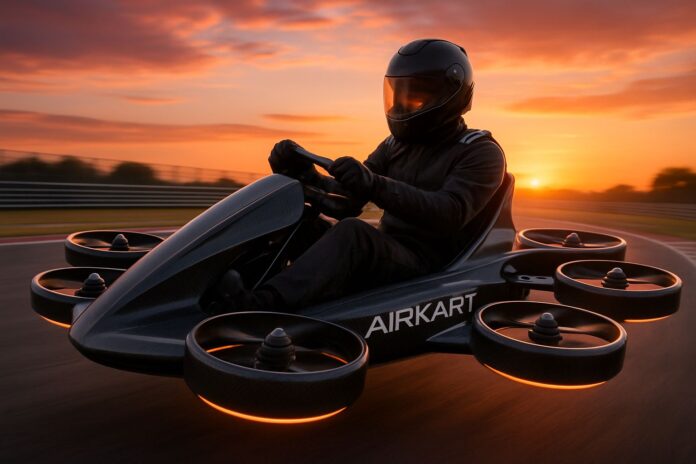
The AirKart is a single-seat electric aircraft built from a lightweight carbon fiber and Kevlar body and powered by eight ducted coaxial propellers. It’s designed to take off vertically, hover, and race around a purpose-built aerial track — think go-karting, but with altitude. The aircraft is electronically fenced within its designated course, meaning it physically cannot stray outside the track boundaries.
The machine is capped at a top speed of 62 miles per hour and a maximum altitude of 1,300 feet. Those numbers are deliberate — they’re fast enough to make your heart pound, but carefully tuned to comply with regulations that allow operation without a traditional pilot’s license.
| Specification | AirKart Detail |
|---|---|
| Propulsion | 8 ducted coaxial electric propellers |
| Body Material | Carbon fiber and Kevlar |
| Top Speed | 62 mph |
| Max Altitude | 1,300 feet |
| Session Length | 15 minutes |
| Session Price | $249 |
| Pilot License Required | No |
The carbon fiber and Kevlar combination isn’t just about weight savings — Kevlar is the same material used in bulletproof vests, chosen specifically for its impact resistance. In a vehicle designed for racing in three dimensions, that structural resilience matters. To understand more about advanced composite materials in aerospace, learn why Toray Industries is a leader in this field.
Why a Closed Track Changes Everything
Open airspace regulation is one of the biggest barriers to widespread personal aviation. By confining the AirKart to a private, electronically geofenced AeroKarting circuit, Elevate Racing sidesteps the mountain of FAA and international airspace rules that would otherwise make a product like this nearly impossible to commercialize. It’s the same logic that made go-karting on a closed track achievable for the masses long before Formula 1 was ever accessible.
The closed-track model also solves the safety conversation in one move. Riders can’t accidentally wander into restricted airspace, can’t exceed programmed altitude or speed limits, and are always within a controlled environment. For a first-time flyer, that safety net is exactly what makes it feel approachable rather than terrifying.
The Startup Behind the AirKart
Elevate Racing isn’t a garage project. It’s a U.K.-based aerospace startup with a clear commercial vision and a founder whose résumé carries real weight in the eVTOL world.
Elevate Racing’s Origin and Vision
The company’s mission is straightforward: make flying a consumer experience, not a privilege. While most eVTOL companies are chasing the air taxi market — a high-cost, high-regulation space — Elevate Racing identified a gap in the recreational sector. Their AeroKarting concept is modeled more like a theme park attraction or motorsport experience than traditional aviation, which is precisely what gives it commercial viability.
Elevate Racing’s global track rollout is planned for locations across the United States, the Caribbean, Europe, and the Middle East, with production of the AirKart scheduled to begin in 2026 ahead of the 2027 track launches. The business model is built on volume — short sessions, high throughput, accessible pricing, similar to the innovative approach seen with the AE200 eVTOL aircraft.
Founder Marcin Michalczyk’s Background at Lilium
Marcin Michalczyk didn’t stumble into eVTOL design. Before founding Elevate Racing, he worked as a design engineer at Lilium, one of the most technically ambitious electric aircraft companies in the world, known for its jet-powered eVTOL air taxi. That experience gave Michalczyk direct, hands-on exposure to the engineering challenges of electric vertical flight — propulsion efficiency, weight management, aerodynamic stability — all of which feed directly into the AirKart’s design.
His description of the AirKart as “the ultimate toy” isn’t just marketing language. It reflects a deliberate design philosophy: build something that prioritizes sensation and excitement first, then engineer the safety and compliance around it. That’s a very different starting point than most aerospace projects, and it shows in how the product has been positioned.
How the AirKart Works
Understanding the AirKart’s engineering helps explain why it can deliver a genuine flying experience while remaining accessible to non-pilots. Every major design decision connects back to two goals: maximum excitement and minimum barrier to entry.
Carbon Fiber and Kevlar Construction
The AirKart’s airframe is built from a combination of carbon fiber and Kevlar — two materials chosen for opposite but complementary reasons. Carbon fiber keeps the vehicle light, which is critical for electric propulsion systems where battery weight is always a constraint. Kevlar adds toughness and impact resistance without significantly adding mass. Together, they create a frame that can handle the physical demands of aggressive aerial maneuvering while keeping the energy requirements of the eight-motor system manageable.
Eight Ducted Coaxial Propellers
The propulsion system is where the AirKart gets interesting from a technical standpoint. Eight ducted coaxial propellers — meaning each duct contains two counter-rotating propellers stacked on the same axis — provide both lift and directional control. The ducted design improves thrust efficiency and reduces noise compared to open rotors, and the coaxial arrangement cancels out the torque reaction that would otherwise make the craft unstable. This is a configuration borrowed from advanced drone and eVTOL engineering, scaled up for a human pilot.
EasyFly Mode vs. Sport Mode
The AirKart isn’t a one-size-fits-all experience. Elevate Racing has built in two distinct flight modes to accommodate riders across the entire experience spectrum. EasyFly Mode is designed for first-timers — the controls are simplified, the responsiveness is dampened, and the aircraft essentially guides itself around the track with minimal input required. It’s the equivalent of a beginner karting session where the throttle is limited and the barriers are forgiving.
Sport Mode is a different animal entirely. In this mode, the AirKart opens up its full performance envelope — sharper response, faster directional changes, and a level of control sensitivity that rewards skill and punishes sloppiness, just like a real racing kart. The two-mode system is smart engineering: it makes the AirKart viable as both a casual attraction and a genuine competitive platform, giving the AeroKarting concept a longer competitive lifespan as riders develop their skills and come back for more.
No Pilot’s License Required
This is the detail that makes the AirKart genuinely revolutionary for recreational aviation. Traditional powered flight — even in a small ultralight aircraft — comes with real licensing requirements, medical certifications, and hours of training. The AirKart is engineered from the ground up to operate outside those requirements, placing it within a regulatory category that lets everyday people climb in and fly on their very first visit.
The key is the combination of a closed, geofenced track environment and hard-coded performance limits built directly into the aircraft’s flight control software. Because the AirKart cannot exceed its programmed speed and altitude ceilings, and because it physically cannot leave its designated airspace, regulatory bodies treat it differently from open-airspace aircraft. The result is a flying experience that requires nothing more than showing up.
FAA Part 103 Compliance Explained
In the United States, FAA Part 103 governs ultralight vehicles — a category of aircraft that can be operated without a pilot’s certificate under specific conditions. These conditions include weight limits, speed restrictions, and single-seat configurations. The AirKart’s design parameters — its lightweight carbon fiber and Kevlar construction, its 62 mph speed cap, and its single-seat layout — are carefully aligned with this regulatory framework. By engineering the aircraft to fit within Part 103, Elevate Racing has found a legal pathway to put non-pilots in the cockpit of a flying vehicle without requiring years of certification.
Speed and Altitude Limits That Keep It Legal
The 62 mph top speed and 1,300-foot altitude ceiling aren’t arbitrary marketing numbers — they’re precisely calculated thresholds that keep the AirKart within its approved operating parameters. At 62 mph, the aircraft delivers enough speed to make aerial racing genuinely exciting while staying below the velocity thresholds that trigger more stringent aviation oversight. The 1,300-foot ceiling keeps the AirKart well below controlled airspace in most locations, avoiding the complex air traffic management requirements that would otherwise apply. For those interested in how advanced designs are shaping aviation, the lift-cruise eVTOL configuration offers a fascinating insight.
These limits are enforced electronically, not just on paper. The AirKart’s onboard flight control system actively prevents the pilot from exceeding either boundary — meaning even the most aggressive Sport Mode rider can’t accidentally push the aircraft into non-compliant territory. That automatic enforcement is what makes the no-license model legally sustainable.
What AeroKarting Will Actually Feel Like
Picture strapping into a racing kart — low seat, wide stance, controls right in front of you — except when you push the throttle, you don’t accelerate along asphalt. You lift. The AirKart’s vertical takeoff means the transition from ground to air is immediate and visceral, with eight ducted motors generating enough thrust to push a human body skyward in seconds. Once airborne, the aircraft responds to steering inputs the way a high-performance drone does: fast, direct, and with a physical sensation of banking and pitching that no ground-based kart can replicate.
At 62 mph in Sport Mode, with a 1,300-foot view beneath you and a competitive lap time on the line, AeroKarting won’t feel like a theme park ride. It will feel like motorsport — just in a dimension that ground racing has never been able to touch. For aviation enthusiasts who’ve spent years watching aircraft from below, this is the closest most people will ever get to the raw sensation of performance flight without a commercial pilot’s license.
The Price of Flying for Fun
Elevate Racing has priced the AirKart experience at a level that’s aspirational but not out of reach — deliberately positioning it as a premium activity rather than an everyday commute.
$249 for 15 Minutes in the Sky
A single AeroKarting session runs $249 for 15 minutes of flight time. That’s not cheap by any measure, but context matters. Consider what else $249 buys you in the experience economy:
- A introductory helicopter flight lesson typically runs $150–$300 and keeps you in the passenger seat for most of it
- An indoor skydiving session at iFLY costs $84–$120 for two short wind tunnel flights with no real altitude
- A single lap experience in a high-performance racing simulator at a premium venue averages $80–$150
- A parasailing experience — passive, no control — runs $80–$150 per person
- A hot air balloon ride typically costs $150–$300 per person with no pilot input whatsoever
Against that backdrop, $249 for 15 minutes of actual piloted, competitive aerial flight — where you are in control, racing at altitude — starts to look like a reasonable premium for something genuinely unprecedented.
The session length of 15 minutes is also strategically chosen. It’s long enough to learn the basics, get comfortable with Sport Mode, and complete multiple competitive laps, but short enough to maintain high track throughput — which is the business model’s core engine. More sessions per day means more revenue per track, which is what makes the global expansion plan financially credible.
How That Compares to Other eVTOL Costs
The broader eVTOL market tells a very different pricing story. Vehicles designed for private air taxi use — such as the Joby Aviation S4 or the Archer Midnight — are targeting per-mile pricing comparable to premium rideshare, but the aircraft themselves represent capital investments well north of $200,000 per unit. Ownership is firmly out of reach for the average consumer, and even as air taxi services launch, they’ll serve a narrow slice of the market concentrated around dense urban corridors.
Elevate Racing’s rental model flips that entirely. Instead of selling the aircraft, they sell the experience — absorbing the capital cost of the AirKart fleet into a per-session revenue model that scales with track traffic. It’s the same financial logic that made go-karting, bowling, and golf ranges into mass-market businesses. The $249 price point is the entry ticket, not the ownership barrier, and that distinction is exactly what makes AeroKarting a viable consumer product where luxury eVTOL ownership is not.
Where and When AeroKarting Tracks Will Open
Elevate Racing has outlined an ambitious but specific global rollout for its AeroKarting circuits, with target regions spanning four major markets and a production and launch timeline that puts the first tracks operational within the next two years.
Target Locations Across the US, Caribbean, Europe, and Middle East
Elevate Racing has identified four primary markets for its first wave of AeroKarting track launches: the United States, the Caribbean, Europe, and the Middle East. These aren’t random choices — they represent a deliberate mix of high-disposable-income tourism markets and experience-hungry urban populations. The Caribbean in particular makes strategic sense as a destination-based experience, where resort guests and tourists are already primed to spend on premium activities. The Middle East, with its appetite for large-scale entertainment infrastructure and luxury experiences, is another natural fit.
In the U.S. and Europe, the target is likely concentrated around major metropolitan areas and existing motorsport or entertainment districts — locations where the infrastructure exists to support a high-volume, high-throughput attraction. No specific city addresses have been confirmed yet, but the market selection signals that Elevate Racing is thinking about AeroKarting as a destination experience first, not a local utility.
2026 Production and 2027 Launch Timeline
Elevate Racing has set 2026 as the production start date for the AirKart, with the first AeroKarting tracks targeted to open to the public in 2027. That timeline puts the company roughly two years out from commercial operations, which is aggressive for an aerospace product but consistent with the closed-track regulatory pathway that sidesteps much of the certification burden that conventional aircraft manufacturers face. Prototype development is already underway, and the 2026 production target suggests Elevate Racing is moving through its engineering validation phases on schedule. For more information about their innovative approach, visit Elevate Racing’s AeroKart.
The AirKart Could Be More Than Just a Thrill Ride
Battery-powered eVTOLs produce zero tailpipe emissions and significantly less noise than helicopters — making AeroKarting not just an adrenaline sport, but a demonstrably cleaner alternative to traditional powered aviation experiences.
Beyond the racing experience itself, the AirKart quietly makes a case for what the future of personal aviation could look like environmentally. Every AiroKarting session runs entirely on electric power — no jet fuel, no combustion emissions, no noise pollution at the level of a conventional helicopter or small fixed-wing aircraft. For an industry that has historically been one of the harder sectors to decarbonize, a fully electric aerial racing platform is a meaningful proof of concept. Learn more about the lift-cruise eVTOL configuration and how this design is shaping the future.
There’s also a skills pipeline argument worth making. AeroKarting could become the on-ramp that introduces a new generation to flight controls, spatial awareness, and aviation thinking in a way that ground-based simulators and textbooks never quite manage. The tactile feedback of actually piloting a vehicle in three dimensions — even at 62 mph in a geofenced circuit — builds instincts that translate directly into more advanced aviation training. If even a fraction of AeroKarting riders are inspired to pursue proper flight training, the platform could feed real pilots into an industry that faces a well-documented global shortage.
For aviation enthusiasts specifically, AeroKarting fills a gap that has existed for decades: an accessible, affordable, genuinely piloted flight experience that doesn’t require a medical certificate, a student pilot certificate, or a $10,000 training commitment just to find out if you love it. It’s the kind of entry point that the aviation community has needed for a long time, and the fact that it arrives packaged as a competitive motorsport experience makes it even more likely to capture the imagination of people who might never have considered flight school in the first place.
Frequently Asked Questions
The AirKart has generated a lot of questions since Elevate Racing unveiled it — and most of them come down to the same core concerns: Is it real? Is it safe? Can I actually do it without a license? The answers are more straightforward than you might expect, largely because Elevate Racing engineered the product specifically to remove the barriers that typically make those questions complicated.
Here’s what you need to know before you start planning your first AeroKarting session:
Do You Need a Pilot’s License to Fly the AirKart?
No — you do not need a pilot’s license to fly the AirKart. Elevate Racing has engineered the vehicle and its operating environment to comply with regulations that permit unlicensed operation, including alignment with FAA Part 103 ultralight vehicle rules in the United States. The closed, geofenced AeroKarting track environment and the AirKart’s hard-coded speed and altitude limits are what make this legally possible. You’ll receive a briefing before your session, but no prior flight experience or certification is required to participate.
How Fast and High Can the AirKart Go?
The AirKart is electronically limited to a top speed of 62 miles per hour and a maximum altitude of 1,300 feet. These limits are enforced by the aircraft’s onboard flight control software — they cannot be overridden by the pilot during a session. The 62 mph ceiling applies in Sport Mode, which delivers the full performance experience. EasyFly Mode operates at more conservative parameters for first-time flyers.
How Much Does It Cost to Ride an AirKart?
A single AeroKarting session is priced at $249 for 15 minutes of flight time. This is a rental experience — you do not purchase the aircraft. The $249 covers full use of the AirKart for your session, including the pre-flight briefing. Elevate Racing’s model is built around the track rental experience, similar to how go-karting venues operate, making flight accessible without the six-figure ownership cost associated with most eVTOL aircraft.
Where Will AeroKarting Tracks Be Located?
Elevate Racing has announced plans to open AeroKarting tracks across four regions: the United States, the Caribbean, Europe, and the Middle East. Specific venue addresses have not yet been publicly confirmed, but the regional targets reflect a focus on high-tourism and high-income markets where premium experience spending is already strong.
The first tracks are expected to open in 2027, following the start of AirKart production in 2026. Given the global scope of the rollout, it’s likely that multiple locations across different regions will launch in close succession rather than a single flagship opening. Elevate Racing’s business model depends on scale, so a fast multi-market launch makes commercial sense.
If you’re an aviation enthusiast planning ahead, the Caribbean and Middle East locations are likely to be destination-style venues integrated with resort or entertainment complexes, while U.S. and European tracks may target urban entertainment districts or existing motorsport facilities. Keep an eye on Elevate Racing’s official channels for confirmed location announcements as the 2026 production date approaches.
Who Built the AirKart and What Is Their Background?
The AirKart was developed by Elevate Racing, a U.K.-based aerospace startup founded by Marcin Michalczyk. Before starting Elevate Racing, Michalczyk worked as a design engineer at Lilium — the German eVTOL company known for its uniquely ambitious electric jet-powered air taxi program. That experience gave him direct engineering exposure to one of the most technically complex electric aircraft programs in the world, covering ducted propulsion systems, lightweight airframe design, and the unique aerodynamic challenges of vertical flight.
“The ultimate toy.” — Marcin Michalczyk on the AirKart, reflecting a design philosophy that puts sensation and excitement at the center of the engineering brief.
Michalczyk’s Lilium background isn’t just a credential — it’s directly visible in the AirKart’s technical architecture. The use of ducted coaxial propellers rather than open rotors echoes the efficiency-focused propulsion philosophy that defined Lilium’s engineering approach. The carbon fiber and Kevlar airframe construction reflects the weight-to-strength optimization that’s fundamental to making electric flight viable at meaningful performance levels.
What distinguishes Elevate Racing from most eVTOL startups is the deliberate decision to target the recreational market rather than air taxi transport. That pivot — from utility aviation to experience aviation — is what unlocks the regulatory pathway, the pricing model, and the mass-market accessibility that makes AeroKarting a commercially viable concept rather than another high-cost personal mobility product fighting for the same narrow luxury customer base as every other eVTOL company.
The combination of genuine aerospace engineering expertise, a founder with hands-on eVTOL development experience, and a business model specifically designed around consumer accessibility gives Elevate Racing a credibility profile that sets it apart from the many flying car concepts that never make it past a flashy render. The AirKart is a real machine, built by someone who knows exactly what goes into making electric vertical flight work — and designed specifically to put that technology in the hands of people who’ve never had access to it before.
The excitement of racing go-karts has taken a new dimension with the introduction of airborne go-karts. These innovative vehicles combine the thrill of traditional go-kart racing with the exhilaration of flying. Companies are now designing models that can soar through the skies, offering a unique experience for adventure seekers. For those interested in exploring this groundbreaking technology, Elevate Racing’s AirKart is leading the way in this revolutionary form of entertainment.