
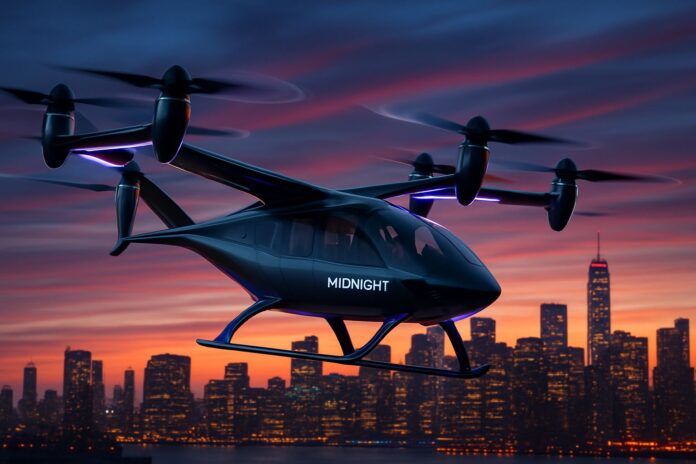

Key Takeaways: Archer’s Midnight eVTOL at a Glance
- Archer Aviation’s Midnight eVTOL is a five-seat (one pilot, four passengers) electric air taxi designed to fly up to 60 miles at speeds of 150 mph — making urban air travel a real possibility by 2025.
- Midnight uses a 12-rotor hybrid lift system with built-in redundancy, meaning no single point of failure can bring the aircraft down — a critical safety milestone for FAA certification.
- United Airlines made a $10 million deposit on 100 Midnight aircraft, signaling serious institutional confidence in Archer’s commercial roadmap.
- The Midnight received its FAA Special Airworthiness Certificate in August 2023, clearing it for active flight testing — a major regulatory step most eVTOL competitors haven’t yet cleared.
- Keep reading to find out why Midnight’s noise profile and safety architecture could make it the most disruptive air taxi ever built — and what still stands between Archer and commercial launch.
Archer Aviation just raised the bar for what an electric air taxi can actually be — and Midnight is the proof.
For years, eVTOL aircraft existed mostly as bold promises and slick renderings. Midnight changes that narrative entirely. Publicly unveiled on November 17, 2022, this full-scale production aircraft isn’t a concept or a scaled-down demonstrator — it’s Archer’s commercial-ready answer to urban air mobility. Electric aviation enthusiasts at the forefront of this industry have been watching Midnight’s development closely, and for good reason: this aircraft represents one of the most technically detailed and investor-backed eVTOL programs in aviation history.
What makes Midnight especially compelling is the combination of real-world specs, serious regulatory progress, and heavyweight partnerships that back it up. This isn’t vaporware — it’s an aircraft that received an FAA Special Airworthiness Certificate in August 2023 and has United Airlines waiting with a deposit on 100 units. Let’s break down everything you need to know.
Midnight Is Archer Aviation’s Biggest Bet Yet
Archer Aviation was founded with a single mission: make sustainable urban air travel a reality. The company’s journey started with the Maker — a two-seat technology demonstrator that achieved its first flight in December 2021. Maker was always a stepping stone, not a destination. Every flight, every system test, and every engineering lesson from Maker fed directly into the design of Midnight.
Midnight is Archer’s production aircraft — the one that’s meant to actually fly paying passengers. Announced by name on August 10, 2022, Midnight is built to handle short urban routes efficiently, quietly, and with zero direct emissions. The company’s commercial target is 2025, with FAA type certification expected by end of 2024.
The ambition here is enormous. Archer isn’t just building an aircraft; it’s trying to redefine how people move through cities. The 2023 Paris Air Show featured Midnight alongside Stellantis — Archer’s manufacturing partner — underscoring just how serious this program has become on a global stage.
- Midnight publicly unveiled: November 17, 2022
- Aircraft name announced: August 10, 2022
- FAA Special Airworthiness Certificate: August 2023
- Target FAA type certification: End of 2024
- Target commercial service launch: 2025
- Manufacturing partner: Stellantis
- Avionics partner: Safran (collaboration announced June 21, 2023)
Midnight’s Technical Specs Break Down
Midnight isn’t built on optimistic assumptions — it’s built around what today’s battery technology can reliably deliver. Archer has been deliberately conservative with its performance targets, which actually makes the numbers more credible, not less impressive.
The aircraft is designed to carry one pilot and four passengers across routes of up to 60 miles (approximately 97 km) at a top speed of 150 mph (241 km/h). Those aren’t theoretical ceiling numbers — they’re the operational targets Archer is engineering toward using current lithium-ion battery chemistry.
12-Rotor Hybrid Lift System
Midnight’s propulsion setup is one of its most technically interesting features. The aircraft uses 12 total rotors arranged in a hybrid lift-plus-cruise configuration. Six of those rotors are larger and optimized for vertical lift during takeoff and landing, while the remaining six smaller rotors are tilted for forward flight. During cruise, the lift rotors fold flat against the aircraft to reduce drag — a design choice that directly improves efficiency and range. This tilt-rotor and fold-rotor hybrid approach sets Midnight apart from pure multicopter designs that sacrifice cruise efficiency for simplicity.
5-Seat Cabin Built for Urban Routes
The cabin seats four passengers plus one pilot, designed specifically around short urban and suburban hops — think airport-to-downtown routes or cross-city transfers that would take 45 minutes by car and under 10 minutes by air. The interior is engineered for passenger comfort at altitude, with Archer emphasizing low noise inside the cabin as a core design target alongside the exterior noise profile.
Range, Speed, and Altitude Capabilities
The 60-mile range and 150 mph cruise speed position Midnight squarely in the urban air mobility sweet spot. These numbers reflect what Archer calls a “conservative approach” — a deliberate strategy to underpromise based on today’s battery technology rather than speculate about future energy density improvements. This matters because it means the performance targets are achievable now, not dependent on a battery breakthrough that may or may not happen before 2025.
Noise Levels vs. Traditional Helicopters
One of the most exciting aspects of Midnight — and one that will determine whether urban communities actually accept air taxi operations — is its acoustic footprint. Archer has designed Midnight to produce significantly less noise than a traditional helicopter. The distributed electric propulsion system, lower rotor tip speeds, and blade count all contribute to a quieter operation. For city regulators and residents, this isn’t just a nice feature — it’s the difference between approving or blocking vertiport infrastructure entirely.
How Midnight Compares to the Maker Demonstrator
Archer’s path to Midnight ran directly through Maker — the two-seat eVTOL technology demonstrator that completed its first flight in December 2021. Maker was never meant to carry passengers commercially. Its entire purpose was to validate Archer’s core propulsion concepts, gather real flight data, and stress-test the engineering assumptions that would later define Midnight’s design.
Key Design Similarities Between Maker and Midnight
Both aircraft share Archer’s fundamental approach to distributed electric propulsion — using multiple rotors to spread lift and thrust across redundant systems rather than relying on a small number of high-power engines. The tilt-rotor philosophy that defines Midnight’s hybrid lift-cruise capability was first explored through Maker’s flight program. Archer carried forward the core lessons around motor sizing, battery thermal management, and rotor acoustics directly from Maker into Midnight’s engineering architecture.
What Changed in the Jump to Full-Scale Production
The leap from Maker to Midnight isn’t incremental — it’s a full-scale redesign optimized for commercial operation. Midnight scales the rotor count to 12, expands the cabin to seat five occupants, integrates production-grade avionics developed in partnership with Safran, and targets FAA type certification under the demanding Part 23 standards. Where Maker was built to learn, Midnight is built to certify, manufacture, and operate at scale. Stellantis joined as a manufacturing partner specifically to bring automotive-grade production discipline to the aircraft build process — a pairing that signals Archer is thinking beyond prototypes and into volume delivery.
Midnight’s Safety Architecture
Safety isn’t a feature Archer bolted onto Midnight — it’s the foundational design philosophy the entire aircraft is built around. In electric aviation, redundancy isn’t just good engineering practice; it’s the primary mechanism through which public trust and regulatory approval are earned.
No Single Point of Failure: What That Actually Means
Midnight is built with redundant systems across every critical aircraft function. The 12-engine configuration is central to this philosophy. If one, two, or even several motors were to fail during flight, the remaining motors can compensate to maintain controlled flight and execute a safe landing. This is a fundamentally different safety model than a conventional helicopter, where a single main rotor failure is catastrophic without an immediate autorotation response.
The redundancy extends beyond just the motors. Archer has engineered multiple independent systems across the aircraft’s power distribution, flight controls, and avionics. The goal is an architecture where no individual component failure — mechanical or electrical — can result in an unrecoverable situation. For the FAA, demonstrating this level of fault tolerance is a core requirement on the path to type certification.
Electric Propulsion vs. Turbine Engine Reliability
Electric motors have a compelling reliability advantage over turbine engines that often gets overlooked in the broader eVTOL conversation. Turbine engines contain thousands of precision-machined moving parts operating under extreme thermal and mechanical stress. Electric motors, by contrast, have dramatically fewer moving components, no combustion cycle, and no high-temperature fatigue mechanisms. This translates directly into lower failure rates, more predictable maintenance intervals, and fewer catastrophic failure modes.
- Moving parts: Electric motors have significantly fewer than turbine engines, reducing mechanical failure points
- Thermal stress: No combustion means no high-cycle thermal fatigue in the propulsion system
- Maintenance predictability: Electric systems degrade more linearly, making maintenance scheduling more reliable
- Failure modes: Motor failures in a distributed system are containable; turbine failures often are not
- Redundancy scalability: Adding redundant electric motors is far more practical than adding redundant turbine engines
This isn’t to say electric propulsion is without risk — battery thermal runaway is a genuine engineering challenge that Archer and every other eVTOL developer must solve rigorously. But the overall reliability profile of distributed electric propulsion, when properly engineered, is genuinely competitive with — and in several dimensions superior to — conventional rotorcraft powerplants.
For Midnight specifically, the combination of 12 independent motors, redundant power distribution, and Safran’s production avionics creates a safety architecture that Archer believes will satisfy the FAA’s most stringent certification requirements. That confidence is backed by the fact that the agency has already issued a Special Airworthiness Certificate — a meaningful regulatory signal that the program is on the right track. This aligns with other eVTOL aircraft technology advancements in the industry.
The Road to FAA Certification
FAA certification is the single most important milestone standing between Archer and commercial revenue. Everything — the United Airlines partnership, the Department of Defense interest, the 2025 launch target — depends on Midnight clearing this regulatory hurdle. Archer knows this, and the company has structured its entire development timeline around it.
FAA Special Airworthiness Certificate Secured August 2023
On August 11, 2023, Archer announced that Midnight received its FAA Special Airworthiness Certificate — the regulatory authorization that allows the aircraft to begin active flight testing under FAA oversight. This is not type certification, but it is the essential precursor. It means the FAA has reviewed Midnight’s design sufficiently to authorize real flight operations, which is a significant vote of confidence in the program’s technical maturity. For an eVTOL program targeting 2024 type certification, receiving this certificate in mid-2023 keeps the timeline credible.
Critical Design Review and What Comes Next
Beyond the Special Airworthiness Certificate, Archer’s path to type certification runs through a series of FAA-mandated design reviews, flight test milestones, and systems validation campaigns. The Critical Design Review process requires Archer to demonstrate that every system on Midnight meets the safety and performance standards defined in the aircraft’s certification basis — the specific set of FAA regulations the agency and Archer agreed Midnight must satisfy.
Flight testing with Midnight is the next major phase. Unlike the Maker demonstrator flights, which were primarily about learning, Midnight’s flight test program is structured to generate the specific data the FAA needs to issue type certification. Every flight hour, every systems test, and every performance envelope expansion directly feeds the certification evidence package. Archer has indicated it expects to complete this process and achieve type certification by end of 2024 — an aggressive but not unrealistic target given where the program stood at the August 2023 milestone.
United Airlines’ $1 Billion Commitment to Midnight
United Airlines didn’t just express interest in Midnight — they put money on the table. On August 10, 2022, the same day Archer formally announced the Midnight name, United Airlines paid a $10 million deposit to secure an order for 100 Midnight aircraft. The total value of the United Airlines agreement is reported at up to $1 billion, making it one of the largest eVTOL purchase commitments in aviation history. For United, Midnight represents a way to extend its brand into the first and last mile of air travel — connecting passengers between airports and city centers in minutes rather than hours. For Archer, the United partnership is a commercial anchor that validates the business case for Midnight’s 2025 launch.
Archer’s $215 Million Investment Round Explained
Archer has secured substantial investment to fund Midnight’s development and certification campaign. The company raised a $215 million funding round that includes participation from strategic partners who bring more than just capital to the program. Stellantis — the automotive group behind brands including Fiat, Chrysler, and Peugeot — is among Archer’s key investors and manufacturing partners, contributing both funding and critical expertise in high-volume vehicle production. This combination of financial backing and industrial partnership is what separates Archer from eVTOL startups that have strong concepts but lack the manufacturing infrastructure to deliver aircraft at commercial scale.
Who Invested and Why It Matters
Stellantis leads the strategic investor roster, but the significance goes beyond the dollar amount. Stellantis brings decades of high-volume vehicle manufacturing experience — the kind of industrial discipline that turns prototype aircraft into deliverable products at scale. Their involvement means Archer has access to supply chain infrastructure, quality management systems, and production engineering expertise that most aerospace startups simply don’t have. Safran, the French aerospace and defense group, joined as the avionics technology partner in June 2023, adding another tier of institutional credibility to the program. When companies like these commit capital and engineering resources, it signals that Midnight has passed a level of technical due diligence that goes well beyond what any press release can communicate.
Midnight’s Potential Role With the U.S. Department of Defense
Archer has publicly stated that it predicts Midnight will be the first eVTOL aircraft delivered to the U.S. Department of Defense. This isn’t a casual claim — military interest in eVTOL technology is real and growing, driven by the platforms’ combination of low acoustic signature, zero direct emissions, mechanical simplicity, and vertical takeoff capability in austere environments. For defense applications, Midnight’s quiet operation and distributed propulsion redundancy are features, not just selling points.
A Department of Defense contract would do more than generate revenue for Archer. It would validate Midnight’s airworthiness and operational reliability in some of the most demanding operating conditions imaginable — a proof point that would accelerate commercial operator confidence and potentially fast-track elements of the FAA certification process. The defense pathway and the commercial pathway aren’t competing priorities for Archer; they’re parallel validation tracks that reinforce each other.
Midnight’s 2025 Commercial Launch Is Closer Than You Think
When Archer says commercial operations begin in 2025, the timeline is grounded in a specific sequence of milestones that are already in motion. The FAA Special Airworthiness Certificate was secured in August 2023. Active flight testing feeds directly into the type certification evidence package. FAA type certification is targeted for end of 2024. That leaves 2025 as the realistic window for the first revenue-generating Midnight flights — likely short urban routes operated in partnership with United Airlines.
The infrastructure side of the equation is developing in parallel. Vertiport development, air traffic management protocols for low-altitude urban airspace, and pilot training pipelines all need to be operational before the first commercial flight. Archer has been working alongside partners and regulators to make sure these pieces are in place before Midnight is certified. The 2025 target isn’t just about building the aircraft — it’s about building the entire ecosystem around it.
- August 2023: FAA Special Airworthiness Certificate secured, flight testing authorized
- Late 2023 – 2024: Active flight test campaign generates FAA certification data
- End of 2024: Target date for FAA type certification
- 2025: Target commercial service launch with United Airlines partnership routes
- Ongoing: Vertiport infrastructure, air traffic management, and pilot training development in parallel
The convergence of certified aircraft, institutional airline partnerships, defense interest, and a manufacturing infrastructure backed by Stellantis puts Archer in a stronger commercial launch position than nearly any other eVTOL developer. The 2025 date isn’t wishful thinking — it’s a milestone that every element of Archer’s program is currently pointed toward.
Frequently Asked Questions
Still have questions about the Archer Midnight eVTOL? Here are the most common ones answered clearly.
What Is Archer Aviation’s Midnight eVTOL?
Midnight is Archer Aviation’s production electric vertical takeoff and landing (eVTOL) air taxi. It is a piloted aircraft designed to carry four passengers plus one pilot on short urban routes, operating with zero direct emissions and significantly less noise than a conventional helicopter.
Archer unveiled the full-scale Midnight aircraft on November 17, 2022. It is the production successor to Archer’s Maker technology demonstrator and represents the company’s commercial product — the aircraft it intends to certify, manufacture at scale, and operate in revenue service beginning in 2025.
How Many Passengers Can the Midnight eVTOL Carry?
Midnight carries four passengers and one pilot, for a total of five occupants. The cabin is designed specifically for short urban and suburban routes, prioritizing passenger comfort, low interior noise, and efficient boarding and deboarding at vertiport facilities.
The five-seat configuration reflects Archer’s focus on the urban air taxi market — routes where a small, quiet, fast aircraft displaces long ground commutes rather than competing directly with regional airline services that require higher passenger capacity. This innovative approach is similar to the AE200 eVTOL aircraft developed by Geely, showcasing the industry’s shift towards urban air mobility solutions.
How Far Can the Midnight eVTOL Fly on a Single Charge?
Midnight is designed to fly up to 60 miles (approximately 97 km) on a single charge using today’s battery technology. Archer has been deliberately conservative with this figure, engineering around current lithium-ion energy density rather than speculating on future battery improvements. The top cruise speed is 150 mph (241 km/h), making a 60-mile route completable in under 30 minutes of flight time.
When Will the Midnight eVTOL Enter Commercial Service?
Archer is targeting commercial operations beginning in 2025, with FAA type certification expected by the end of 2024. The August 2023 issuance of the FAA Special Airworthiness Certificate cleared Midnight for active flight testing, which is the critical step that precedes type certification. United Airlines, which has placed a deposit on 100 Midnight aircraft, is expected to be among the first commercial operators.
How Quiet Is the Midnight eVTOL Compared to a Helicopter?
Midnight is designed to produce significantly less noise than a traditional helicopter. The acoustic advantage comes from several engineering factors working together: distributed electric propulsion spreads thrust across 12 rotors rather than concentrating it in one or two large blades, lower rotor tip speeds reduce the dominant noise-generating mechanism in rotorcraft, and the absence of a combustion powerplant eliminates one of the loudest noise sources in conventional helicopters.
This isn’t just a passenger comfort feature — it’s a regulatory and community acceptance requirement. Urban vertiport operations will only be viable if the aircraft operating from them don’t generate the noise complaints that have historically limited helicopter operations in cities. Midnight’s acoustic profile is engineered to clear that bar.
For electric aviation enthusiasts, Midnight’s noise reduction represents one of the most meaningful technical achievements in the program — proof that high-performance air travel and community-compatible operations aren’t mutually exclusive. The aircraft that changes urban mobility won’t just be fast and clean; it will be quiet enough that cities actually want it flying overhead. Midnight is being built to be exactly that aircraft.
If you’re passionate about the future of electric aviation and want to stay at the leading edge of developments like Archer’s Midnight program, explore the resources and community built for electric aviation enthusiasts who refuse to watch this revolution from the sidelines.