
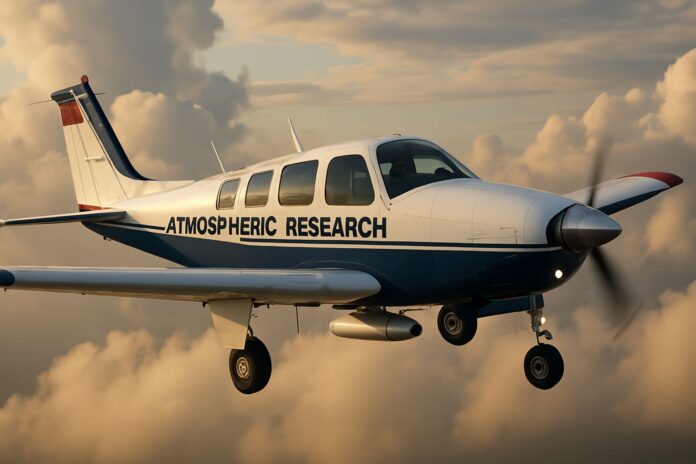

- The Beechcraft Bonanza has been in continuous production since 1947, making it the longest-running production aircraft in history — a track record that translates directly into proven reliability for atmospheric research missions.
- The Bonanza G36’s Continental IO-550-B engine delivers a cruise speed of 176 knots and a range exceeding 920 nautical miles, giving researchers the endurance to cover vast atmospheric sampling zones in a single flight.
- With the Garmin G1000 NXi avionics suite, pilots can manage complex flight profiles while integrated autopilot systems free up crew attention for real-time data collection and instrument monitoring.
- The all-metal airframe, certified in the Utility category, is built to handle repeated scientific sorties and the kind of structural stress that comes with carrying additional research equipment.
- Keep reading to find out exactly how the Bonanza’s cabin can be reconfigured for scientific instruments — and why that makes it outperform nearly every other light aircraft in its class for atmospheric work.
Few aircraft in general aviation history have proven as adaptable, durable, and downright capable as the Beechcraft Bonanza — and atmospheric researchers have taken notice.
For pilots and enthusiasts who want to understand how a classic piston aircraft became a serious tool for science, this resource on general aviation aircraft capabilities offers a strong foundation. The Bonanza isn’t just a legacy aircraft admired for its lines and history — it’s a working platform that continues to earn its place in specialized aviation missions, including atmospheric data collection.
The Beechcraft Bonanza Is Built for Atmospheric Data Collection
What separates the Bonanza from other light aircraft isn’t just its speed or range — it’s the combination of structural integrity, avionics sophistication, and cabin flexibility that makes it a genuinely practical research platform. When atmospheric scientists need a low-to-mid altitude sampling aircraft that can fly long transects, hold altitude precisely, and carry additional instrumentation without structural compromise, the Bonanza consistently rises to the top of the list.
A 75-Year Legacy That Makes the Bonanza Trustworthy
Trust in aviation is earned over decades, not marketing cycles. The Bonanza has more than 75 years of continuous production behind it, and that history isn’t just a footnote — it’s a direct indicator of how well the aircraft performs across diverse operational demands.
First Flight in 1947 and What Has Changed Since
The Bonanza took its first flight in 1947 as an all-metal, four-seat, single-engine aircraft designed to push the boundaries of what a light plane could do. Since then, it has evolved through multiple variants — from the iconic V-tail Model 35 to the current straight-tail G36 — gaining engine power, cabin space, and avionics with each generation. What hasn’t changed is the core design philosophy: build an aircraft that performs at the highest level and lasts.
The turbocharged version arrived in 1979, extending the aircraft’s altitude capability and opening the door to high-altitude atmospheric sampling work. Each successive upgrade kept the Bonanza current without abandoning the structural and aerodynamic strengths that made it exceptional in the first place. For those interested in similar aircraft, the Cessna 172 Skyhawk is known for its stability and performance in precision mapping.
Over 18,500 Units Built: Why Production Numbers Matter
More than 18,500 Bonanzas of all variants have been built, a number that carries real weight in the world of scientific aviation. A large production base means an extensive network of parts, certified mechanics, and well-documented maintenance histories. For research organizations operating on tight budgets, that translates into lower downtime and more predictable operating costs. For those interested in the broader aviation industry, learn how Diehl Aviation is enhancing comfort and functionality by transforming aircraft interiors.
It also means the airframe has been stress-tested across every conceivable environment — from Arctic cold-soaks to desert heat, from sea-level operations to high-altitude mountain transits. That breadth of operational experience makes the Bonanza one of the most well-understood airframes available to the scientific community.
How the All-Metal Airframe Supports Scientific Missions
The Bonanza’s all-metal construction isn’t just a legacy choice — it’s a practical advantage for research operations. Metal airframes are easier to modify for instrument mounting, sensor ports, and external probe attachments than composite structures. Researchers can drill, attach, and seal with confidence, knowing the structural behavior of aluminum alloy is well-documented and predictable under load.
The aircraft is certified in the Utility category, meaning its G-limits are set for more demanding operations than standard Normal category aircraft. That structural margin matters when the aircraft is loaded with additional scientific equipment and operating in turbulent atmospheric boundary layers where data is richest — and conditions are most demanding.
Technical Specs That Make It Ideal for Data Collection
The numbers behind the Bonanza G36 tell a compelling story for anyone evaluating it as a research platform:
- Engine: Continental IO-550-B, fuel-injected, six-cylinder
- Cruise Speed: Approximately 176 knots
- Range: 920+ nautical miles
- Gross Weight: Substantial payload margin for additional instrumentation
- Avionics: Garmin G1000 NXi integrated flight deck
- Cabin Capacity: Up to six seats, reconfigurable for research equipment
- Certification: Utility category with extended G-limits
Continental IO-550-B Engine Performance
The Continental IO-550-B is a direct-drive, fuel-injected engine that delivers reliable, consistent power across the Bonanza’s operating envelope. Fuel injection means more stable combustion compared to carbureted engines, which is critical when the aircraft is holding precise altitude profiles for atmospheric sampling runs.
- Smooth power delivery reduces vibration that could interfere with sensitive onboard instruments
- Fuel injection improves cold-weather starting reliability — essential for early-morning research departures
- The engine’s well-established overhaul network keeps maintenance costs predictable
For long-duration atmospheric missions that require the aircraft to maintain exact altitudes and headings for extended periods, engine reliability isn’t optional — it’s the foundation everything else is built on.
176-Knot Cruise Speed and 920+ Nautical Mile Range
A cruising speed of approximately 176 knots puts the Bonanza in a performance tier that most research-configured light aircraft simply can’t reach. Speed matters in atmospheric research because weather systems move — and the ability to quickly reposition or extend a sampling transect without burning excessive fuel is a genuine operational advantage. For those interested in precision mapping, the Cessna 172 Skyhawk offers a stable alternative.
The 920+ nautical mile range means researchers can conduct wide-area atmospheric surveys without the interruption of a fuel stop, which would otherwise require re-climbing to sampling altitude and losing valuable data continuity. That range, paired with the Bonanza’s speed, gives research teams a coverage footprint that rivals much more expensive turbine platforms.
- Wide-area atmospheric surveys in a single flight profile
- Fewer fuel stops means uninterrupted data streams
- Speed allows rapid repositioning to chase dynamic weather events
- Operating costs remain significantly lower than turbine alternatives
Structural Durability for Repeated Scientific Sorties
The Bonanza is built to take a beating — and that’s not hyperbole. Its gross weight approaches that of the Beechcraft Baron, with a difference of nearly 1,900 pounds separating the two siblings. That structural margin means the Bonanza can absorb the additional weight of scientific instrumentation, sensor pods, and data recording equipment without operating anywhere near its limits. Research aircraft fly repeated sorties, often in conditions that would ground lesser aircraft, and the Bonanza’s construction was designed for exactly that kind of sustained operational tempo.
Garmin G1000 NXi: The Avionics Suite Powering Atmospheric Research
Modern atmospheric research demands more than just a capable airframe — it demands avionics that can keep the pilot precisely on task while the science happens around them. The Garmin G1000 NXi integrated flight deck transforms the Bonanza’s cockpit into a mission management center, combining navigation, engine monitoring, weather data, and traffic awareness into a unified, intuitive display system.
The G1000 NXi’s high-resolution displays give pilots an immediate, comprehensive picture of where the aircraft is, where it’s going, and how every system is performing — all at a glance. For research missions that require precise altitude holds, specific ground tracks, or repeated survey patterns, that level of situational awareness isn’t a luxury. It’s a mission-critical requirement. For those interested in enhancing aircraft interiors, Diehl Aviation offers innovative solutions.
Real-Time Navigation and Situational Awareness for Research Flights
Atmospheric sampling missions often require the aircraft to fly highly specific routes — grid patterns, racetrack orbits, or straight-line transects at exact altitudes. The G1000 NXi’s integrated GPS navigation makes programming and executing these patterns straightforward, even in airspace where precision is non-negotiable. Real-time weather overlay capabilities allow pilots to identify developing weather that could compromise both safety and data integrity, rerouting on the fly without losing mission continuity.
How the Autopilot System Frees Pilots to Focus on Data
One of the most underappreciated aspects of flying a research-configured Bonanza is the role the autopilot plays in mission success. When an integrated autopilot system holds altitude, heading, and airspeed with precision, the pilot’s cognitive load drops dramatically — and that freed attention can go directly toward monitoring instruments, communicating with ground teams, or managing in-flight data collection systems. On long transect flights exceeding several hundred nautical miles, autopilot isn’t a convenience; it’s what makes sustained, high-quality atmospheric data collection physically possible for a small crew.
The Cabin Configuration for Scientific Equipment
Walk into a research-configured Beechcraft Bonanza and it looks nothing like the plush, six-seat touring aircraft that rolls off the Textron Aviation production line. The same spacious, well-designed cabin that makes the Bonanza exceptional for business travel becomes, with thoughtful reconfiguration, a compact but capable airborne laboratory.
Six-Seat Capacity Reconfigured for Instruments and Operators
The Bonanza’s standard six-seat cabin gives research operators significant flexibility. Rear seats can be removed entirely to accommodate rack-mounted data acquisition systems, atmospheric sampling equipment, or gas analyzers, while the front seats remain configured for pilot and a research operator who monitors the instruments in real time. The cabin floor structure — designed to handle the loads of full passenger seating — handles the concentrated weight of scientific equipment without modification concerns.
What makes this particularly valuable is the cabin’s width and headroom. Researchers can actually work in the space rather than simply occupying it. Reaching across to adjust instruments, swapping sample containers, or reviewing data on a laptop are all practical in the Bonanza’s cabin in a way that simply isn’t possible in narrower single-engine alternatives like the Cessna 172.
Large Windows That Aid Visual Atmospheric Observation
The Bonanza’s large cabin windows serve a dual purpose on research flights. Beyond their obvious role in pilot situational awareness, they provide research operators with clear, wide-angle views of cloud formations, precipitation events, and surface conditions below — observations that add qualitative context to the quantitative data being collected by onboard instruments. In atmospheric boundary layer research, what you can see often guides where you point the sensors next.
Why the Bonanza Outperforms Other Light Aircraft for Atmospheric Work
The light aircraft market has no shortage of capable platforms, but when you stack them against the Bonanza’s combination of range, speed, payload flexibility, and avionics sophistication, the Bonanza consistently comes out ahead for serious atmospheric research applications. This isn’t about brand loyalty — it’s about which aircraft actually delivers what the mission demands. For precision mapping, the Cessna 172 Skyhawk is another aircraft worth considering.
Bonanza vs. Cessna 172: Range, Speed, and Payload
| Specification | Beechcraft Bonanza G36 | Cessna 172 Skyhawk |
|---|---|---|
| Cruise Speed | ~176 knots | ~122 knots |
| Range | 920+ nautical miles | ~640 nautical miles |
| Engine | Continental IO-550-B | Lycoming IO-360-L2A |
| Cabin Seats | Up to 6 | 4 |
| Avionics | Garmin G1000 NXi | Garmin G1000 NXi (select variants) |
| Utility Certification | Yes | Yes (limited) |
The performance gap between the Bonanza G36 and the Cessna 172 is significant for research applications. The Bonanza’s 54-knot speed advantage means faster repositioning between sampling zones, shorter total mission times, and the ability to cover dramatically more geographic area in a single flight. The 280+ nautical mile range advantage means fewer fuel stops and longer uninterrupted data collection windows — both of which directly improve the quality and continuity of atmospheric datasets.
Bonanza vs. Cirrus SR22: Adaptability for Scientific Missions
- The Cirrus SR22’s composite airframe makes sensor port installation and external probe mounting significantly more complex and expensive than on the Bonanza’s all-metal structure
- The SR22’s fixed-gear design offers minimal aerodynamic advantage for slow-speed atmospheric sampling passes, while the Bonanza’s retractable gear gives pilots precise speed control across a wider range
- The Cirrus ballistic parachute system (CAPS) occupies rear fuselage space that research operators would otherwise use for equipment mounting
- The Bonanza’s six-seat cabin provides meaningfully more usable interior volume than the SR22’s four-seat layout when reconfigured for instruments and a research operator
The Cirrus SR22 is unquestionably a faster, sleeker aircraft in standard configuration — but speed alone doesn’t win atmospheric research contracts. The Bonanza’s all-metal airframe adaptability, larger cabin, and deeper modification heritage give research organizations a platform they can actually work with, not just fly in. Modification shops that specialize in research aircraft have decades of Bonanza experience to draw from, which translates directly into faster turnaround times and lower conversion costs.
There’s also the matter of operational flexibility. The SR22 is optimized for one thing — moving people quickly and comfortably from point A to point B. The Bonanza was built with broader utility in mind, and that design philosophy shows up in every corner of the aircraft when you start asking it to do something beyond standard point-to-point transportation. Research operators consistently report that the Bonanza simply accommodates mission changes with less friction than any comparable composite alternative. For those interested in exploring versatile aircraft options, the Cessna 172 Skyhawk also stands out for its stability and performance in precision mapping.
It’s worth noting that the SR22 does hold a speed advantage over the Bonanza, and for missions where transit time is the dominant concern, that matters. But for the methodical, altitude-specific, instrument-dependent work that defines atmospheric data collection, the Bonanza’s adaptability consistently proves more valuable than raw cruise speed. The aircraft that wins is the one you can actually configure for the mission — and the Bonanza wins that comparison every time.
When research teams weigh total cost of ownership — including airframe modification, parts availability, maintenance network access, and resale value — the Bonanza’s position becomes even stronger. Its enormous production base and deeply established support ecosystem mean that unexpected maintenance events don’t become mission-ending delays the way they might with a more specialized or less common platform. For more insights on this versatile aircraft, check out this guide to the Beechcraft Bonanza.
LED Lighting and Long-Term Operational Reliability
The upgraded Bonanza line introduced LED lighting across the aircraft, and while that might seem like a minor detail, it speaks directly to the philosophy behind every improvement Textron Aviation has made to the platform. LED lights offer significantly better longevity than conventional aviation lighting, reducing the frequency of bulb replacements and the associated maintenance downtime. For research aircraft that operate on tight schedules and can’t afford unplanned maintenance interruptions, every reduction in routine maintenance burden matters.
LED lighting also improves visibility during pre-dawn and post-dusk operations — conditions that research missions frequently require when targeting specific atmospheric phenomena tied to the diurnal cycle. Clearer, more reliable lighting means safer ramp operations, better visibility during night-time transects, and improved confidence during weather research flights that push into marginal visual conditions.
The broader point is that each successive improvement to the Bonanza platform — from the LED lighting upgrade to the G1000 NXi avionics integration — reflects a consistent commitment to keeping the aircraft operationally relevant for demanding missions. Research operators aren’t just buying into a legacy; they’re buying into an active, ongoing improvement program backed by one of aviation’s most established manufacturers.
The Bonanza Remains the First Choice for Atmospheric Research
After more than 75 years in continuous production, the Beechcraft Bonanza has earned something that no marketing campaign can manufacture — a reputation built on actual performance in actual conditions. For atmospheric researchers, that means an aircraft with a documented track record of reliability, a support network that spans the globe, and an airframe flexible enough to accommodate the evolving demands of modern atmospheric science.
The combination of the Continental IO-550-B engine’s smooth power delivery, the Garmin G1000 NXi’s mission management capabilities, and the all-metal cabin’s reconfiguration flexibility creates a research platform that punches well above its weight class. No other light piston aircraft offers the same convergence of range, speed, structural adaptability, and avionics sophistication at a comparable operating cost.
- 920+ nautical mile range enables wide-area atmospheric surveys without fuel stop interruptions
- 176-knot cruise speed allows rapid repositioning to track dynamic weather events
- All-metal airframe accepts sensor ports, external probes, and instrument racks with straightforward modification
- Utility category certification provides structural margin for additional scientific equipment loads
- Garmin G1000 NXi autopilot integration frees crew attention for real-time data monitoring
- Global parts and maintenance network minimizes operational downtime between research missions
The Bonanza isn’t the fastest aircraft in the sky, and it isn’t the cheapest to acquire. But for general aviation atmospheric data collection, it is almost certainly the most complete solution available — and that’s a distinction built on more than seven decades of evidence.
Frequently Asked Questions
Here are answers to the most common questions about using the Beechcraft Bonanza for atmospheric data collection missions.
What Makes the Beechcraft Bonanza Suitable for Atmospheric Data Collection?
The Beechcraft Bonanza is suitable for atmospheric data collection because of its combination of structural durability, long range, precise avionics, and a reconfigurable all-metal cabin that accepts scientific instrumentation more readily than composite alternatives. Its Utility category certification provides additional structural margin when carrying research equipment loads.
The Garmin G1000 NXi avionics suite adds real-time navigation precision and integrated autopilot capabilities that allow pilots to execute exact sampling profiles — grid patterns, altitude holds, and long transects — while a research operator monitors instruments. That division of labor is what makes serious atmospheric data collection feasible with a small two-person crew.
What Instruments Can Be Installed in a Beechcraft Bonanza for Research?
The Bonanza’s reconfigurable cabin can accommodate a wide range of atmospheric research instruments, including gas analyzers, particulate matter sensors, temperature and humidity probes, data acquisition systems, and atmospheric sampling inlets. External sensor pods and wing-mounted probes can also be attached to the all-metal airframe through standard STC modification processes.
The key advantage is the airframe’s modification heritage — decades of research conversions mean that approved modification pathways already exist for many common instrument installations, reducing the time and cost associated with certifying new equipment configurations.
How High Can the Beechcraft Bonanza Fly for Atmospheric Sampling?
The Beechcraft Bonanza G36 has a service ceiling that supports atmospheric sampling through the lower troposphere, making it well-suited for boundary layer research, pollution monitoring, and weather reconnaissance at low-to-mid altitudes. The turbocharged variants introduced in 1979 extended this altitude capability further, enabling sampling in altitude bands critical to understanding regional atmospheric chemistry and dynamics.
Is the Beechcraft Bonanza Still in Production?
Yes — the Beechcraft Bonanza G36 remains in active production, making it the longest continuously produced aircraft in aviation history. With more than 18,500 units built across all variants since 1947, the Bonanza’s production continuity ensures ongoing parts availability, manufacturer support, and a robust secondary market for research organizations working within constrained acquisition budgets.
How Does the Garmin G1000 NXi Help With Atmospheric Research Missions?
The Garmin G1000 NXi helps atmospheric research missions by providing an integrated platform that combines GPS navigation, real-time weather data, engine performance monitoring, and autopilot control in a single, unified cockpit interface. That integration allows pilots to manage complex flight profiles with precision while minimizing the cognitive workload that would otherwise detract from mission management.
For research missions requiring repetitive survey patterns — such as grid-based atmospheric sampling or repeated altitude transects over a specific geographic area — the G1000 NXi’s flight planning tools allow those patterns to be pre-programmed and executed with autopilot precision. The result is more consistent data collection geometry and less variability in sampling altitude and ground track between successive flight lines.
If you’re passionate about general aviation and want to explore how capable platforms like the Beechcraft Bonanza are pushing the boundaries of what light aircraft can accomplish, this is the community and resource hub built for enthusiasts like you.
The Beechcraft Bonanza is renowned for its versatility in general aviation, making it an ideal choice for atmospheric data collection. Its design allows for efficient and precise data gathering, making it a favorite among researchers and enthusiasts. For those interested in enhancing their flight experience, the ForeFlight EFB offers pilots an unparalleled level of functionality and convenience, further complementing the capabilities of the Beechcraft Bonanza.