
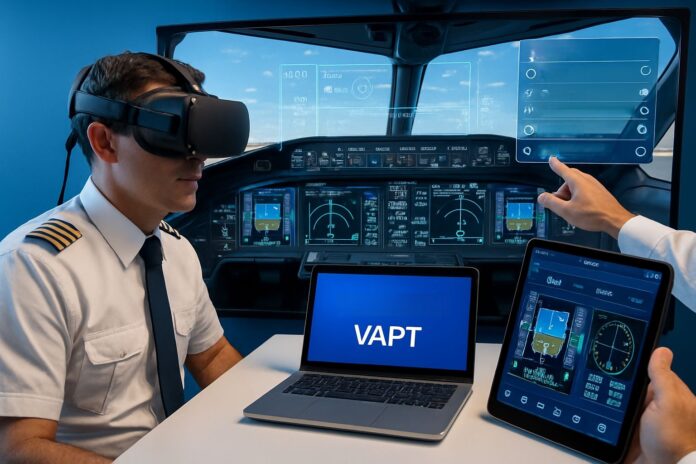

Article-At-A-Glance
- Boeing’s Virtual Airplane Procedures Trainer (VAPT) is a major leap forward in how pilots train, using immersive 3D simulation powered by Microsoft Azure and Microsoft Flight Simulator.
- VAPT allows pilots to practice flows and checklists on a laptop or tablet — outside of costly, time-limited physical simulator sessions.
- The platform is currently available for the Boeing 737 MAX, with additional aircraft models set to follow.
- Boeing CEO Chris Raymond has called this a turning point in pilot training flexibility and aviation safety outcomes.
- There’s one key difference between VAPT and traditional simulators that changes everything about how airlines can now scale their training programs — keep reading to find out what it is.
Boeing Just Changed Pilot Training Forever
Pilot training has always been expensive, logistically complex, and bottlenecked by limited simulator availability — but Boeing just disrupted that model entirely. At the European Aviation Training Summit in Cascais, Portugal, on November 6, 2025, Boeing announced the launch of the Virtual Airplane Procedures Trainer (VAPT), a platform that brings immersive, accessible flight training directly to a laptop or tablet.
This isn’t just a software update. It’s a fundamental rethinking of when and where pilot training happens. For airlines managing hundreds of pilots across multiple time zones and aircraft types, that kind of flexibility isn’t a nice-to-have — it’s operationally transformative. Platforms like Boeing’s Virtual Airplane suite represent the kind of innovation the aviation industry has needed for years.
What the Virtual Airplane Procedures Trainer Actually Does
VAPT gives flight crews access to highly accurate 3D simulations of Boeing aircraft so they can rehearse cockpit flows, run through checklists, and build procedural muscle memory before they ever sit down in a full-motion simulator. Think of it as structured, repeatable cockpit familiarity training — available on demand, without booking simulator time weeks in advance.
“We’re very excited about the launch of Virtual Airplane. This new software will significantly impact how and when pilots and operators train and will provide them with much needed flexibility.”
— Chris Raymond, Chief Executive Officer of Boeing Global Services
That quote from Raymond cuts to the heart of what VAPT solves. Traditional training pipelines are rigid. VAPT makes them adaptive — a critical advantage in an industry where pilot training shortages and simulator slot scarcity are ongoing pressure points.
Why This Launch Matters for Aviation Safety
More practice opportunities directly correlate with better procedural recall under pressure. When pilots can run through emergency flows and normal checklists repeatedly on their own device, they arrive at the physical simulator session already familiar with the cockpit layout and sequence of actions. That familiarity frees up simulator time for higher-complexity scenario training — the kind that actually stress-tests decision-making.
What Is the Virtual Airplane Procedures Trainer (VAPT)?
The Virtual Airplane Procedures Trainer is Boeing’s latest digital training product, unveiled at the European Aviation Training Summit. It is a procedures trainer built to run on standard consumer hardware — laptops and tablets — making it one of the most accessible high-fidelity pilot training tools ever released by a major airframe manufacturer.
The platform was developed in partnership with Microsoft, leveraging two of Microsoft’s most powerful platforms to deliver its core experience. It is not a toy or a stripped-down version of simulation. The 3D aircraft environments are described as highly accurate representations of actual Boeing aircraft interiors, built specifically to support procedural learning.
What separates VAPT from general aviation apps or consumer flight simulators is its purpose-built focus on procedures. This is not about flying from point A to point B. It is about learning the exact sequence of cockpit actions that pilots must execute safely and consistently on every flight.
| Feature | Traditional Simulator | Boeing VAPT |
|---|---|---|
| Hardware Required | Full-motion sim bay | Laptop or tablet |
| Availability | Scheduled slots only | On demand, anytime |
| Primary Use | Full scenario training | Flows, checklists, familiarity |
| Cost Per Session | High | Significantly lower |
| Current Aircraft | Multiple types | Boeing 737 MAX (expanding) |
Powered by Microsoft Azure and Microsoft Flight Simulator
VAPT runs on Microsoft Azure for its cloud infrastructure and uses Microsoft Flight Simulator as the visual and environmental simulation engine. Microsoft Flight Simulator has been the benchmark in realistic flight environment modeling since the 1980s — over four decades of continuous development that Boeing is now putting directly in the hands of commercial flight training organizations.
Available on Computers and iPad for Boeing 737 MAX
At launch, VAPT is available for the Boeing 737 MAX, one of the most widely operated narrowbody jets in commercial aviation. The platform runs on both laptop computers and tablets, meaning a pilot can access a fully rendered 737 MAX cockpit from a hotel room the night before a simulator session.
That kind of pre-training preparation changes the calculus for training departments. Instead of arriving at a simulator cold, pilots show up already familiar with cockpit geography and procedural sequences. Simulator time then gets used more efficiently — which directly reduces training costs at scale.
Expansion to additional aircraft types is already planned, which signals Boeing’s intention to make VAPT a platform-wide training solution rather than a single-aircraft product.
How Pilots Use It to Practice Flows and Checklists
Inside VAPT, pilots interact with a highly accurate 3D representation of the 737 MAX cockpit. They can work through normal procedures — like pre-flight flows, engine start sequences, and approach checklists — in a self-paced, repeatable environment. The goal is procedural automation: the kind of deep familiarity that makes checklist execution reliable even under stress.
Key Features of Boeing’s Virtual Airplane Platform
What makes VAPT more than just another digital training tool is the combination of fidelity, flexibility, and focus it brings to the table. Each design decision points back to one objective: giving pilots more quality reps before they enter the simulator. For those interested in how innovative flight schools are embracing technology, the Diamond DA40 offers a great example.
The platform is described as immersive, accessible, and customizable — three qualities that address the three biggest pain points in traditional pilot training pipelines. Immersive means the simulation environment is realistic enough to build genuine procedural memory. Accessible means pilots can use it without specialized hardware. Customizable means airlines and training organizations can tailor the experience to their specific operational needs. For more details, check out Boeing’s launch of virtual airplane training tools.
- Highly accurate 3D cockpit environments modeled directly from Boeing aircraft data
- Laptop and tablet compatibility with no specialized hardware required
- On-demand access removing the dependency on simulator scheduling
- Customizable training content for both individual pilots and organizational training programs
- Powered by Microsoft Azure for reliable cloud delivery at scale
- Built on Microsoft Flight Simulator for proven, high-fidelity visual environments
1. Highly Accurate 3D Aircraft Simulations
The 3D cockpit environments inside VAPT are built to reflect the actual Boeing aircraft they represent — not approximations. This level of fidelity matters because procedural memory is spatial. Pilots need to know exactly where a switch is, what it looks like, and what feedback they receive when they activate it. A low-fidelity environment builds habits that have to be unlearned in the real aircraft. VAPT is designed to build habits that transfer directly.
2. Flexible Access on Laptop and Tablet Devices
One of the most operationally significant aspects of VAPT is that it requires no specialized hardware. A pilot needs nothing more than a laptop or tablet to access a fully rendered Boeing 737 MAX cockpit. This removes one of the most persistent barriers in aviation training — the requirement to be physically present at a training center with simulator availability. A first officer on a layover in Singapore can run through approach checklists the same way a captain in Chicago can prep for a recurrent training session.
3. Customizable Lessons for Individual and Organizational Needs
VAPT is not a one-size-fits-all training module. The platform is built to be customizable at both the individual pilot level and the organizational level, giving flight training departments the ability to align the tool with their specific standard operating procedures, regulatory requirements, and fleet-specific configurations.
This is particularly valuable for airlines that operate modified or regionally configured variants of the 737 MAX. Rather than working through generic procedural sequences, training departments can shape the content to reflect exactly what their pilots will encounter in the cockpit. That alignment between simulation and operational reality is what separates useful training from checkbox training.
4. Real-World Scenario Modeling Including Weather and Air Traffic Control
Powered by Microsoft Flight Simulator’s mature environment engine, VAPT can replicate realistic atmospheric conditions, visibility constraints, and air traffic control interactions that pilots encounter in actual operations. Training in variable conditions — crosswind approaches, low-visibility procedures, high-traffic departure sequences — builds the kind of adaptive decision-making that rote checklist repetition alone cannot develop.
This scenario depth pushes VAPT beyond a simple procedures trainer and into a more complete pre-simulator preparation tool. When pilots have already mentally rehearsed how weather variables affect their flows and callouts, they use physical simulator time to refine rather than discover — a meaningful shift in training efficiency.
How VAPT Fits Into Traditional Pilot Training
VAPT is not designed to replace the full-motion flight simulator. It is designed to make every hour spent in that simulator count more. Understanding where VAPT sits in the training pipeline is essential to understanding why Boeing’s approach here is strategically sound rather than simply technologically impressive.
Professional pilot training follows a structured progression: ground school, computer-based training, fixed-base simulator sessions, full-motion Level D simulator sessions, and finally line flying under supervision. VAPT inserts itself between ground school and simulator sessions as a high-fidelity procedural rehearsal layer — one that was previously either absent or filled by lower-quality tools.
The Role of Physical Simulators Before VAPT
Full-motion Level D flight simulators are the gold standard of pilot training — and also among the most expensive and logistically complex training assets in aviation. A single simulator session can cost thousands of dollars per hour when facility, instructor, and equipment costs are factored in. Slots are booked weeks in advance, and any time spent in the simulator relearning cockpit layout or basic flow sequences is time not spent on the complex scenarios that actually require that level of fidelity.
How Virtual Training Bridges the Gap Before Full Simulator Sessions
VAPT fills the preparation gap by giving pilots structured, repeatable access to cockpit procedures before they ever step into a Level D simulator. A pilot who has already run through engine start flows, taxi procedures, and approach checklists dozens of times in VAPT arrives at their simulator session with a foundation already built. Instructors can move faster, cover more ground, and focus on higher-order decision-making — which is exactly where simulator time delivers its greatest return.
The Business Case for Virtual Pilot Training
Aviation training organizations are operating under significant pressure. Global pilot demand continues to grow, training pipelines are already stretched thin, and simulator availability remains a chronic constraint. VAPT addresses all three pressure points simultaneously by reducing the procedural preparation burden that currently consumes expensive simulator time.
Cost Reduction Through Standardized Digital Training
When airlines can standardize procedural training through a digital platform like VAPT, they reduce variability in pilot preparation, shorten the time needed in costly simulator sessions, and create a consistent baseline across their entire fleet operation. For large carriers operating hundreds of 737 MAX aircraft, that standardization translates directly into measurable cost savings at scale. The upfront investment in a platform like VAPT is offset rapidly when compared against the per-hour cost of full-motion simulator sessions it effectively replaces or shortens. For those interested in how innovative flight schools are adapting, the Diamond DA40 is a noteworthy example.
What Chris Raymond Said About Boeing’s Digital Innovation Commitment
Boeing Global Services CEO Chris Raymond made Boeing’s position clear at the European Aviation Training Summit: “This new software will significantly impact how and when pilots and operators train, providing them with much-needed flexibility. Virtual Airplane underscores Boeing’s enduring commitment to enhancing aviation safety and improving training outcomes.” That language — safety and training outcomes — is deliberate. Boeing is not positioning VAPT as a cost-cutting tool. It is positioning it as a safety-enhancing one, which carries significantly more weight with regulators, airlines, and the flying public.
Microsoft Flight Simulator’s Four-Decade Foundation
Since its original release in the early 1980s, Microsoft Flight Simulator has been the benchmark for realistic flight environment simulation. Over four decades, the platform evolved from a basic desktop flying program into a sophisticated simulation engine capable of replicating global terrain, real-time weather systems, and detailed aircraft systems modeling. That deep technical foundation is precisely what Boeing chose to build VAPT on top of — not because it was convenient, but because the fidelity and reliability of the Microsoft Flight Simulator engine is already proven at a standard that professional aviation training demands.
What Comes Next for Boeing’s Virtual Training Suite
The launch of VAPT at the European Aviation Training Summit was not a one-off product announcement. It was the opening move in what Boeing is calling the Virtual Airplane product suite — a broader family of digital training tools designed to modernize every layer of pilot preparation. The 737 MAX is the starting point, but the roadmap extends well beyond a single aircraft type.
Expansion Beyond the Boeing 737 MAX
At launch, VAPT supports the Boeing 737 MAX, but Boeing has confirmed that additional aircraft simulators are coming. This expansion matters enormously for airlines that operate mixed fleets. A carrier running both 737 MAX and 787 Dreamliner operations, for example, could eventually standardize its pre-simulator preparation across both fleets using a single platform — same interface, same training philosophy, different cockpit environments. That kind of fleet-wide consistency is exactly what large training departments are looking for. For more details on Boeing’s innovative training tools, you can read about their next-generation training tools.
Boeing’s Broader Push Into Digital Aviation Services
VAPT sits within Boeing Global Services’ growing digital training portfolio. Boeing has been steadily building out its services business as a strategic counterweight to the cyclical pressures of aircraft manufacturing. Digital training tools represent a recurring revenue stream that scales with fleet size — every new 737 MAX delivered to an airline is also a potential new VAPT user license. That business model alignment gives Boeing strong commercial incentive to invest deeply in making VAPT genuinely excellent rather than merely adequate.
The partnership with Microsoft Azure also signals Boeing’s long-term infrastructure intentions. Cloud-delivered training means Boeing can push updates, new aircraft modules, and enhanced scenario content to users globally without requiring any hardware changes on the airline’s end. As regulatory requirements evolve and new procedures are introduced, VAPT can be updated centrally and deployed instantly — a significant operational advantage over legacy training software that requires manual updates at each training center.
Boeing’s VAPT Is a Turning Point, Not Just a New Tool
The release of the Virtual Airplane Procedures Trainer marks a genuine inflection point in commercial pilot training. For decades, the industry operated on the assumption that high-fidelity training required expensive, facility-bound hardware. VAPT dismantles that assumption. By putting a procedurally accurate, Microsoft-powered Boeing 737 MAX cockpit on a tablet, Boeing has fundamentally changed what’s possible between ground school and the simulator bay. The pilots who train with it will arrive better prepared. The airlines that deploy it will run more efficient training programs. And the passengers on those aircraft will benefit from flight crews who have had more quality repetitions of the procedures that matter most. That is not a marginal improvement — it is a structural shift in how aviation training works.
Frequently Asked Questions
Here are answers to the most common questions about Boeing’s Virtual Airplane Procedures Trainer and how it fits into modern pilot training.
What is Boeing’s Virtual Airplane Procedures Trainer?
The Virtual Airplane Procedures Trainer (VAPT) is a digital pilot training platform developed by Boeing and powered by Microsoft Azure and Microsoft Flight Simulator. It provides flight crews with access to highly accurate 3D simulations of Boeing aircraft cockpits, allowing pilots to practice flows, checklists, and procedural sequences on a laptop or tablet — outside of traditional simulator environments. It was unveiled at the European Aviation Training Summit in Cascais, Portugal, in November 2025. For a deeper understanding of the importance of training aircraft, you might want to explore why the Piper PA-28 is the top choice for flight training schools.
What devices is the VAPT available on?
VAPT is designed to run on standard consumer hardware, specifically laptop computers and tablets. No specialized simulation hardware, motion platforms, or dedicated training facility equipment is required. A pilot can access the full VAPT cockpit environment from any location with an internet connection, making it one of the most accessible high-fidelity training tools available in commercial aviation today.
Which aircraft models does VAPT currently support?
- Boeing 737 MAX — available at launch
- Additional Boeing aircraft types — confirmed as coming soon, with no specific models or release dates announced at time of launch
The 737 MAX was the logical starting point given its status as one of the most widely operated narrowbody jets in the global commercial fleet. Airlines operating the 737 MAX can begin integrating VAPT into their training pipelines immediately, while Boeing works to expand the platform to cover additional aircraft types.
The phased rollout approach also allows Boeing to refine the platform based on real-world user feedback from 737 MAX operators before scaling the technology across a broader range of cockpit environments. That iterative development process is standard practice for enterprise software platforms and suggests Boeing is treating VAPT as a long-term product investment rather than a single release.
As additional aircraft modules are confirmed and released, airlines running mixed Boeing fleets will be able to standardize their pre-simulator training across multiple aircraft types within a single platform — reducing administrative complexity and improving training consistency across the board.
How does VAPT differ from a traditional flight simulator?
A traditional full-motion Level D flight simulator replicates the complete physical experience of flying an aircraft — motion cues, hydraulic systems, instructor-controlled failure scenarios, and regulatory-approved evaluation environments. VAPT is not designed to replicate that. Instead, it focuses specifically on procedural familiarization — giving pilots repeatable, on-demand access to cockpit flows and checklist practice before they enter the physical simulator. The two tools work together: VAPT handles preparation, the Level D simulator handles complex scenario training and certification. The result is more efficient use of expensive simulator time and better-prepared pilots at every stage of training.
Who developed the technology behind Boeing’s Virtual Airplane platform?
VAPT was developed by Boeing Global Services in partnership with Microsoft, using two core Microsoft technologies: Microsoft Azure for cloud infrastructure and delivery, and Microsoft Flight Simulator for the 3D cockpit visualization and environmental simulation engine.
Microsoft Flight Simulator brings over four decades of continuous development to the platform — a simulation engine that has been refined since the early 1980s into one of the most realistic flight environment tools available anywhere. Boeing selected this foundation specifically because its fidelity and reliability meet the rigorous standards that professional aviation training demands.
If you’re looking to stay at the forefront of aviation training innovation, Boeing’s Virtual Airplane platform is setting the new standard for how pilots prepare before they ever step into a simulator.