
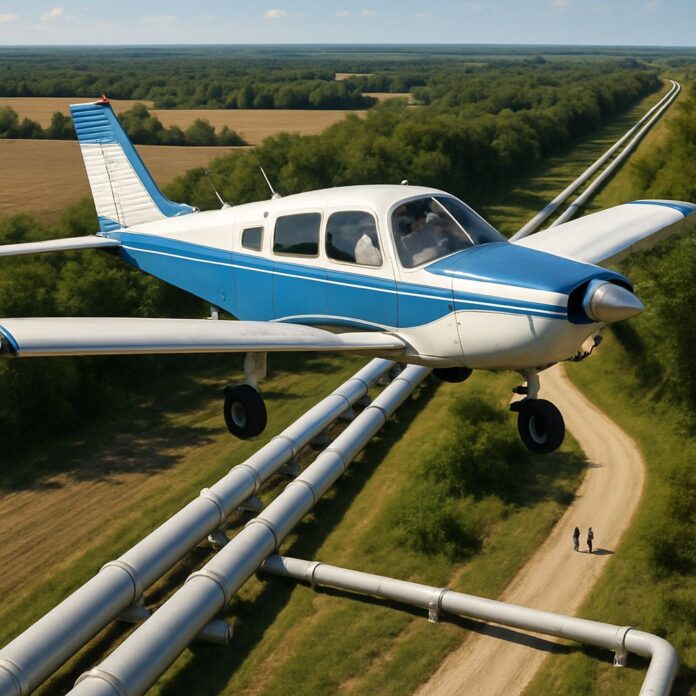

- The Piper PA-28 Cherokee is one of the most cost-effective aircraft for aerial pipeline inspection, combining low operating costs with reliable performance on long patrol routes.
- Pipeline patrol pilots typically fly at 300–500 feet AGL at reduced cruise speeds to maximize visual coverage of the pipeline corridor.
- The PA-28’s Lycoming O-360 engine has a 2,000-hour TBO, making it one of the most dependable powerplants for repetitive, low-altitude patrol work.
- Aerial inspections can cover vastly more pipeline distance per hour than ground crews — a critical efficiency advantage for operators managing hundreds of miles of infrastructure.
- There’s a specific piece of equipment that pipeline inspection operators frequently add to the PA-28 that dramatically improves detection accuracy — covered below.
Aerial pipeline inspection is one of those aviation jobs that demands exactly the kind of aircraft most pilots already know and trust.
The Piper PA-28 Cherokee has quietly become a go-to platform for pipeline patrol operations across the United States and beyond. Its combination of low operating costs, stable low-speed handling, and a roomy cabin with excellent downward visibility makes it a practical workhorse for operators who need to cover hundreds of miles of pipeline corridor efficiently. For those in the aviation services industry, understanding how general aviation aircraft like the PA-28 fit into critical infrastructure inspection is becoming increasingly important as pipeline operators look to reduce costs without sacrificing safety coverage.
Why the PA-28 Cherokee Works So Well for Pipeline Inspections
Not every aircraft can do this job well. Pipeline patrol flying is a unique discipline that sits somewhere between utility flying and aerial survey work. The aircraft needs to fly slowly, hold altitude consistently at low levels, burn fuel efficiently over long patrol legs, and give the pilot or observer a clear, unobstructed view of the ground below. The PA-28 ticks every one of those boxes.
Low-Speed Stability Makes It Ideal for Low-Altitude Surveys
The PA-28’s rectangular “Hershey bar” wing — designed by John Thorp and aeronautical engineer Fred Weick — produces exceptionally predictable stall characteristics. This matters more than most people realize during pipeline patrol work. When a pilot needs to slow down to get a second look at a suspicious area along the right-of-way, the Cherokee doesn’t punish them with unpredictable handling. It simply slows down and flies.
The wing’s constant chord design generates a gentle, progressive stall that begins at the root and moves outward, keeping the ailerons effective right up to the break. For low-altitude maneuvering in turbulent conditions — common when flying low over terrain on hot summer days — that predictability is not just convenient, it’s a genuine safety feature.
The Lycoming O-360 Engine: Reliable Enough for Long Patrol Routes
The Lycoming O-360-A1A powering the PA-28-180 carries a Time Between Overhaul (TBO) of 2,000 hours. For pipeline patrol operators running aircraft five days a week, that translates directly into lower per-hour maintenance costs and fewer unexpected groundings. This engine has earned a reputation in general aviation as one of the most robust four-cylinder powerplants ever built, and its track record in repetitive, low-altitude patrol operations backs that claim up.
Fuel Efficiency Compared to Larger Patrol Aircraft
Operators who run turbine-powered aircraft or larger piston twins for pipeline work face significantly higher fuel and maintenance bills per flight hour. The PA-28-180 burns approximately 9–10 gallons per hour at normal cruise power settings, compared to twin-engine alternatives that can consume 16–25 gallons per hour combined. Over a full week of patrol flying, that difference adds up to thousands of dollars in saved operating costs — without any meaningful reduction in coverage capability on the types of routes the Cherokee is suited for.
How Pipeline Inspections Are Conducted from the Air
Aerial pipeline inspection isn’t just flying over a line on a map. It’s a structured, methodical process governed by both aviation regulations and pipeline safety requirements. A trained patrol pilot follows the pipeline corridor at a precisely controlled altitude and airspeed, systematically scanning the right-of-way for anything that shouldn’t be there.
What Pilots Look for During a Pipeline Patrol Flight
The list of anomalies a pipeline patrol pilot is trained to identify is longer than most people expect. During each pass over the pipeline corridor, the pilot or a dedicated observer is scanning for:
- Ground disturbances, excavation activity, or construction encroachments near the pipeline
- Discoloration of soil or vegetation that may indicate a gas leak or product release
- Dead or dying vegetation in a linear pattern along the pipeline route
- Exposed pipe sections caused by erosion, flooding, or land movement
- Unauthorized third-party activity including digging, drilling, or heavy equipment operation
- Pipeline markers that are damaged, missing, or obscured
- Evidence of flooding, washouts, or geotechnical movement affecting the right-of-way
Each of these indicators has a specific reporting protocol, and pilots are trained to document locations using GPS coordinates so that ground crews can respond quickly and precisely.
Typical Altitude and Speed Range for Effective Inspections
Most pipeline patrol operations are flown between 300 and 500 feet AGL (Above Ground Level), with airspeed typically reduced to between 90 and 110 knots depending on terrain and visibility conditions. At these parameters, the PA-28 Cherokee is in its element — stable, controllable, and delivering a clear field of view directly below and to either side of the fuselage through its large cabin windows.
Flying higher reduces the ability to detect ground-level anomalies, while flying lower introduces terrain clearance risks especially in rolling or heavily wooded areas. The 300–500 foot band has become the operational standard because it balances detection effectiveness with a manageable safety margin.
How Findings Are Reported and Acted Upon
When a pilot identifies an anomaly, the reporting process kicks in immediately. Most operators use a standardized aerial patrol report form that captures the GPS coordinates, time of observation, nature of the finding, and a severity classification. Critical findings — such as active leaks, unauthorized excavation directly over the pipeline, or exposed pipe — trigger an immediate ground response, often within hours of the aerial observation.
Non-critical findings are logged and passed to the pipeline operator’s integrity management team for scheduling follow-up inspection. The PA-28’s GPS-equipped cockpit makes precise location reporting straightforward, and many operators now equip their patrol aircraft with digital reporting tablets that allow pilots to file observations in real time during the flight.
The PA-28 Cherokee’s Key Specs That Matter for This Role
When evaluating any aircraft for pipeline patrol work, raw performance numbers tell only part of the story. What matters operationally is how those numbers translate into real-world patrol capability — how far the aircraft can fly on a single fuel load, how slow it can cruise without becoming a handling challenge, and how well the pilot can actually see what’s beneath the aircraft. For a comparison of stability and performance in aviation, see how the Cessna 172 Skyhawk performs in precision mapping.
The PA-28 delivers on each of these dimensions in ways that are directly relevant to pipeline inspection operations. Its specifications aren’t flashy, but they are consistently practical for the mission profile that pipeline patrol demands day after day.
Below is a breakdown of the key performance figures for the PA-28-180 Cherokee, the variant most commonly used in pipeline patrol roles:
| Specification | PA-28-180 Cherokee | Relevance to Pipeline Patrol |
|---|---|---|
| Cruise Speed | 122 knots (140 mph) | Covers ground efficiently between patrol segments |
| Stall Speed (flaps down) | 49 knots (56 mph) | Wide slow-flight envelope for close observation passes |
| Range | 465 nautical miles | Handles long pipeline routes with fewer fuel stops |
| Fuel Burn | ~9–10 GPH at cruise | Low operating cost per patrol hour |
| Engine TBO | 2,000 hours (Lycoming O-360) | Minimal maintenance interruption to patrol schedules |
| Useful Load | Approx. 1,000 lbs | Accommodates pilot, observer, and patrol equipment |
| Cabin Width | 43 inches | Comfortable side-by-side seating for pilot and observer |
Cruise Speed and Range for Extended Patrol Routes
A cruise speed of 122 knots and a range of 465 nautical miles mean the PA-28-180 can cover substantial pipeline segments in a single flight. For operators managing 200–300 mile pipeline corridors, this often translates to a complete route inspection in a single sortie with one fuel stop or none at all, depending on the routing and wind conditions.
That range also provides meaningful reserve fuel when the patrol route requires extended time at reduced airspeed over areas of interest. A pilot who spends an extra 20 minutes orbiting a suspicious ground disturbance isn’t immediately compromising their fuel safety margins — the Cherokee’s efficient fuel burn gives them the operational flexibility to do their job thoroughly.
Visibility from the Cockpit: The Cherokee’s Wide Cabin Windows
The PA-28’s side cabin windows extend low into the door panel, giving both the pilot and right-seat observer a direct downward sightline to the terrain below — something that high-wing designs like the Cessna 172 paradoxically struggle with due to the wing blocking the view directly beneath the aircraft. For pipeline patrol work, where the observer needs to look straight down at the right-of-way, this low-wing visibility advantage is a genuine operational benefit that pilots in the field consistently cite as a key reason they prefer the Cherokee for this role.
Aerial Pipeline Inspection vs. Ground-Based Inspection
Ground patrols and aerial patrols are not competing methods — they’re complementary. But understanding where each method excels helps pipeline operators allocate their inspection resources efficiently. Aerial inspection with an aircraft like the PA-28 handles broad area coverage and rapid anomaly detection. Ground teams handle the detailed close-up work that follows.
Cost Differences Between Aerial and Ground Patrol Methods
A typical aerial pipeline patrol in a PA-28 Cherokee operates at a total cost of roughly $150–$250 per flight hour when factoring in fuel, maintenance reserves, insurance, and pilot costs. A ground patrol crew covering the same corridor requires vehicles, multiple personnel, and significantly more time — often making the per-mile cost of ground patrol considerably higher for long, accessible pipeline segments. For operators managing hundreds of miles of right-of-way, the economics of aerial patrol are difficult to argue against.
Coverage Speed: How Much Ground an Aircraft Can Cover vs. a Ground Crew
This is where aerial inspection creates an almost unfair comparison. A PA-28 cruising at 100 knots along a pipeline corridor covers approximately 115 miles per hour of actual ground distance. A ground patrol vehicle, navigating access roads, terrain obstacles, and right-of-way gates, might realistically cover 15–25 miles in the same timeframe. For initial threat detection and routine monitoring, the speed advantage of aerial patrol is the single most compelling argument for using aircraft like the Cherokee in pipeline integrity programs.
Limitations of Aerial Inspections That Ground Teams Still Handle
Aerial inspections have real limitations that no amount of pilot skill or equipment can fully overcome. Vegetation canopy can obscure ground-level detail, precise measurement of erosion depth or pipe exposure requires boots on the ground, and certain regulatory inspection requirements specifically mandate physical contact inspection of pipeline components. Ground teams also handle valve inspections, cathodic protection testing, and any remediation work that follows an aerial finding. The PA-28 finds the problem — the ground crew fixes it.
Regulatory Requirements for Aerial Pipeline Inspection in the U.S.
Operating a pipeline patrol aircraft in the United States means navigating two separate regulatory frameworks simultaneously. The FAA governs everything about the flight itself — aircraft airworthiness, pilot certification, airspace authorization, and minimum safe altitudes. The Pipeline and Hazardous Materials Safety Administration (PHMSA) governs the inspection requirements from the pipeline safety side, including patrol frequency, documentation standards, and what constitutes an acceptable inspection method.
These two frameworks overlap in important ways that pipeline patrol operators must understand before putting an aircraft on a patrol contract. FAA regulations under 14 CFR Part 91.119 establish minimum safe altitudes over populated and unpopulated areas, but also include a specific exemption allowing flights below those minimums when necessary for pipeline patrol operations — provided the flight can be conducted without hazard to persons or property on the surface. This exemption is what legally enables the 300–500 foot AGL patrol altitudes that make aerial inspection effective in the first place.
FAA Rules Governing Low-Altitude Patrol Flights
Under 14 CFR Part 91.119, aircraft must maintain a minimum altitude of 500 feet over uncongested areas and 1,000 feet over congested areas. However, the FAA provides a specific operational exception for aircraft engaged in pipeline patrol work. This exception allows pilots to descend below standard minimums when the operation can be conducted without creating a hazard to persons or property on the surface — which is precisely how professional pipeline patrol pilots operate every day in the PA-28 Cherokee.
Pilots conducting aerial pipeline patrol must hold at minimum a Private Pilot Certificate with an appropriate category and class rating for the aircraft being flown. In practice, most pipeline operators prefer pilots with a Commercial Certificate and meaningful low-altitude flying experience. Some operators require instrument ratings as well, particularly for routes that cross controlled airspace or require flight in marginal visual meteorological conditions. The PA-28’s straightforward systems make it accessible to pilots at various experience levels, which also keeps training and transition costs manageable for operators building out a patrol fleet.
Pipeline and Hazardous Materials Safety Administration (PHMSA) Oversight
PHMSA regulations under 49 CFR Part 192 (natural gas pipelines) and 49 CFR Part 195 (hazardous liquid pipelines) establish the minimum patrol frequency requirements for aerial and ground inspections. For transmission pipelines in Class 1 locations — lower population density areas — aerial patrols are typically required at intervals not exceeding three weeks, but not more than 26 days between inspections. In Class 3 and Class 4 locations with higher population density, patrol intervals tighten considerably. These regulatory frequencies are what drive the operational tempo of pipeline patrol flying and make consistent aircraft availability — a strength of the economical, easy-to-maintain PA-28 — a genuine business priority for operators holding pipeline inspection contracts.
The Cherokee Remains a Smart Choice for Pipeline Operators
After decades of pipeline patrol operations across North America, the PA-28 Cherokee’s position in this niche hasn’t eroded — it’s solidified. Newer aircraft have come and gone from consideration, drones have entered the conversation, and yet the Cherokee continues to show up on pipeline patrol contracts because it delivers what operators actually need: reliable coverage at a cost that makes business sense, day after day, week after week. For those interested in how the Cherokee enhances aerial experiences, enjoy exceptional sightseeing experiences in the Piper PA-28 Cherokee.
Unmanned aerial systems (UAS) are increasingly discussed as a potential replacement for manned pipeline patrol aircraft, and in certain limited applications they’re already being used. But current FAA regulations under 14 CFR Part 107 restrict most commercial drone operations to visual line-of-sight, which makes them impractical for the long linear routes that pipeline patrol demands. Beyond Visual Line of Sight (BVLOS) waivers exist but are difficult to obtain and operationally complex to execute at scale. For the foreseeable future, manned aircraft like the PA-28 Cherokee remain the practical backbone of aerial pipeline inspection in the United States.
Operational Snapshot: PA-28-180 on a Typical Pipeline Patrol Day
Route Length: 180 nautical miles of pipeline corridor
Patrol Altitude: 300–500 feet AGL
Patrol Airspeed: 95–105 knots
Total Flight Time: Approximately 2.5–3 hours including fuel stop
Fuel Consumed: ~27–30 gallons (Lycoming O-360 at patrol power settings)
Findings Documented: GPS-logged with digital or paper patrol report
Estimated Operating Cost: $375–$600 for the complete sortie. For those interested in sightseeing experiences in the Piper PA-28 Cherokee, this cost offers a great value.
Equivalent Ground Patrol Time: 2–3 full days with a two-person crew
That operational snapshot tells the whole story in practical terms. The PA-28 Cherokee compresses what would take a ground crew the better part of a week into a single morning’s flying — at a fraction of the cost, with immediate GPS-referenced documentation ready for the pipeline operator’s integrity management system.
Frequently Asked Questions
Pipeline patrol aviation is a specialized field, and questions about how it works — particularly around the PA-28 Cherokee’s specific role — come up consistently among pilots considering entering the field, pipeline operators evaluating aerial inspection programs, and aviation professionals curious about this practical application of general aviation aircraft. Here are the answers to the most common questions.
- What makes the Piper PA-28 Cherokee suitable for pipeline inspections?
- How low can a Piper PA-28 fly during a pipeline inspection?
- How often are aerial pipeline inspections required?
- Can a single pilot conduct a pipeline inspection in a PA-28 Cherokee?
- What equipment is typically added to a PA-28 for pipeline patrol work?
What Makes the Piper PA-28 Cherokee Suitable for Pipeline Inspections?
The Piper PA-28 Cherokee is suitable for pipeline inspections because it combines low operating costs, predictable low-speed handling, a reliable 2,000-hour TBO engine, and wide cabin windows that provide direct downward visibility along the pipeline corridor. Its rectangular “Hershey bar” wing produces gentle, progressive stall characteristics that make slow-flight maneuvering at low altitude both safe and manageable — a critical requirement for effective pipeline patrol work where pilots regularly need to slow down and circle areas of interest.
How Low Can a Piper PA-28 Fly During a Pipeline Inspection?
During a pipeline inspection, a Piper PA-28 can legally operate below the standard 500-foot AGL minimum established by 14 CFR Part 91.119, thanks to the FAA’s operational exception for pipeline patrol flights. In practice, most pipeline patrol operations are conducted at 300 to 500 feet AGL, which provides the detection resolution needed to identify ground anomalies while maintaining a safe terrain clearance buffer. Flights below 300 feet AGL are rare and typically only occur when specific terrain or vegetation conditions require a closer look at a confirmed area of concern.
How Often Are Aerial Pipeline Inspections Required?
The required frequency of aerial pipeline inspections depends on the pipeline classification under PHMSA regulations. The general framework breaks down as follows:
- Class 1 locations (low population density): Patrol intervals not to exceed 26 days, no more than three weeks apart on average
- Class 2 locations (moderate population density): More frequent intervals with tighter scheduling requirements
- Class 3 and Class 4 locations (higher population density/urban areas): Most frequent patrol requirements, often requiring patrols every one to two weeks
- Offshore and specialized segments: Governed by separate inspection protocols with additional requirements
These intervals are minimums — not targets. Responsible pipeline operators often schedule patrols more frequently than regulations require, particularly following severe weather events, flooding, seismic activity, or any period when third-party construction activity near the right-of-way increases the risk of pipeline interference.
For a pipeline operator managing a large transmission network, these regulatory frequencies translate into a substantial ongoing flying commitment. A 500-mile pipeline system patrolled every three weeks requires consistent aircraft availability and dependable pilot scheduling — exactly the kind of operational tempo the economical, low-maintenance PA-28 Cherokee is built to sustain without constant service interruptions.
It’s also worth noting that PHMSA allows operators to substitute alternative inspection methods in certain cases, including ground patrol and — increasingly — approved UAS operations. However, for long transmission pipelines in accessible terrain, aerial patrol with a manned aircraft remains the most efficient and widely accepted primary inspection method under current regulations.
Can a Single Pilot Conduct a Pipeline Inspection in a PA-28 Cherokee?
Yes, a single pilot can legally conduct a pipeline inspection in a PA-28 Cherokee, and some operators do run single-pilot patrol operations. However, the most effective pipeline patrol configurations use a pilot plus a dedicated observer in the right seat. The observer handles documentation, GPS logging, radio communications with the pipeline operator’s control center, and continuous visual scanning — freeing the pilot to focus entirely on flying the aircraft safely at low altitude. Single-pilot operations place a significant workload burden on one person and can compromise both detection quality and flight safety, which is why most professional pipeline patrol contracts specify a two-person crew.
What Equipment Is Typically Added to a PA-28 for Pipeline Patrol Work?
A stock PA-28 Cherokee can conduct basic visual pipeline patrol without modification, but most operators configure their patrol aircraft with a focused package of mission equipment that meaningfully improves detection capability and reporting accuracy. For enhanced flight experience and efficiency, many pilots rely on advanced tools such as ForeFlight as their ultimate electronic flight bag.
The most common additions include:
- GPS moving map display with pipeline route overlay loaded — allows the pilot to track position relative to the pipeline centerline with precision
- Digital reporting tablet or EFB (Electronic Flight Bag) — enables real-time anomaly logging with GPS-stamped coordinates and photo documentation
- Forward-looking or downward-facing camera system — provides a recorded visual record of each patrol sortie for regulatory documentation and post-flight review
- Upgraded intercom system — essential for clear crew communication during the high-workload low-altitude patrol environment
- Infrared or thermal imaging camera — increasingly used on equipped patrol aircraft to detect temperature anomalies that may indicate subsurface gas migration or product leaks not visible to the naked eye
The thermal imaging addition deserves special mention. Gas pipeline leaks, particularly natural gas, don’t always produce visible surface indicators like dead vegetation — especially in early-stage seepage events. A calibrated infrared camera mounted on the PA-28’s wing strut or fuselage can detect the subtle temperature differential created by escaping gas interacting with surface soil, dramatically improving the probability of detection on each patrol pass.