
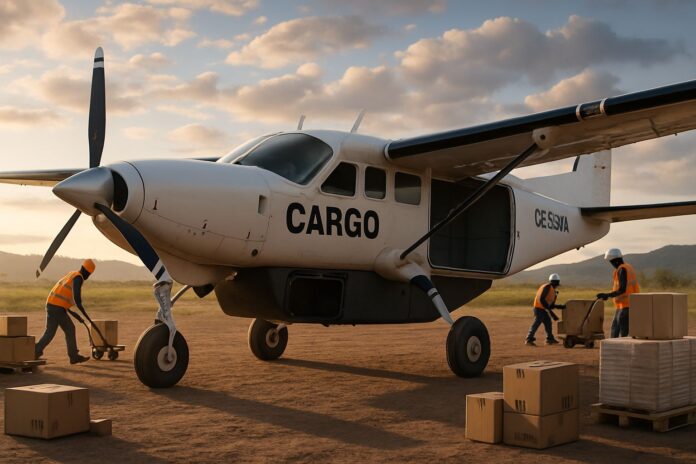

Article At A Glance: Why the Cessna 208 Caravan Dominates Regional Freight
- The Cessna 208 Caravan’s freighter configuration carries over 3,000 lbs of cargo, making it one of the most capable single-engine turboprops in regional freight.
- Its STOL capability — with a takeoff roll as short as 1,160 ft — opens up remote routes that larger cargo aircraft simply can’t access.
- The PT6A-114A turboprop engine delivers 675 shaft horsepower, balancing raw payload performance with surprisingly low operating costs.
- One often-overlooked advantage of the Caravan is how its fixed landing gear and simple airframe design dramatically cut maintenance downtime — a critical factor explored later in this article.
- The Garmin G1000 NXi avionics suite keeps freight operations safe and efficient across remote and challenging routes.
Regional freight operators looking for a reliable, cost-effective workhorse don’t have to look far — the Cessna 208 Caravan has been answering that call for decades.
Whether you’re moving time-sensitive medical supplies to a remote community or routing e-commerce cargo across secondary markets, the right aircraft changes everything. The Cessna 208 Caravan has earned its place as the go-to platform for operators who need genuine versatility without the overhead of a larger turboprop or jet. For those looking to explore available Caravan aircraft for freight operations, GlobalAir.com is a trusted resource for aircraft listings and aviation market intelligence.
The Cessna 208 Caravan Is Built for Regional Freight
The Caravan wasn’t designed as a luxury commuter that got repurposed for cargo. From the ground up, Cessna engineered this aircraft to handle demanding utility missions — and freight operations are exactly where it thrives. Its high-wing configuration, reinforced airframe, and robust undercarriage aren’t accidental design choices. They’re deliberate decisions that make the 208 uniquely suited for the physical realities of cargo transport.
What Makes It Different From Other Cargo Aircraft
Most regional cargo aircraft force operators to choose between payload and access. Larger turboprops like the Beechcraft King Air 350ER carry impressive loads but demand paved, prepared runways. Smaller piston twins offer flexible access but can’t move meaningful freight volumes. The Cessna 208 Caravan sits precisely in the gap between those two worlds — capable enough to carry serious freight, yet rugged enough to operate where the infrastructure doesn’t exist.
Its high-wing design keeps the fuselage low to the ground, which simplifies loading and unloading without ground support equipment. That matters enormously at remote strips where a forklift isn’t an option and turnaround time directly impacts profitability.
Cessna 208 Caravan vs. Common Regional Cargo Aircraft
Aircraft Max Payload Engine Type Runway Requirement Operating Cost Cessna 208 Caravan ~3,000+ lbs Single Turboprop ~1,160 ft (STOL) Low Beechcraft King Air 350ER ~3,700 lbs Twin Turboprop ~3,200 ft High Piper PA-31 Navajo ~1,400 lbs Twin Piston ~2,000 ft Moderate Pilatus PC-12 ~2,400 lbs Single Turboprop ~2,200 ft Moderate-High
The Caravan’s combination of STOL performance and meaningful payload capacity is genuinely rare in this class. That’s why operators from FedEx feeder networks to bush cargo carriers in Alaska and sub-Saharan Africa have standardized on it.
The PT6A-114A Engine: Power Behind the Payload
The Pratt & Whitney Canada PT6A-114A is the engine that makes the Cessna 208 Caravan’s freight credentials credible. Rated at 675 shaft horsepower, it delivers the torque and reliability that cargo operations demand. The PT6 family has accumulated hundreds of millions of flight hours across aviation, and the -114A variant is specifically tuned for the Caravan’s utility mission profile — meaning it handles the repeated short cycles and high-demand takeoffs that freight operations generate on a daily basis.
Key Specs That Matter for Freight Operators
- Engine: Pratt & Whitney Canada PT6A-114A, 675 SHP
- Cruise Speed: ~186 mph (162 knots)
- Maximum Range: ~1,070 nautical miles
- Useful Load (Freighter Config): Over 3,000 lbs
- Takeoff Distance (STOL): ~1,160 ft
- Max Occupants: Up to 14 (passenger config)
- Landing Gear: Fixed tricycle (low maintenance)
- Avionics: Garmin G1000 NXi
These aren’t just spec sheet numbers — each one has a direct operational implication for freight operators. The 162-knot cruise keeps schedules tight. The 1,070 nm range covers most regional freight corridors without fuel stops. And the 675 SHP engine pulls full payload loads off short strips without drama.
Cargo Capacity and Configuration Options
Flexibility is the Caravan’s defining trait, and that extends directly to how cargo is loaded, secured, and transported. Operators aren’t locked into a single mission profile — the aircraft can be reconfigured to match the freight demands of the day.
How Much Freight Can the Cessna 208 Caravan Actually Carry
In a dedicated freighter configuration, the Cessna 208 Caravan can carry over 3,000 lbs of cargo. The usable cabin volume gives operators genuine flexibility for handling mixed freight types — from dense, heavy packages to bulkier, lower-density goods. The underfloor cargo area adds additional stowage, further maximizing the aircraft’s total payload utility per flight.
Freighter vs. Combi Configuration: Which Works Best for You
The choice between a dedicated freighter setup and a combi (combination passenger/cargo) layout depends entirely on your route economics. Pure freighter configurations remove all passenger seating and install a full cargo floor liner, tie-down rings, and a cargo barrier net — maximizing usable volume and protecting the airframe from shifting loads. For those interested in enhancing aircraft interiors, Diehl Aviation offers innovative solutions that improve comfort and functionality.
Combi configurations, on the other hand, retain some passenger seating in the forward cabin while dedicating the rear section to cargo. This works well for operators serving remote communities where both people and supplies need to move on the same flight — a common scenario in Alaskan bush operations, Pacific island routes, and African regional networks.
The economics shift depending on the route. On a freight-only corridor with guaranteed volume, a full freighter configuration maximizes revenue per flight. On thinner routes where passenger revenue subsidizes cargo economics, the combi layout can make marginal routes viable that wouldn’t support a dedicated freighter.
Neither configuration requires extensive downtime to switch between — the Caravan’s interior modularity is one of its genuine operational strengths, allowing operators to adapt the aircraft as their network evolves.
Freighter vs. Combi: Quick Decision Guide
Factor Full Freighter Combi Config Max Cargo Volume ✓ Higher ✗ Reduced Passenger Revenue ✗ None ✓ Available Route Flexibility Freight-focused Mixed-use routes Remote Community Use Cargo only ✓ Ideal Interior Reconfiguration ✓ Modular ✓ Modular
The Large Cargo Door Advantage for Fast Loading
The Cessna 208 Caravan features a large cargo door on the rear left fuselage that significantly speeds up ground operations. In freight, time on the ground is money lost — and a door that allows fast, unobstructed access to the full cabin width directly impacts turnaround time at every stop on a route.
At remote airstrips without ground handlers or mechanized loading equipment, this design becomes even more valuable. A single operator can load and secure freight efficiently without needing specialized tools or multiple crew members.
- Wide opening accommodates standard freight containers and irregularly shaped cargo
- Low sill height reduces physical strain during manual loading at remote locations
- Reinforced cargo floor handles dense, concentrated loads without airframe stress
- Integrated tie-down points allow proper load securing for turbulent flight conditions
- Underfloor baggage compartment adds overflow capacity for smaller items
For operators running multi-stop freight routes — a common model in island chains, mountain regions, and remote industrial supply chains — the ability to load and depart quickly at each stop compounds into significant daily efficiency gains.
STOL Capability Opens Up More Delivery Routes
The single biggest competitive advantage the Cessna 208 Caravan holds over most regional cargo aircraft isn’t its payload or its range — it’s where it can actually go.
How a 1,160 ft Takeoff Roll Changes Your Route Options
A 1,160 ft takeoff roll doesn’t sound remarkable until you start mapping the destinations it unlocks. The vast majority of commercial turboprops need at least 2,500 to 3,500 ft of prepared runway to get airborne with a meaningful load. The Cessna 208 Caravan’s STOL performance cuts that requirement dramatically, which means operators can serve airstrips that are completely off-limits to competing aircraft in the same payload class.
In practical terms, this translates directly into route exclusivity. When your aircraft can operate from a 1,200 ft grass strip in rural Alaska, a remote mining camp in northern Canada, or a flood-affected community accessible only by a short unpaved strip, you’re not competing for that freight contract — you’re the only option. That competitive position is worth far more than any marginal speed or payload advantage on conventional routes. Learn more about the Cessna 208 Caravan and its capabilities.
Unpaved Runways, Grass Strips, and Remote Airstrips
The Caravan’s robust fixed tricycle landing gear and reinforced undercarriage aren’t just built to handle paved surfaces — they’re engineered for the punishment of repeated operations on unprepared strips. Gravel, grass, packed dirt, and even seasonal ice runways are all within the aircraft’s operating envelope, provided proper weight and density altitude calculations are applied. This is the operational reality for freight operators serving indigenous communities in northern Canada, island networks in the Pacific, and resource extraction operations across sub-Saharan Africa.
Operators running floatplane-equipped Caravan variants extend this access even further. With amphibious floats installed, the Caravan can deliver freight directly to lakeside communities, coastal villages, and waterway-accessible sites with no runway infrastructure whatsoever. The same aircraft, the same payload capability, but access to a completely different category of destination — that’s the kind of operational flexibility that defines the Caravan’s freight value proposition.
Operating Costs vs. Other Regional Freight Aircraft
Payload capacity and route access only matter if the economics work. The Cessna 208 Caravan’s operating cost profile is one of the primary reasons it has become the default platform for regional freight operators worldwide — and those cost advantages show up across fuel, maintenance, and airframe complexity in ways that compound significantly over a fleet’s operational lifespan.
Fuel Efficiency of the PT6A-114A Turboprop
The PT6A-114A burns approximately 50 to 60 gallons per hour at cruise power settings, which is highly competitive for a turboprop delivering 675 shaft horsepower and moving over 3,000 lbs of freight at 162 knots. On shorter regional freight legs — the 100 to 400 nm segments that define most Caravan operations — that fuel burn translates into a cost-per-nautical-mile figure that consistently undercuts twin-engine alternatives in the same payload category. Single-engine turboprop economics simply can’t be matched by twin-turboprop platforms when you’re operating at the regional freight scale the Caravan targets.
Maintenance Simplicity and Downtime Reduction
The PT6A engine family’s maintenance record is one of the most trusted in commercial aviation. Its reverse-flow combustion design — where air enters the rear and exhaust exits the front — keeps hot section components cooler and extends time between overhauls compared to conventional turboprop designs. For freight operators running daily cycles across multiple stops, fewer unscheduled maintenance events directly protect revenue and schedule reliability.
Beyond the engine, the Caravan’s overall airframe design philosophy prioritizes accessibility and simplicity. Inspection panels are logically placed, systems are straightforward, and the aircraft has accumulated decades of in-service experience that has produced an extensive global maintenance network. Whether you’re operating out of Anchorage, Nairobi, or Brisbane, finding certified PT6A maintenance support is rarely a problem — and that global parts and service availability is a critical operational consideration for any serious freight operator.
Fixed Landing Gear: Less Complexity, Lower Costs
Retractable landing gear systems add hydraulic complexity, additional failure points, and meaningful maintenance overhead. The Cessna 208 Caravan’s fixed tricycle gear eliminates all of that. While fixed gear does create slightly more aerodynamic drag, the tradeoff — lower acquisition cost, reduced maintenance burden, and one less system that can generate an AOG (aircraft on ground) event — makes clear economic sense for operators whose primary concern is maximizing aircraft availability across a demanding freight schedule.
Range and Speed for Time-Sensitive Freight
Regional freight is rarely forgiving on schedule. Medical supply chains, perishable goods, e-commerce last-mile deliveries, and industrial parts shipments all carry time sensitivity that makes aircraft performance directly relevant to contract performance. The Cessna 208 Caravan’s range and cruise speed combination covers most regional freight corridors without compromise.
The aircraft’s 1,070 nautical mile maximum range and 162-knot cruise speed aren’t just performance figures — they’re the parameters that determine whether a freight operator can commit to a service level agreement. On routes where schedule reliability is part of the contract, knowing your aircraft can cover the distance at a predictable speed without fuel stops is operationally significant.
1,070 nm Range: What Routes Does That Actually Cover
A 1,070 nm range puts significant regional freight corridors within direct reach. From Miami, that covers the entire Caribbean basin. From Anchorage, it connects virtually every Alaskan bush community. From Darwin in northern Australia, it reaches across the remote outback and into Papua New Guinea. That’s not theoretical range — it’s the practical operational radius that freight operators are actually using the Caravan to cover, day in and day out, in some of the most logistically challenging environments on the planet.
186 Knots Cruise Speed in Real-World Freight Operations
At 186 mph (approximately 162 knots) cruise, the Caravan moves freight faster than ground transport on any meaningful distance while keeping block times short enough to run multiple rotations per day on tighter regional routes. On a 300 nm freight leg, the difference between 162 knots and a slower piston-twin isn’t just a time saving — it’s the difference between completing two full round trips before sunset or settling for one. For operators pricing freight contracts on a per-flight basis, that daily rotation capacity is a direct revenue multiplier.
Speed also matters in the context of weather. Faster block times mean shorter exposure windows to developing weather systems on VFR routes, which is particularly relevant for bush freight operations where routing decisions are made dynamically and weather windows can close quickly. Getting freight to the destination before conditions deteriorate isn’t just an efficiency metric — it’s a safety and reliability consideration that experienced freight operators weigh carefully when selecting their aircraft platform.
Garmin G1000 NXi Avionics Keep Freight Moving Safely
Remote freight operations don’t get the luxury of ATC radar coverage, dense navigation aids, or weather reporting infrastructure that airline routes enjoy. The Garmin G1000 NXi integrated flight deck addresses this reality directly, equipping Caravan freight operators with situational awareness tools that are genuinely mission-critical in low-infrastructure environments. The G1000 NXi’s dual large-format displays replace the traditional cluster of analog instruments with a unified, intuitive interface that reduces pilot workload during demanding single-pilot freight operations — the configuration that defines most Caravan cargo missions.
Terrain Awareness and Weather Data Link for Cargo Routes
The G1000 NXi includes TAWS-B (Terrain Awareness and Warning System Class B) as a standard feature, which is not a luxury in mountainous freight corridors — it’s a necessity. When you’re flying a loaded Caravan through Alaskan mountain passes at night or navigating hilly terrain in East Africa with limited ground-based navigation infrastructure, TAWS-B provides the terrain proximity alerts that give pilots the reaction time they need. The system continuously cross-references GPS position with a terrain database and generates visual and audio warnings well before a dangerous proximity event develops.
Weather data link capability through SiriusXM Weather integration gives Caravan freight operators access to real-time weather overlay directly on the moving map display. For single-pilot freight operations on routes without weather reporting stations, the ability to see precipitation, icing conditions, and convective activity overlaid on your route in real time changes the quality of in-flight decision-making fundamentally. Pilots can identify developing weather cells, adjust routing proactively, and make go/no-go decisions with actual data rather than educated guesswork.
How Modern Avionics Reduce Risk in Remote Operations
Single-pilot freight operations in remote environments carry an inherent workload challenge — the pilot must simultaneously navigate, communicate, manage aircraft systems, and monitor weather while executing the actual flight. The G1000 NXi’s integrated architecture addresses this directly by consolidating all primary flight information, navigation data, engine monitoring, and communication management into a unified interface that minimizes head-down time and cognitive switching between instruments.
- Synthetic Vision Technology (SVT) renders a 3D terrain picture on the primary flight display, giving spatial awareness in IMC conditions or night operations over dark, featureless terrain
- GPS/WAAS navigation enables precision approach capability at airstrips without ILS infrastructure, significantly expanding all-weather operational capability
- Integrated engine monitoring tracks PT6A-114A parameters in real time, alerting pilots to developing engine anomalies before they become critical events
- Traffic Advisory System (TAS) integration improves traffic awareness on uncontrolled routes without radar coverage
- Automatic Flight Log captures flight data automatically, reducing administrative burden on single-pilot operations
For freight operators, reduced pilot workload isn’t just a safety metric — it’s an operational one. A pilot managing less cognitive load makes better decisions, catches developing problems earlier, and arrives at the destination less fatigued. On multi-leg freight days with three, four, or five stops, that accumulated workload difference is meaningful.
The G1000 NXi also supports LPV (Localizer Performance with Vertical Guidance) approaches using WAAS GPS, which effectively gives Caravan freight operators an ILS-like precision approach capability at thousands of airstrips globally that have no traditional instrument approach infrastructure. That directly translates into more consistent schedule performance in marginal weather — exactly the kind of reliability that freight customers expect and contract terms demand. Learn more about how stability meets performance in aviation technology.
The Cessna 208 Caravan Remains the Smart Choice for Regional Freight
Decades of operational history across some of the world’s most demanding freight environments have proven one thing consistently: the Cessna 208 Caravan delivers where other aircraft in its class simply can’t. It’s not the fastest regional cargo aircraft, and it’s not the highest-payload single-engine turboprop available. But no other aircraft combines STOL access, genuine freight capacity, low operating costs, proven powerplant reliability, and modern avionics capability in a single platform that operators at every scale of regional freight can actually afford to operate profitably.
The operators who standardize on the Caravan aren’t making a default choice for lack of alternatives — they’re making a deliberate decision based on route economics, maintenance support availability, pilot training resources, and the hard-won knowledge that an aircraft still earning its keep after four decades of global freight service has earned that trust for good reasons. Whether you’re building a regional freight network from scratch or expanding an existing one, the Cessna 208 Caravan is the platform that makes the math work and keeps the freight moving.
Frequently Asked Questions
Here are answers to the most common questions freight operators and aviation professionals ask about the Cessna 208 Caravan’s cargo capabilities, performance, and operational suitability.
Question Quick Answer Max cargo in freighter config? Over 3,000 lbs usable payload Can it land on unpaved runways? Yes — gravel, grass, dirt, and seasonal ice Maximum range? ~1,070 nautical miles Operating cost vs. twin turboprops? Significantly lower — single-engine economics Avionics suite? Garmin G1000 NXi with TAWS-B and WAAS GPS
The Cessna 208 Caravan’s freight credentials are backed by real-world operational data accumulated across decades of service in the world’s most demanding cargo environments — from Alaskan bush routes to Pacific island supply chains to African resource logistics networks. These aren’t theoretical capabilities. They’re documented, demonstrated, and relied upon daily by freight operators worldwide.
Understanding the specific configuration, performance parameters, and operational requirements that apply to your particular freight mission is essential before committing to any aircraft platform. The Caravan’s versatility means it fits a wide range of use cases, but matching the right configuration to your specific route network, payload requirements, and infrastructure realities will determine whether you’re extracting the aircraft’s full economic potential. For those interested in similar aircraft, the Cessna 172 Skyhawk offers stability and performance for precision mapping.
For operators currently evaluating the Cessna 208 Caravan for a freight expansion or new route development, the availability of qualified used aircraft in the current market represents a genuine opportunity to enter or scale within regional freight at a lower capital cost than new aircraft acquisition. Maintenance infrastructure, pilot training resources, and parts availability for the Caravan platform are mature and globally distributed — reducing the typical new-platform risk that operators face when standardizing on less proven aircraft types.
How much cargo can the Cessna 208 Caravan carry in freighter configuration?
In a dedicated freighter configuration, the Cessna 208 Caravan carries over 3,000 lbs of usable payload. The exact figure varies based on fuel load, crew weight, and configuration specifics, but the aircraft’s useful load in freighter trim consistently delivers meaningful cargo capacity for regional freight missions. Additional underfloor storage further extends total volume capacity for smaller items alongside the primary cabin cargo load.
Can the Cessna 208 Caravan land on unpaved or grass runways?
Yes — the Cessna 208 Caravan is specifically designed for operations on unprepared and semi-prepared surfaces. Its fixed tricycle landing gear is reinforced for the repeated stress of operations on gravel, grass, packed dirt, and seasonal ice strips. Proper weight and balance calculations and density altitude assessments are required, as they are for any aircraft operating off prepared surfaces, but the Caravan’s airframe and undercarriage are engineered to handle this operating environment routinely.
Amphibious float-equipped Caravan variants extend this capability further, enabling water landings and takeoffs that give operators access to lakeside and coastal communities with no runway infrastructure whatsoever. This dramatically expands the aircraft’s usable route network in island, river basin, and remote coastal freight environments.
What is the maximum range of the Cessna 208 Caravan for freight operations?
The Cessna 208 Caravan has a maximum range of approximately 1,070 nautical miles. In real-world freight operations with full payload loads, effective range will be reduced as fuel load is balanced against cargo weight, but the aircraft’s range envelope comfortably covers most regional freight corridors without intermediate fuel stops — a significant operational advantage on routes where fuel availability is limited or infrastructure is sparse.
How does the Cessna 208 Caravan compare in operating costs to other regional cargo aircraft?
The Cessna 208 Caravan’s single-engine turboprop configuration delivers a cost-per-flight-hour advantage over twin-turboprop alternatives in the same payload class. The PT6A-114A’s fuel burn of approximately 50 to 60 gallons per hour at cruise, combined with the airframe’s low maintenance complexity, fixed landing gear, and mature global parts and service network, produces an operating cost profile that consistently undercuts twin-engine competitors. For freight operators whose margins depend on managing cost-per-pound-carried, that difference compounds significantly across a fleet and over a full operating year.
What avionics does the Cessna 208 Caravan use for navigation in remote areas?
The Cessna 208 Caravan is equipped with the Garmin G1000 NXi integrated flight deck, which provides GPS/WAAS navigation, TAWS-B terrain awareness, SiriusXM Weather data link, Synthetic Vision Technology, and LPV precision approach capability. These systems collectively provide the situational awareness tools that remote freight operations require, where ground-based navigation infrastructure and ATC radar coverage are often absent.
The G1000 NXi’s WAAS GPS enables LPV approaches — precision instrument approaches equivalent in accuracy to a traditional ILS — at airstrips equipped with appropriate procedures but without expensive ground-based localizer and glideslope infrastructure. This is particularly valuable for freight operators serving remote communities where schedule reliability in marginal weather directly impacts their service contracts and community relationships.
For single-pilot freight operations — the standard crew configuration for most Caravan cargo missions — the G1000 NXi’s integrated architecture reduces workload by consolidating navigation, engine monitoring, weather awareness, and communication management into a unified display interface. That workload reduction translates into better decision-making across long, multi-stop freight days in demanding environments.
Overall, the Garmin G1000 NXi positions the Cessna 208 Caravan as a genuinely capable instrument platform for freight operations in low-infrastructure environments — not a basic VFR utility aircraft making do with minimal avionics, but a properly equipped working aircraft that meets the reliability and safety standards that serious freight operators and their customers demand.
If you’re ready to explore Cessna 208 Caravan listings or connect with regional freight aviation resources, GlobalAir.com provides comprehensive aircraft search tools and industry expertise to help operators make informed acquisition decisions.
The Cessna 208 Caravan is a highly versatile aircraft known for its ability to efficiently transport freight across regional distances. Its robust design and reliable performance make it a popular choice for operators looking to optimize their logistics operations. For those interested in precision mapping, the Cessna 172 Skyhawk offers another excellent option within the Cessna family.