

Article At A Glance
- Electric jetpacks and personal eVTOLs are no longer concept art — the LEO JetBike debuted at CES 2026 as a real, orderable aircraft using propeller-free electric jet propulsion.
- Anyone can fly the LEO JetBike legally without a pilot’s license thanks to FAA Part 103 ultralight rules — the same framework that’s opening up personal flight to the masses.
- The LEO JetBike builds on proven technology from LEO Flight’s LX1-R Technology Demonstrator, meaning this isn’t vaporware — it’s validated engineering in a rideable form.
- There’s a critical difference between electric jet propulsion and traditional drone-style propellers that makes this technology safer, quieter, and more practical for everyday use.
- The first 100 customers get access to the exclusive Pioneers Club — keep reading to find out what that means and whether the $1,000 deposit is worth it.
Personal flight just got real, and 2026 may be the year everything changes.
For decades, the idea of strapping into a personal aircraft and lifting off without a runway, a flight school, or a six-figure helicopter budget existed purely in the realm of science fiction. That era is ending. The convergence of electric propulsion, solid-state battery advances, and smarter regulatory frameworks has quietly built the foundation for something extraordinary — and the LEO JetBike, unveiled at CES 2026, is the most concrete proof yet that personal electric flight has arrived.
If you’re someone who has followed the eVTOL space for years, companies like LEO Flight represent the leading edge of where this industry is heading — not just building aircraft, but redefining who gets to fly them. This isn’t about licensed pilots or aerospace insiders. It’s about adventurers, commuters, and everyday people who’ve always looked up and wondered what if.
Electric Jetpacks Are No Longer Science Fiction
The shift happened faster than most people expected. Just a few years ago, personal flight demos were flashy stunts — a suited figure hovering for thirty seconds over a trade show floor before landing with a thud. Today, companies are shipping real products, taking deposits, and operating under actual FAA classifications. The technology matured quietly while the headlines stayed loud.
What changed? Three things converged at once: battery energy density finally reached a point where sustained electric flight became practical, electric motor efficiency crossed a threshold that made propeller-free ducted propulsion viable, and regulators — particularly the FAA — already had a framework ready in Part 103 ultralight rules that fit these new vehicles almost perfectly. The stars aligned, and the LEO JetBike is the result.
What Makes Electric Jet Propulsion Different From Propellers
Most personal eVTOLs you’ve seen — from the Jetson ONE to early hoverbike concepts — rely on exposed propellers or open rotors. They work, but they come with real tradeoffs: exposed spinning blades near a rider’s body, high noise output, and significant maintenance complexity. Electric jet propulsion takes a fundamentally different approach, as seen in the AE200 eVTOL aircraft.
How Electric Jet Propulsion Works
Instead of open rotor blades generating lift and thrust, electric jet propulsion uses fully ducted propulsion — the moving components are enclosed within a shroud or duct. This containment does several things simultaneously. It protects the rider from blade contact, it shapes airflow more efficiently at low speeds, and it significantly reduces the acoustic signature of the aircraft. LEO Flight validated this architecture through their LX1-R Technology Demonstrator before ever putting a rider on the JetBike, which means the propulsion system you’d be flying on has real test hours behind it — not just CAD renders.
Why Propeller-Free Flight Is a Big Deal
The safety implication alone is enormous. One of the most persistent barriers to public acceptance of personal aerial vehicles has been the visceral danger of exposed spinning rotors near human bodies. Fully ducted electric jet propulsion removes that hazard from the equation entirely. It also opens up operation in tighter environments — near structures, over crowds, in spaces where an open rotor would be an obvious liability.
Beyond safety, the ducted design changes the maintenance profile of the aircraft. Fewer exposed moving parts means fewer components subjected to environmental wear, debris ingestion, and physical damage from hard landings or minor collisions. For a vehicle aimed at non-pilot adventurers, that matters as much as the flight experience itself.
The Noise Factor
Traditional small aircraft and helicopter operations generate noise levels that make urban or suburban use essentially impossible from a community acceptance standpoint. Electric jet propulsion systems, particularly in the fully ducted configuration LEO Flight uses, produce a significantly quieter acoustic profile than open-rotor equivalents. This isn’t just a comfort feature — it’s a regulatory and social license issue that will determine where personal aircraft can actually be flown in the real world.
The LEO JetBike: Personal Flight Unveiled at CES 2026
CES 2026 was the public debut of the LEO JetBike, and it immediately stood out from the crowd of concept renders and prototype teasers that typically dominate tech showcases. This was an aircraft with completed testing, open pre-orders, and a defined delivery timeline — a level of commercial readiness that’s rare in the personal aviation space at any stage, let alone at a consumer electronics show. The innovative design of the LEO JetBike is reminiscent of the Lift + Cruise eVTOL configuration, which is shaping the future of personal flight.
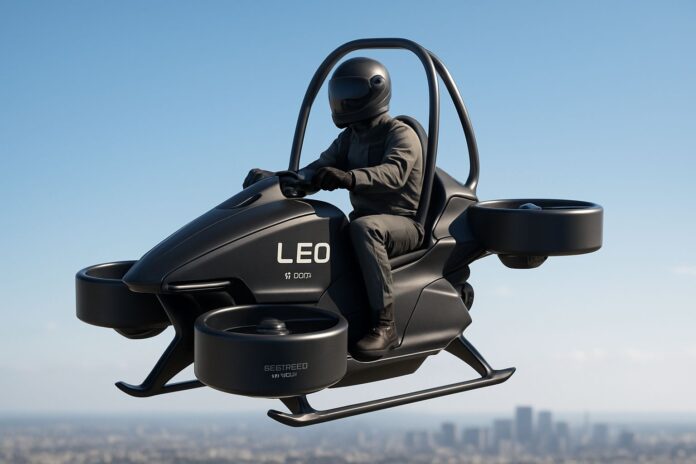
The JetBike is a single-seat electric aircraft built around LEO Flight’s proprietary electric-jet propulsion architecture. It’s designed explicitly for simplicity, targeting a wide range of pilot skill levels — including people who have never flown anything before. That accessibility-first philosophy shapes every design decision, from the intuitive controls to the electronically limited flight ceiling.
Core Specs at a Glance
- Propulsion: Propeller-free, fully ducted electric jet propulsion
- Flight altitude: Electronically limited to approximately 15 feet
- Footprint: 6.5 x 6.5 feet — fits in a standard garage bay
- Safety system: Roll-hoop safety frame for rider protection
- Charging: Home-chargeable — no special infrastructure required
- Regulatory classification: FAA Part 103 ultralight — no pilot’s license needed
- Availability: Pre-orders open; Q4 2026 delivery target
Solid-State Battery Power
The JetBike’s power system is one of its most forward-looking elements. Solid-state battery technology offers higher energy density than conventional lithium-ion cells, better thermal stability, and a longer cycle life — all critical factors for an aircraft that needs to be recharged and reused regularly by a non-technical owner. The ability to charge at home, without specialized equipment, is a deliberate design choice that removes one of the biggest practical barriers to personal aircraft ownership: infrastructure dependency.
The Roll-Hoop Safety Frame
The roll-hoop safety frame is one of those design details that tells you a company is thinking seriously about real-world use rather than just demo conditions. Borrowed conceptually from motorsport safety engineering, the roll hoop wraps around the rider to provide structural protection in the event of a tip-over, hard landing, or low-altitude incident. For a vehicle operating at 15 feet with a rider who may have zero flight experience, this isn’t an optional feature — it’s a core part of what makes the JetBike a credible consumer product rather than an extreme sport prototype.
The frame also contributes to the overall rigidity of the aircraft structure, meaning it pulls double duty as both safety equipment and chassis reinforcement. That kind of integrated engineering thinking — where a safety feature also serves a structural purpose — is exactly what you want to see in a vehicle that needs to be lightweight, strong, and survivable all at once.
Home Charging and the 6.5×6.5 Footprint
Two of the most underrated specs on the LEO JetBike are its physical footprint and its charging requirements. At 6.5 x 6.5 feet, the JetBike fits comfortably in a standard single-car garage bay — no dedicated hangar, no airport tie-down, no special storage facility required. Pair that with home charging capability and you’ve removed two of the most significant logistical barriers that have historically kept personal aircraft out of mainstream ownership. You park it, plug it in, and it’s ready for the next flight. That simplicity is intentional, and it’s a major part of what separates the JetBike’s design philosophy from earlier personal aviation concepts.
No Pilot’s License Required: FAA Part 103 Explained
This is the regulatory detail that changes everything. The LEO JetBike operates under FAA Part 103 ultralight vehicle rules, which means that in the United States, no pilot’s license, no medical certificate, and no FAA registration is required to fly one. Part 103 was originally written in 1982 to govern single-seat, slow-moving recreational aircraft, and it has become the regulatory home for a new generation of personal eVTOLs that fit within its weight and speed parameters.
It’s worth understanding what this framework actually permits — and what it doesn’t. Part 103 ultralights are restricted to daytime flight, must stay clear of congested areas and controlled airspace, and are limited to a maximum airspeed of 55 knots. The JetBike’s electronically enforced 15-foot altitude ceiling adds another layer of built-in compliance on top of the regulatory baseline. Within those boundaries, the freedom is remarkable: no license, no certification, no bureaucratic gatekeeping between you and the sky.
What FAA Part 103 Ultralight Rules Actually Mean for You
In practical terms, FAA Part 103 means you could theoretically take delivery of a LEO JetBike and fly it legally on the same day — provided you’re operating in appropriate airspace, during daylight hours, away from congested areas. There’s no written exam, no flight hours requirement, and no instructor sign-off mandated by federal regulation. LEO Flight does recommend training, and responsible operation is always the priority, but the legal barrier to entry is genuinely as low as it gets in powered aviation.
LEO JetBike vs Jetson ONE vs Pivotal Helix: Who Leads the No-License Race
The LEO JetBike isn’t the only personal eVTOL playing in the Part 103 space. The Jetson ONE, developed by Swedish company Jetson, is an open-frame single-seat octocopter that also operates under ultralight rules and has been delivering to customers since 2022 at a price point around $92,000. The Pivotal Helix takes a different physical form — a fixed-wing tilt-rotor design — but similarly targets the no-license market with a subscription-based ownership model. What sets the LEO JetBike apart from both is its propeller-free ducted jet propulsion system, which represents a meaningfully different safety and noise profile compared to the exposed rotor configurations used by Jetson and Pivotal.
| Aircraft | Propulsion Type | License Required | Altitude Limit | Price Range |
|---|---|---|---|---|
| LEO JetBike | Ducted electric jet | No (FAA Part 103) | ~15 ft (electronic limit) | TBA (deposit $1,000) |
| Jetson ONE | Open rotor octocopter | No (FAA Part 103) | Pilot-controlled | ~$92,000 |
| Pivotal Helix | Tilt-rotor fixed wing | No (FAA Part 103) | Pilot-controlled | Subscription model |
How to Get Your Hands on a LEO JetBike
Pre-orders for the LEO JetBike opened at CES 2026, and the process is straightforward. LEO Flight is accepting reservations now, with a targeted delivery window of Q4 2026 for early customers. The company has completed extensive testing and validation of the JetBike prior to launch, which means the production timeline is grounded in a vehicle that already flies — not one still being engineered around a concept.
The demand signal from the personal aviation community has been strong since the CES reveal. LEO Flight’s approach of building on their proven LX1-R Technology Demonstrator architecture rather than starting from scratch gives this timeline more credibility than many personal aircraft pre-order campaigns that have stretched years beyond their original delivery promises.
The $1,000 Deposit and Q4 2026 Delivery Timeline
Securing a reservation requires a $1,000 deposit, which places you in the delivery queue ahead of general availability. For context, this is a relatively low barrier for a personal aircraft reservation — the Jetson ONE required a significantly larger commitment at a much higher final price point. The Q4 2026 delivery target gives LEO Flight roughly three to four quarters from the CES debut to move from validated prototype to customer deliveries, a timeline that’s aggressive but not unreasonable given the testing that has already been completed.
Final pricing for the JetBike has not been publicly confirmed at the time of the CES announcement. What LEO Flight has made clear is that accessibility — both in terms of operation and ownership — is central to the product’s mission. Competitive pricing relative to other Part 103 personal aircraft in the market is an implied commitment of that positioning.
What the Pioneers Club Offers First 100 Customers
The first 100 customers to secure reservations gain entry into LEO Flight’s Pioneers Club — an exclusive group designed to give early adopters a closer relationship with the company and the product as it moves toward delivery. While LEO Flight has not published a detailed breakdown of every Pioneers Club benefit, the designation signals priority access, early communication, and likely direct involvement in the feedback loop that shapes the production version of the JetBike. For enthusiasts who want to be part of the story from the beginning rather than just purchasing a finished product, this is the entry point that matters.
The Bigger Picture: LEO Flight’s Vision Beyond the JetBike
The JetBike isn’t where LEO Flight’s ambitions stop. The company has been quietly building toward a broader personal flight ecosystem, with the LX1-R Technology Demonstrator serving as the proof-of-concept backbone for everything that follows. Their earlier work on the LEO Coupe — a more enclosed personal aerial vehicle utilizing what LEO Flight calls “Electric Jetpack Technology” — signals that the JetBike is one expression of a propulsion architecture designed to power multiple form factors. The same core electric-jet system that makes the JetBike possible can scale into faster, higher-altitude, and more enclosed personal aircraft as battery technology and regulatory frameworks continue to evolve.
What LEO Flight is really building is a blueprint for accessible personal aviation — not just a single product, but a platform. The decision to debut the JetBike under FAA Part 103, target home charging, engineer a compact footprint, and price entry at a $1,000 deposit all point to a company that understands the adoption curve for transformative technology. You don’t win the personal flight market by building the most extreme aircraft. You win it by building the one that the most people can actually use.
Personal Electric Flight Is Finally Within Reach in 2026
The gap between “theoretically possible” and “you can order one today” has finally closed. That’s the real story of 2026 in personal electric flight. The LEO JetBike isn’t a trade show prop or a crowdfunding fantasy — it’s a tested, pre-orderable aircraft with a defined delivery window, a regulatory classification, and a propulsion system that has already logged real flight hours. For anyone who has followed this space through years of promising-but-never-shipping concepts, that distinction is enormous.
The broader personal eVTOL market is moving in the same direction. Jetson ONE deliveries proved that consumers would actually buy and fly personal electric aircraft. Pivotal demonstrated that alternative form factors had a market. LEO Flight’s JetBike takes the next step by introducing a fundamentally safer propulsion architecture — propeller-free, fully ducted — into a vehicle that costs less to reserve than a motorcycle down payment. The trajectory is clear. Personal electric flight is not arriving someday. It’s here, and 2026 is the year the first wave of non-pilot adventurers will actually experience it.
Frequently Asked Questions
The personal electric flight space moves fast, and it raises a lot of legitimate questions — about safety, regulation, practicality, and how these new vehicles actually compare to each other. Here are the answers to the questions that matter most right now.
Do You Need a Pilot’s License to Fly the LEO JetBike?
No. The LEO JetBike operates under FAA Part 103 ultralight vehicle rules, which do not require a pilot’s license, medical certificate, or FAA aircraft registration in the United States. This is the same regulatory classification that governs other personal eVTOLs like the Jetson ONE.
FAA Part 103 Key Requirements:
• Single-seat vehicle only
• Daytime flight only
• Maximum airspeed of 55 knots (63 mph)
• Must avoid congested areas and controlled airspace
• No pilot’s license or medical certificate required
• No FAA registration required
• No written exam or flight hours mandated by federal regulation
The JetBike adds an additional layer of built-in compliance through its electronically enforced ~15-foot altitude ceiling, which keeps the aircraft well within the low-altitude parameters where Part 103 operations are most straightforward. LEO Flight recommends training before flying, even though it isn’t federally required — and that’s good advice worth taking seriously for any first-time pilot regardless of regulatory minimums.
How Fast and How Far Can the LEO JetBike Travel?
LEO Flight has not published a confirmed top speed or range figure for the JetBike at the time of its CES 2026 debut. What is confirmed is the electronically limited flight ceiling of approximately 15 feet and the Part 103 maximum airspeed ceiling of 55 knots, which applies as the regulatory upper boundary. Specific flight time per charge and distance per charge figures are expected to be released closer to the Q4 2026 delivery window as the production specification is finalized.
For practical context, the 15-foot altitude limit is a deliberate safety and regulatory design choice rather than a technical limitation of the propulsion system. The electric-jet architecture validated by the LX1-R demonstrator is capable of more — but for a vehicle targeting first-time flyers in an accessible consumer market, keeping the operational envelope tight and predictable is exactly the right engineering priority at launch.
What Is Electric Jet Propulsion and How Is It Different From a Drone?
Electric jet propulsion uses fully ducted propulsion systems where all moving components are enclosed within a shroud or duct — there are no exposed spinning blades. A conventional drone, by contrast, uses open rotors that spin freely and are directly exposed to the environment and anyone near the aircraft. The ducted design shapes airflow more efficiently at low speeds, dramatically reduces the risk of blade contact injury, lowers the acoustic output of the system, and reduces maintenance exposure from debris and environmental wear.
The key distinction for personal aviation is what that enclosed architecture means in practice: a rider can operate the JetBike in closer proximity to structures, vegetation, and people than would ever be safe with an open-rotor vehicle. It also changes the risk profile for incidents — a tip-over or hard landing on a propeller-free aircraft is a fundamentally different event than the same incident on a vehicle with exposed spinning rotors. LEO Flight’s electric-jet system isn’t just a different engineering choice — it’s a different safety philosophy.
When Can Customers Expect Delivery of the LEO JetBike?
LEO Flight has targeted Q4 2026 for customer deliveries, with pre-orders open now via a $1,000 reservation deposit. The first 100 customers gain entry into the Pioneers Club. Given that LEO Flight completed extensive testing and validation of the JetBike prior to the CES 2026 public debut — building on the already-proven LX1-R Technology Demonstrator architecture — the Q4 2026 timeline has a stronger foundation than many personal aircraft delivery promises that have come before it.
How Does the LEO JetBike Compare to the Jetson ONE?
The Jetson ONE is currently the most commercially proven personal eVTOL on the market, with deliveries to customers beginning in 2022 at approximately $92,000. It uses an open-frame octocopter design with eight exposed rotors, offers a pilot-controlled altitude with no electronic ceiling, and has logged more real-world consumer flight hours than any comparable vehicle. It’s a legitimate, flyable aircraft with a real track record.
The LEO JetBike differentiates itself on three primary dimensions: propulsion safety through its propeller-free ducted jet system, accessibility through its lower deposit threshold and home-charging capability, and form factor through its compact 6.5×6.5 footprint. The Jetson ONE’s open rotors are effective but carry an inherently different risk profile than fully ducted propulsion. Whether that tradeoff matters to a given buyer depends on their priorities — raw flight experience and proven delivery history versus a safer propulsion architecture and a lower barrier to entry.
The honest answer is that both vehicles are impressive achievements in personal aviation, and the competition between them — along with Pivotal, LEO Flight, and whoever comes next — is exactly what the market needs to push the technology, the pricing, and the safety standards forward. The real winner of that competition is anyone who has ever looked up at the sky and wanted in.