
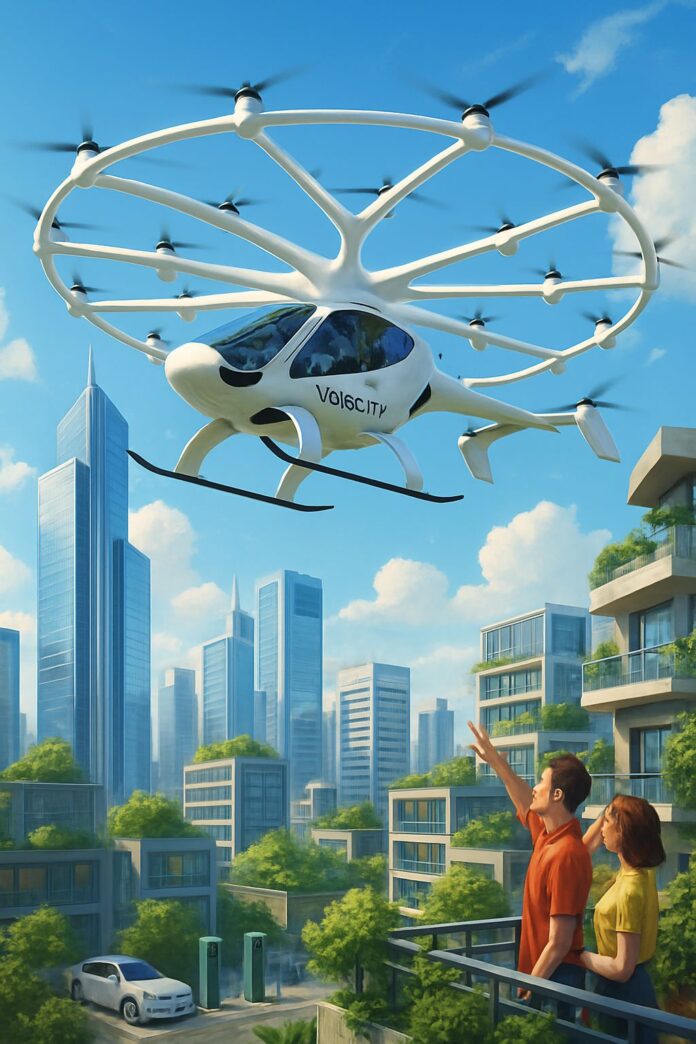

Article At A Glance
- The Volocopter VoloCity is an all-electric, 2-seat air taxi with 18 rotors that produces zero emissions and is four times quieter than a conventional helicopter.
- Every critical system on the VoloCity has at least two backups, exceeding standard aviation safety requirements set by EASA.
- With over 2,000 test flights completed, Volocopter is one of the most battle-tested electric air mobility developers in the world.
- The VoloCity is designed to connect major transport hubs like airports and train stations, cutting through city congestion entirely.
- Keep reading to find out how the VoloCity’s autonomous future could completely change how cities move people.
Urban air mobility is no longer a concept confined to science fiction — it’s being flight-tested right now, above real cities, with real passengers.
Volocopter, headquartered in Bruchsal, Germany, has been at the forefront of this shift since 2011, when it became the first company to build and fly an electric multirotor air taxi prototype. The VoloCity is the flagship result of over a decade of engineering, testing, and regulatory collaboration. Volocopter’s official platform outlines how the VoloCity is being developed to meet the rigorous standards required for commercial urban flight.
The VoloCity Is Rewriting Urban Travel
City roads are at a breaking point. Commuters in megacities lose hundreds of hours every year sitting in traffic, and traditional transit infrastructure simply cannot keep up with urban population growth. The VoloCity takes a completely different approach — it bypasses the streets entirely.
Instead of competing for space on congested roads, the VoloCity operates in the lower urban airspace, connecting key transit nodes like train stations, airports, and city centers. The result is a seamless travel experience that integrates with existing transport networks rather than replacing them.
- Flies in the lower urban airspace above street-level congestion
- Designed to link airports, train stations, and city hubs
- Runs entirely on electricity — zero direct emissions per flight
- Four times quieter than a conventional small helicopter
- Capable of vertical takeoff and landing (VTOL) without a traditional runway
This isn’t just a faster commute. It’s a fundamentally different relationship between cities and transportation infrastructure, enhancing airport security through biometric technology.
What Makes the VoloCity Different From Other Air Taxis
The electric air taxi market is growing fast, but not all aircraft are built the same. The VoloCity stands apart through a combination of radical simplicity, redundant safety engineering, and a design philosophy built entirely around urban usability.
2 Seats, 18 Rotors, and Zero Emissions
The VoloCity carries one pilot and one passenger. That’s intentional. Keeping the design focused on point-to-point urban transport means the aircraft can remain lightweight, efficient, and easier to certify. The 18-rotor configuration isn’t just for show — it’s a carefully engineered system where each rotor operates within a narrow frequency band, and together they largely cancel out each other’s noise signature.
Powered entirely by electricity, the VoloCity produces zero direct emissions during flight. The aircraft uses nine swappable battery packs, which allows ground crews to turn the aircraft around quickly between flights without lengthy recharge windows. This is a critical operational advantage for a commercial air taxi service running on tight schedules.
Built to Meet EASA’s Strict Aviation Standards
The European Aviation Safety Agency (EASA) sets some of the most rigorous aviation certification standards in the world. The VoloCity has already earned Design Organization Approval (DOA) from EASA, and Volocopter is actively working toward full Type Certification (TC). This regulatory progress is not just a formality — it’s proof that the VoloCity’s engineering holds up under intense independent scrutiny.
From Prototype to City Skies: 2,000+ Test Flights
Since the first prototype took flight in 2011, the VoloCity has accumulated over 2,000 test flights across multiple prototype iterations. Volocopter has received permits to fly in several countries, and in November 2024, the company announced a European sandbox program launching in 2026. This program, developed in partnership with ADAC Luftrettung, will simulate real-world commercial operations — including flight procedures, ground handling, and full passenger experience trials using both the VoloCity and the VoloXPro.
Safety Features That Go Beyond Requirements
When it comes to air travel, safety isn’t a selling point — it’s the baseline. The VoloCity doesn’t just meet the minimum bar. It’s engineered to exceed it at every level.
Every Critical System Has at Least Two Backups
The VoloCity features full redundancy across every critical system on board. The rotors, electric motors, batteries, avionics, and display systems each have a minimum of two independent backups. If one fails, another takes over immediately — automatically, without pilot input. This level of redundancy actually exceeds the technical requirements set by aviation certification bodies, which is a deliberate engineering choice, not a regulatory checkbox.
This fail-safe architecture means that a single point of failure cannot bring down the aircraft. For passengers boarding an air taxi for the first time, that’s not a small detail — it’s the difference between hesitation and confidence.
100+ Microprocessors Keep Every Flight Stable
Stability in an 18-rotor aircraft requires constant, real-time adjustments that no human pilot could manage manually. The VoloCity solves this with more than 100 onboard microprocessors working in unison. These processors monitor and adjust rotor performance, balance, altitude, and orientation continuously throughout each flight — making the aircraft extraordinarily stable even in challenging urban air conditions.
Intuitive Controls Make Flying Accessible
Because the microprocessor network handles the complexity of flight dynamics, the pilot interface can remain remarkably simple. Altitude, balance, and landing are all managed through intuitive, state-of-the-art assistance systems. This simplicity also reduces the risk of pilot error — one of the leading causes of accidents in conventional aviation.
The VoloCity Is Four Times Quieter Than a Helicopter
Noise pollution is one of the biggest barriers to public acceptance of urban air mobility. Nobody wants a city filled with the constant roar of helicopter blades. The VoloCity addresses this head-on with an acoustic profile that’s dramatically quieter than anything currently flying over cities.
How 18 Rotors Cancel Each Other’s Noise Out
The secret is in the rotor configuration. All 18 rotors on the VoloCity operate within a narrow, closely matched frequency range. When multiple rotors spin at similar frequencies, their sound waves interact and largely cancel each other out — a principle known as destructive interference. The result is a soft, even hum rather than the aggressive thwop-thwop of a traditional helicopter rotor.
The numbers speak clearly: the VoloCity is four times quieter than a comparable small helicopter. In dense urban environments where noise ordinances are strict and resident pushback can derail infrastructure projects entirely, this acoustic advantage isn’t just pleasant — it’s a commercial necessity.
All-Electric Power and What It Means for You
- Zero direct emissions per flight, making it compatible with urban clean air zones
- Nine swappable battery packs allow rapid ground turnaround between flights
- Electricity is both more economical and increasingly sustainable compared to aviation fuel
- Streamlined mechanical components reduce the frequency and cost of maintenance
- Lower operating costs translate to more competitive passenger pricing over time
Nine Swappable Batteries Keep Turnaround Times Fast
One of the practical challenges with electric aircraft is recharge time. The VoloCity sidesteps this problem entirely through its nine-battery swappable system. Ground crews can replace depleted battery packs with fully charged units in minutes, keeping the aircraft operational throughout the day without extended downtime. For a commercial service that depends on consistent scheduling, this is a genuine operational breakthrough. Learn more about how electric aircraft like the Piper PA-28 are transforming the aviation industry.
Lower Running Costs Compared to Fuel-Powered Aircraft
Aviation fuel is expensive, volatile in price, and subject to supply chain disruption. Electricity is none of those things. The VoloCity’s all-electric powertrain removes fuel costs from the operating equation entirely, replacing them with the far more predictable and increasingly affordable cost of electricity. As renewable energy infrastructure expands globally, the environmental and economic case for electric air taxis only strengthens.
Fewer Mechanical Parts Mean Less Maintenance
Conventional helicopters are mechanical masterpieces — and mechanical nightmares. Gearboxes, tail rotors, hydraulic systems, and complex drive trains all require constant inspection, servicing, and eventual replacement. The VoloCity eliminates most of this complexity by replacing mechanical systems with electric motors and digital control systems.
Fewer moving parts means fewer failure points. Fewer failure points means less time in the hangar and more time in the air. For operators running a fleet of air taxis across a busy city, reduced maintenance overhead is a direct contributor to profitability and service reliability.
Where the VoloCity Will Take You
The VoloCity isn’t designed for long-haul travel. It’s purpose-built for the urban middle mile — the congested, time-consuming segment of a journey that ground transport handles poorly. Think of the 45-minute taxi ride from a city center to an airport that should only take 15 minutes. That’s exactly the gap the VoloCity is built to close.
Airport and Train Station Connections in Megacities
Volocopter’s operational vision centers on connecting high-traffic transit hubs — international airports, major train stations, and business districts — with fast, direct air links. Passengers would move seamlessly from a train onto a VoloCity, fly over the city, and land directly at their departure terminal. No traffic, no transfers, no wasted time.
This hub-to-hub model also simplifies the infrastructure requirement. Rather than needing landing pads scattered across an entire city, Volocopter can concentrate its VertiPorts at a small number of high-demand locations, making the initial rollout far more manageable and cost-effective for city partners and operators alike.
Cities Already Hosting Volocopter Test Flights
Volocopter has conducted demonstration flights in Dubai, Helsinki, Singapore, and several locations across Europe. These weren’t closed-course tests — they were live demonstrations in active urban environments, designed to prove that electric air taxis can operate safely and reliably above real cities. The upcoming 2026 European sandbox program, developed with ADAC Luftrettung, will push this further by simulating full commercial operations with the VoloCity and VoloXPro side by side.
Piloted Now, Autonomous Later
Initial VoloCity flights operate with one pilot and one passenger. This phased approach is deliberate — it allows Volocopter to build public trust, accumulate real-world operational data, and satisfy regulatory requirements before transitioning to fully autonomous operations. The digital architecture already built into the VoloCity, including its 100+ microprocessors and advanced flight assistance systems, is designed with autonomy as the end goal. The pilot is there now because regulators and passengers need time to build confidence in the system, not because the technology requires one. Learn more about how Parrot is innovating in commercial UAVs and contributing to the future of autonomous flight.
As data from thousands of commercial flights accumulates and regulatory frameworks for autonomous air vehicles mature, Volocopter has a clear pathway toward removing the pilot entirely. That shift would dramatically increase the aircraft’s passenger capacity per day, reduce operating costs further, and open up entirely new service models for cities around the world.
The VoloCity Is the Air Taxi Urban Commuters Have Been Waiting For
Every design decision in the VoloCity — 18 rotors for quiet flight, swappable batteries for fast turnaround, full system redundancy for safety, and a streamlined two-seat cabin for urban efficiency — points to one conclusion: this aircraft was built specifically for the city. It’s not a helicopter adapted for urban use. It’s a ground-up rethink of what urban air mobility should look like, backed by over a decade of real-world testing and one of the most rigorous regulatory processes in aviation history. The future of city travel isn’t on the road. It’s 300 feet above it.
Frequently Asked Questions
The VoloCity generates a lot of questions — and rightfully so. It represents a category of transportation that most people have never experienced. Here are the most common questions answered directly. To learn more about this innovative air mobility solution, visit the Volocopter VoloCity page.
How many passengers can the Volocopter VoloCity carry?
The VoloCity carries one passenger plus one pilot. This two-seat configuration is intentional — it keeps the aircraft lightweight, efficient, and optimized for point-to-point urban trips rather than mass transit.
Feature VoloCity Specification Seating Capacity 1 pilot + 1 passenger Number of Rotors 18 Propulsion All-electric Battery System 9 swappable battery packs Noise Level 4x quieter than a small helicopter Onboard Processors 100+ microprocessors Test Flights Completed 2,000+ Certification Body EASA (DOA achieved, TC in progress)
As Volocopter progresses toward autonomous operations, the pilot seat will eventually free up for a second revenue-generating passenger, further improving the economics of each flight for operators.
Is the Volocopter VoloCity safe to fly in?
Yes. The VoloCity is engineered with full redundancy across every critical system — rotors, electric motors, batteries, avionics, and displays each have at least two independent backups. This redundancy architecture actually exceeds the technical safety requirements set by EASA, the European Aviation Safety Agency.
The aircraft has also completed over 2,000 test flights across multiple prototype iterations, and the VoloCity design has already earned EASA’s Design Organization Approval (DOA). Volocopter is currently working toward full Type Certification, which is the gold standard for commercial aviation safety validation.
How quiet is the VoloCity compared to a regular helicopter?
The VoloCity is four times quieter than a comparable small helicopter. This is achieved through its 18-rotor configuration, where each rotor operates within a closely matched frequency range. The overlapping sound waves largely cancel each other out through destructive interference, producing a soft hum rather than the aggressive rotor noise associated with traditional rotorcraft.
Where can I ride a Volocopter VoloCity?
Commercial VoloCity passenger services are not yet broadly available to the public, but Volocopter has conducted demonstration flights in cities including Dubai, Helsinki, and Singapore. The company is actively advancing toward commercial launch, with a European sandbox program scheduled for 2026 that will simulate full commercial operations in real urban environments.
Once commercial certification is achieved, initial services are expected to launch at major transit hubs — connecting airports, train stations, and key city destinations. Keep an eye on Volocopter’s official site for the latest updates on route announcements and launch markets.
Will the VoloCity eventually fly without a pilot?
Yes — full autonomy is the stated long-term goal. The VoloCity’s current piloted configuration is a stepping stone, not the final state. The digital infrastructure already embedded in the aircraft, including its advanced microprocessor network and flight assistance systems, is designed to support autonomous operation once regulatory frameworks and public confidence are ready to support it.
Volocopter’s phased approach — piloted first, autonomous later — is the most pragmatic path to broad adoption. It allows operators, regulators, and passengers to build familiarity and trust with the technology before the training wheels come off entirely.
If you’re curious about what the next chapter of urban transportation looks like, Volocopter is actively building it — one test flight at a time. Discover how Diehl Aviation is enhancing comfort and functionality by transforming aircraft interiors, contributing to the future of air mobility.
The aviation industry is rapidly evolving with new technologies and innovations. Companies are focusing on enhancing passenger comfort and flight efficiency. For instance, Diehl Aviation is transforming aircraft interiors to provide a more comfortable and functional experience for travelers. These advancements not only improve the passenger experience but also contribute to the overall efficiency of air travel.