
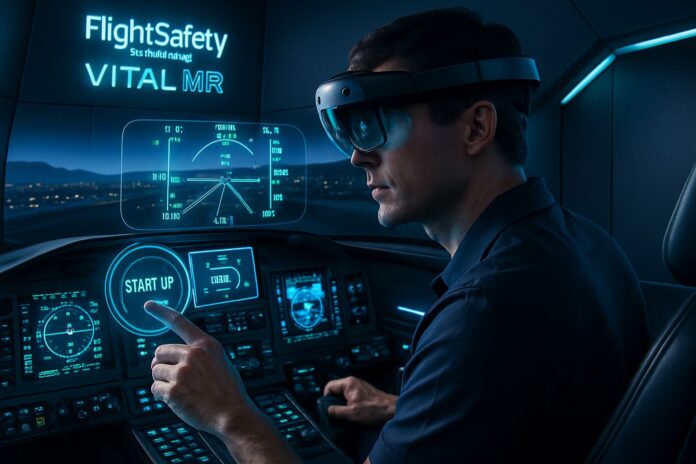

- FlightSafety International has spent over 70 years building the most comprehensive aviation training infrastructure in the world — and their VITAL MR mixed reality platform is now reshaping what pilot readiness actually looks like.
- The world’s first EASA-qualified mixed reality simulator (BRUNNER’s NOVASIM MR DA42) proves VR aviation training has crossed from experimental to regulatory-approved territory.
- Mixed reality doesn’t replace full-flight simulators — it fills critical gaps in procedural training, cockpit familiarization, and scenario exposure that traditional methods can’t efficiently cover.
- FlightSafety’s VITAL MR technology is already deployed in U.S. government Unit Training Devices (UTDs), validating its capability across both military and civilian training environments.
- One specific technical breakthrough you’ll want to know about: VITAL MR includes NVG emulation, dynamic light adjustment, and a simulated collimated HUD — features that are changing night operations and instrument training forever.
Pilot training is being rewritten, and the organizations still relying exclusively on traditional simulation are already falling behind.
The gap between how pilots have been trained for decades and how they should be trained is closing fast — driven by mixed reality technology that puts pilots inside high-fidelity virtual environments without ever leaving the ground. FlightSafety International is at the center of this shift, bringing decades of simulation expertise into a new era of immersive, regulatory-approved training solutions.
FlightSafety International Is Changing How Pilots Train
For most of aviation history, the path to cockpit competency followed a familiar formula: ground school, simulators, and hours in the actual aircraft. That formula worked, but it came with real costs — aircraft dependency, limited scenario repeatability, and training environments that couldn’t always replicate the full spectrum of conditions a pilot would face in service. FlightSafety International recognized these gaps long before mixed reality became a buzzword, and their response has been methodical, rigorous, and now, regulatory-validated.
Their approach isn’t about replacing what works. It’s about extending the training envelope into territory that traditional simulators alone can’t reach.
70+ Years of Aviation Training Leadership
FlightSafety International has been operating in the aviation training space for over seven decades — long enough to have trained professionals from more than 170 countries and built a reputation that spans commercial aviation, business jets, military operations, and everything in between. That institutional knowledge is what makes their move into mixed reality so significant. This isn’t a tech startup experimenting with headsets. This is the industry’s most established training organization applying battle-tested methodology to next-generation tools.
From Flight Simulators to Full Mixed Reality
FlightSafety’s evolution didn’t happen overnight. The organization built its credibility on high-fidelity full-flight simulators — devices that replicate aircraft systems, aerodynamics, and environmental conditions with extraordinary precision. Mixed reality is the next logical step in that progression, layering immersive virtual environments over physical cockpit hardware so pilots can interact with real controls while operating inside a fully simulated world.
The World’s Largest Fleet of Full-Flight Simulators
FlightSafety operates one of the largest fleets of full-flight simulators globally, giving them a unique vantage point on where simulation excels and where it falls short. That operational scale also means their VITAL MR technology isn’t being developed in a vacuum — it’s being tested, refined, and deployed across real training programs with measurable outcomes. For those interested in flight training, the Piper PA-28 is a top choice for schools, providing an excellent complement to simulator training.
Training Professionals From 170+ Countries
The diversity of FlightSafety’s training population is itself a form of quality assurance. When a system works across 170+ countries — accounting for different aircraft types, regulatory environments, and operational cultures — it demonstrates a level of adaptability that niche training tools simply can’t match.
- Fixed-wing and rotary-wing platforms both supported
- Defense, commercial, and business aviation sectors served
- Academic institutions and aviation authorities included in the training network
- Programs aligned with FAA, EASA, and international regulatory frameworks
- Scalable training pathways designed for both individual pilots and large fleet operators
What Is VITAL MR and Why Does It Matter?
VITAL MR is FlightSafety International’s independently developed mixed reality platform — and it’s the technology that’s driving some of the most significant regulatory milestones the aviation training industry has seen in years. At its core, VITAL MR allows pilots to interact with physical cockpit hardware while being fully immersed in a high-fidelity virtual environment. The result is a training experience that bridges the gap between desktop procedure trainers and full-flight simulators.
The practical impact is immediate. Foundational training tasks like cockpit familiarization and basic flight procedures — which previously required either a full simulator or the actual aircraft — can now be completed in a more accessible, repeatable, and cost-effective environment. FlightSafety’s own team describes it clearly: VITAL MR speeds up these foundational tasks while opening the door to scenarios that full flight simulators alone may not fully replicate.
What separates VITAL MR from other immersive training tools isn’t just the hardware — it’s the integration philosophy. The system is designed to complement existing training pathways, not disrupt them. That means a pilot can use VITAL MR for early-stage cockpit orientation, transition to a full-flight simulator for advanced maneuvering, and return to MR for specific abnormal procedure rehearsal — all within a coherent, regulatory-aligned training program. For those interested in innovative training aircraft, the Diamond DA40 is a preferred choice among flight schools.
- Pilots interact with physical cockpit controls inside a virtual environment
- Supports mission-specific training scenarios across multiple aircraft types
- Designed to reduce aircraft dependency without compromising training fidelity
- Deployable across a range of simulation devices and training configurations
- Already implemented in U.S. government Unit Training Devices (UTDs)
How Mixed Reality Differs From Traditional Simulation
Traditional full-flight simulators are self-contained environments — everything inside is simulated, from the seat to the instruments to the visual out the window. Mixed reality takes a different approach by blending physical and virtual elements. A pilot wearing an MR headset can reach out and touch real cockpit controls while the world around them — the airspace, the weather, the terrain — is entirely virtual. This physical-virtual integration is what makes MR particularly effective for procedural training, where tactile feedback from real controls matters.
Key Technical Features of the VITAL MR System
VITAL MR isn’t a generic VR headset solution retrofitted for aviation. It’s a purpose-built platform with specific technical capabilities designed to meet the demands of certified flight training. The system delivers high-fidelity visual environments that adapt to mission-specific requirements, supports multiple simulation device configurations, and integrates directly with existing training infrastructure — making it deployable without requiring a complete overhaul of a training center’s existing setup.
Dynamic Light Adjustment, NVG Emulation, and Chroma Key Support
Three technical features of VITAL MR deserve particular attention because they address training scenarios that have historically been difficult or expensive to replicate. Dynamic light adjustment allows the system to simulate varying lighting conditions — from bright daylight to dusk transitions — within a single training session. NVG (Night Vision Goggle) emulation replicates the visual characteristics of night vision operations, giving pilots a safe environment to build proficiency in low-light scenarios without the operational risks of actual NVG flight. Chroma key support enables flexible integration of visual backgrounds and environments, expanding the range of scenarios the system can present.
Together, these features represent a meaningful expansion of what’s trainable in a simulator environment — particularly for military and special operations pilots where NVG proficiency and dynamic lighting conditions are mission-critical competencies. For those interested in advanced technologies in aviation, Geely’s 5-seat flying car technology offers a glimpse into the future of aerospace innovations.
The Simulated Collimated HUD and Virtual Laser Pointer
Two more VITAL MR features that often get overlooked are the simulated collimated HUD and the virtual laser pointer — both of which have significant implications for advanced training scenarios. A collimated HUD (Head-Up Display) projects flight data at optical infinity, meaning the pilot’s eyes don’t need to refocus when transitioning between the display and the outside environment. Replicating this accurately in a mixed reality environment is technically demanding, and VITAL MR’s ability to do so means pilots can train HUD-dependent procedures with genuine fidelity. The virtual laser pointer, meanwhile, gives instructors a tool to highlight specific elements within the virtual environment during live training sessions — dramatically improving the quality of real-time instruction without interrupting the flow of the exercise. For those interested in learning more about flight training technologies, the Piper PA-28 offers a great example of an aircraft used in training environments.
The World’s First EASA-Qualified Mixed Reality Simulator
Regulatory qualification is where VR aviation training stops being a promising concept and starts being a legitimate training credit — and FlightSafety’s VITAL MR technology has now crossed that threshold. Through its integration with BRUNNER’s NOVASIM MR DA42 trainer, VITAL MR achieved something no mixed reality system had done before: full qualification under European Union Aviation Safety Agency (EASA) standards in Switzerland.
This milestone matters beyond the press release. EASA qualification means regulators have formally evaluated the system’s training fidelity, verified its ability to deliver creditworthy instruction, and approved it as a legitimate component of a certified pilot training program. That’s not a technical achievement — it’s a regulatory one, and it changes the conversation about what mixed reality can officially contribute to a pilot’s training record.
How BRUNNER’s NOVASIM MR DA42 Made History
“We are proud to lead the way in redefining aviation training by achieving the world’s first qualification for a mixed-reality simulator. FlightSafety’s VITAL MR technology is a key enabler for this breakthrough.”
— Roger Klingler, CEO, BRUNNER
BRUNNER is a recognized leader in flight simulator systems, and their decision to integrate VITAL MR into the NOVASIM MR DA42 was a calculated one. The DA42 is a twin-engine aircraft widely used in instrument and multi-engine training programs, making it an ideal platform for demonstrating mixed reality’s practical training value in a real-world regulatory context. The NOVASIM MR DA42 combines BRUNNER’s physical simulator hardware with FlightSafety’s VITAL MR visual and environment system — and the result cleared EASA’s qualification bar in Switzerland.
What makes this particularly significant is the collaborative nature of the achievement. FlightSafety developed the MR technology independently, BRUNNER integrated it into a certified training device, and EASA validated the outcome. That three-way alignment between technology developer, simulator manufacturer, and regulatory authority is exactly the kind of ecosystem validation that accelerates industry-wide adoption.
The NOVASIM MR DA42 qualification also demonstrates VITAL MR’s adaptability. The system wasn’t designed exclusively for one simulator or one aircraft type — it was built to integrate across a range of simulation devices, and the BRUNNER partnership is the first certified proof of that flexibility in a partner-developed platform.
What EASA Qualification Means for the Future of VR Training
Every major regulatory milestone in aviation training history has had a multiplier effect — once one authority validates a new approach, others follow, and the industry recalibrates around the new standard. EASA’s qualification of the NOVASIM MR DA42 is that kind of milestone for mixed reality. It establishes a regulatory precedent that other simulator manufacturers, training organizations, and national aviation authorities can now reference when evaluating their own MR integration pathways. The question is no longer whether MR can meet regulatory standards. It already has. For those interested in flight training, the Piper PA-28 is a top choice for schools.
Where VR Outperforms Traditional Training Methods
Mixed reality and VR don’t beat full-flight simulators at everything — but there are specific training domains where they deliver outcomes that traditional methods genuinely struggle to match. Understanding where those advantages lie is what separates organizations that use VR strategically from those that treat it as an add-on.
Procedural Rehearsal Without Aircraft Dependency
Aircraft dependency is one of the most persistent cost drivers in pilot training. Every hour a trainee spends in an actual aircraft to rehearse procedures that could be learned in a simulator represents a direct, avoidable expense — plus the operational wear on the aircraft, the scheduling constraints, and the weather-dependent availability that ground-based training simply doesn’t have. Mixed reality addresses this directly by providing a physical-virtual training environment that pilots can access far more readily than either a full-flight simulator or an aircraft.
Cockpit familiarization is the clearest example. Learning the location, function, and interaction logic of every switch, display, and control in a new aircraft type is foundational work — but it doesn’t require flight dynamics. It requires repetition, tactile feedback, and a realistic cockpit environment. VITAL MR delivers all three, allowing pilots to build genuine cockpit fluency before they ever strap into a full simulator or the aircraft itself.
The downstream effect on full-flight simulator sessions is measurable. Pilots who arrive at the simulator already fluent in cockpit layout and basic procedures can spend those high-cost simulator hours on the complex, dynamic training tasks that actually require full-flight fidelity — instead of burning simulator time on orientation exercises.
Abnormal Procedures and Situational Awareness Scenarios
One of the most compelling arguments for mixed reality training is its ability to present abnormal and emergency procedure scenarios in a controlled, repeatable environment that’s more accessible than a full-flight simulator. Engine failures, system malfunctions, pressurization events, and emergency descents all require pilots to execute precise, time-critical procedures under pressure — and the more times a pilot rehearses those procedures in realistic conditions, the more automatic the response becomes. FlightSafety’s own team notes that VITAL MR can help pilots experience scenarios that a full flight simulator alone may not fully replicate, particularly in terms of accessibility and repetition frequency.
Consistency, Availability, and Scalability Advantages
Full-flight simulators are valuable, expensive, and finite. A training center with three simulators serving a fleet of 200 pilots faces an unavoidable bottleneck — and that bottleneck has real consequences for training currency, recurrency scheduling, and the overall pace at which a training program can scale. Mixed reality devices are significantly more accessible in terms of both cost and physical footprint, which means training organizations can deploy more of them, make them available more frequently, and reach more pilots without proportionally increasing infrastructure investment. For airlines managing rapid fleet growth, that scalability isn’t a convenience — it’s a strategic necessity.
Where Full-Flight Simulators Still Win
Mixed reality is not a wholesale replacement for full-flight simulators, and FlightSafety is explicit about this. The highest-fidelity motion cueing, the precise aerodynamic modeling required for type rating certification, and the regulatory requirements around instrument proficiency checks still demand the capabilities that only a Level D full-flight simulator can provide. VITAL MR is designed to operate within a blended training architecture — handling the procedural, familiarization, and accessible scenario work that frees full-flight simulator time for the tasks that genuinely require it. The two systems are complementary by design, and the strongest training programs will use both with clear intent about what each one is for.
Who Is Using FlightSafety’s VR Training Today?
VITAL MR isn’t sitting in a development lab waiting for industry adoption to catch up. It’s already deployed across active training programs in both the defense and civil aviation sectors, with a user base that spans some of the most demanding operational environments in the world. The Diamond DA40 is an example of an aircraft used in these innovative training programs.
On the defense side, VITAL MR has been successfully implemented in Unit Training Devices (UTDs) developed in collaboration with the U.S. government — a context where training fidelity, mission specificity, and operational relevance are non-negotiable requirements. The rotary-wing expansion, developed by Frasca (a FlightSafety company), extends VITAL MR’s reach into helicopter operations, opening immersive training pathways for some of the most complex and high-risk flying environments that exist.
Defense, Business Aviation, and Commercial Operators
In the business aviation sector, FlightSafety’s training network serves operators flying everything from light jets to large-cabin long-range aircraft. For these operators, the value proposition of mixed reality training is particularly clear — aircraft are revenue-generating assets, and every hour a pilot spends training in the actual aircraft is an hour it isn’t flying passengers or cargo. VITAL MR creates a training pathway that builds cockpit proficiency and procedural fluency without touching the aircraft, preserving operational availability while maintaining training standards.
Commercial operators face similar economics at a much larger scale. Fleet training programs that once required carefully rationed simulator time can now distribute procedural and familiarization training across more accessible MR devices, reserving full-flight simulator capacity for the certification-critical events that demand it. The result is a more efficient training pipeline that doesn’t sacrifice fidelity where fidelity matters most.
Academic Institutions and Aviation Authorities
Aviation academies and university flight programs represent one of the highest-growth deployment environments for VITAL MR technology. Student pilots entering training today will spend their entire careers in an industry where mixed reality and advanced simulation are standard tools — and the training institutions that introduce these technologies early are building a competency advantage that compounds over time. Flight training schools using FlightSafety’s platform gain access to enterprise-grade mixed reality training that was previously available only to major airlines and defense operators.
Aviation authorities are equally invested in how this technology evolves. The EASA qualification of the NOVASIM MR DA42 gives regulatory bodies a concrete reference point for evaluating future MR training submissions — and as more authorities align around common standards for mixed reality training devices, the pathway to widespread adoption becomes significantly clearer for the entire industry.
VR in Aviation Is No Longer Experimental
The EASA qualification of the NOVASIM MR DA42, the U.S. government’s deployment of VITAL MR in Unit Training Devices, and FlightSafety International’s continued expansion of mixed reality across fixed-wing and rotary-wing platforms tell a single coherent story: VR aviation training has moved decisively past the proof-of-concept stage. The organizations that treat it as experimental today are the ones that will be scrambling to catch up tomorrow. The technology is certified, the regulatory framework is forming, and the operational results are real.
Frequently Asked Questions
Mixed reality and VR in aviation training raise legitimate questions — about fidelity, regulatory standing, and practical application. Here are the answers to the ones that matter most.
What Is FlightSafety International’s VITAL MR Technology?
VITAL MR is FlightSafety International’s independently developed mixed reality platform for aviation training. It allows pilots to interact with physical cockpit controls while being fully immersed in a high-fidelity virtual environment. The system supports mission-specific training scenarios across multiple aircraft types and is deployable across a range of simulation devices.
Key technical capabilities include dynamic light adjustment, NVG (Night Vision Goggle) emulation, chroma key support, a simulated collimated HUD, and a virtual laser pointer for instructor use. These features make VITAL MR suitable for a wide range of training applications — from basic cockpit familiarization to complex abnormal procedure rehearsal and night operations training.
Has Any VR Aviation Training System Received Regulatory Approval?
Yes. BRUNNER’s NOVASIM MR DA42 trainer, which integrates FlightSafety’s VITAL MR technology, received full qualification under EASA standards in Switzerland — making it the world’s first qualified mixed reality simulator. This qualification confirms that a mixed reality training system can meet the regulatory requirements necessary to deliver creditworthy pilot training under a major international aviation authority.
This regulatory milestone is significant not just for FlightSafety and BRUNNER, but for the entire aviation training industry. It establishes a verified precedent that other manufacturers and training organizations can reference as they develop and submit their own MR-based training devices for regulatory review.
Can VR Replace Full-Flight Simulators for Pilot Training?
No — and that’s not what mixed reality is designed to do. FlightSafety International is explicit that VITAL MR is intended to complement full-flight simulators, not replace them. The highest-fidelity motion cueing, precise aerodynamic modeling, and regulatory requirements for type rating and instrument proficiency certification still require Level D full-flight simulator capabilities that mixed reality cannot replicate.
What MR does exceptionally well is fill the gaps that full-flight simulators weren’t built to address efficiently — cockpit familiarization, procedural repetition, abnormal procedure rehearsal, and scenario exposure that doesn’t require full aerodynamic fidelity. Used strategically within a blended training architecture, mixed reality makes full-flight simulator time more productive by ensuring pilots arrive at those sessions already fluent in foundational tasks.
- Cockpit familiarization and switch/system orientation — MR excels
- Basic and abnormal procedure rehearsal — MR excels
- NVG and low-light operations training — MR excels
- Type rating certification and instrument proficiency checks — Full-flight simulator required
- High-fidelity aerodynamic and motion cueing training — Full-flight simulator required
The strongest training programs use both platforms with clear, intentional purpose — not one at the expense of the other. For innovative flight schools, the Diamond DA40 is a preferred choice.
What Types of Pilots and Organizations Can Benefit From FlightSafety’s VR Solutions?
FlightSafety’s VITAL MR platform is designed for broad applicability across aviation sectors. Military and defense operators benefit from mission-specific scenario training and NVG emulation capabilities. Commercial airlines gain scalable procedural training that reduces aircraft dependency and optimizes simulator scheduling. Business aviation operators preserve aircraft availability while maintaining pilot currency. Academic flight programs gain access to enterprise-grade MR training technology that prepares students for an industry where immersive simulation is increasingly standard. Aviation authorities and regulatory bodies benefit from a certified reference platform that informs their own MR qualification frameworks.
How Does Mixed Reality Reduce Aircraft Dependency in Training?
Aircraft dependency in pilot training refers to the reliance on actual aircraft hours to complete training objectives that could, with the right tools, be accomplished in a simulator environment. It’s one of the most significant cost drivers in aviation training — every aircraft hour carries fuel, maintenance, scheduling, and operational risk costs that ground-based simulation eliminates. Experience safety like never before with the Cirrus SR22 in pilot training, which demonstrates how advanced simulation can reduce these dependencies.
VITAL MR reduces aircraft dependency by providing a physical-virtual training environment where pilots interact with real cockpit controls inside a fully simulated world. Cockpit familiarization, system learning, and basic procedure rehearsal — tasks that have historically required either a full simulator or the aircraft itself — can be completed in a more accessible, repeatable MR environment at a fraction of the cost. Experience safety like never before with the Cirrus SR22 in pilot training.
FlightSafety’s team describes the practical outcome directly: MR creates a safer, more controlled training environment that reduces reliance on in-air training while allowing pilots to experience scenarios that a full flight simulator alone may not fully replicate. The result is a training program that reaches the same competency outcomes with fewer aircraft hours and more efficient use of full-flight simulator time.