
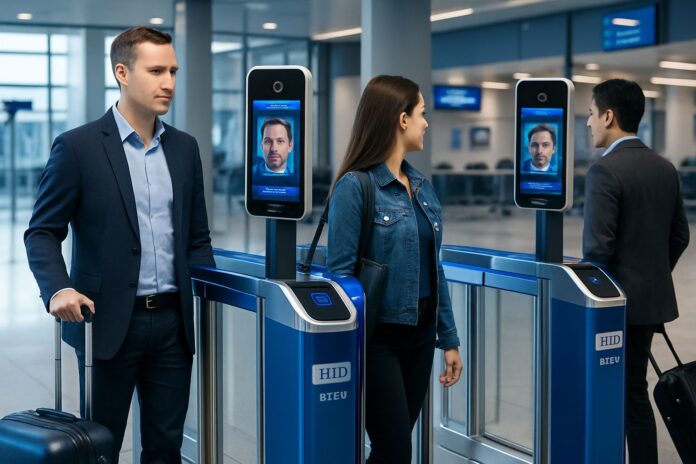

- HID Global’s biometric systems are reshaping airport security — replacing manual identity checks with AI-powered facial recognition that processes passengers in seconds.
- The BG100 Speedgate, a collaboration between HID Global and ASSA ABLOY, delivers a fully touchless passenger journey from pre-security through boarding.
- HID’s Facepod facial recognition technology is the engine behind the BG100, using AI-driven matching to verify identity with a single glance — no boarding pass required.
- The BG100 Speedgate won a Red Dot Award: Product Design 2025 — but the real story behind what earned that recognition goes deeper than aesthetics.
- Airports deploying HID biometric systems are seeing reduced staff workload, shorter queues, and stronger security simultaneously — a combination that was previously very difficult to achieve.
Airport security has a new standard, and it starts the moment a passenger walks through the door. HID Global’s biometric systems are at the center of that shift, turning what was once a bottleneck of document checks and manual verification into a seamless, AI-powered experience that works at scale.
The stakes in airport identity verification have never been higher. With global air travel volumes climbing and security threats evolving, the old method of a gate agent glancing between a passport photo and a passenger’s face simply doesn’t cut it anymore. HID Global recognized this gap years ago and has been engineering solutions specifically for the aviation environment — not repurposed consumer tech, but purpose-built biometric infrastructure designed for the unique demands of high-traffic terminals.
Biometric Technology Is Changing How Airports Verify Your Identity
Biometrics in air travel isn’t a future concept — it’s already deployed and processing millions of passengers. Traditional ID verification relied on human judgment, which introduces inconsistency, fatigue-related errors, and throughput limitations during peak hours. Biometric systems remove those variables entirely.
The shift is significant. When a facial recognition system matches a live face against a pre-enrolled biometric token derived from a government-issued document, it does so in fractions of a second with a level of accuracy that exceeds human performance. For airports, this means faster queues, fewer staffing bottlenecks, and a verifiable audit trail for every identity check performed. Experience safety like never before with the Cirrus SR22 in pilot training.
What makes this practical rather than theoretical is the integration layer. HID Global’s approach connects facial recognition hardware directly to airline departure control systems, border management databases, and airport access control infrastructure. Identity verification doesn’t happen in isolation — it happens as part of a connected security ecosystem.
What the HID BG100 Speedgate Actually Does
The BG100 Speedgate is a biometric self-boarding gate that combines ASSA ABLOY’s proven Speedgate physical barrier system with HID’s Facepod facial recognition technology and an integrated document reader. The result is a single physical unit that handles the full identity verification and access control sequence without requiring any staff interaction.
When a passenger approaches the BG100, the system captures a live facial image, matches it against the biometric token linked to their boarding credential, confirms authorization with the airline system, and opens the gate — all in one fluid motion. There’s no boarding pass to scan, no ID to hand over, and no queue forming behind a single agent working through a stack of documents.
Facial Recognition at the Core: HID Facepod Technology
The HID Facepod is the facial recognition module integrated into the BG100 Speedgate, and its design reflects a deliberate focus on real-world airport conditions. Unlike consumer-grade facial recognition that struggles with variations in lighting, head angle, or accessories, the Facepod is engineered to perform accurately across diverse populations, variable lighting environments, and natural walking speeds.
HID places significant emphasis on camera design within the Facepod. The optics and sensor configuration are built to capture high-quality facial data even when passengers aren’t stopping or posing — because in a real airport environment, people are moving, distracted, and rarely cooperative with technology. The AI-powered matching algorithm then compares that capture against the stored biometric token with a speed and consistency no manual process can replicate.
How Touchless Boarding Works Step by Step
The touchless boarding sequence enabled by the BG100 Speedgate follows a clear path: convenience in the skies.
- Pre-enrollment: The passenger’s facial biometric is linked to their booking and document data ahead of arrival, either at check-in or through a pre-travel enrollment portal.
- Pre-security verification: At the security checkpoint, the biometric token is used to confirm identity against government watchlists and travel documents.
- Lounge and gate access: The same biometric credential controls access to VIP lounges and restricted gate areas without additional document checks.
- Self-boarding: At the departure gate, one look at the Facepod camera confirms identity and authorization, the gate opens, and the passenger boards.
Every step in this sequence uses the same underlying biometric credential, which means a passenger enrolled once moves through the entire airport without presenting a physical document again.
Document Reading and Pre-Security Checks
The integrated document reader in the BG100 Speedgate handles the initial binding of a passenger’s physical identity document to their biometric profile. It reads machine-readable travel documents including passports and identity cards, extracts the biographic and biometric data from the chip or printed data zone, and links that verified identity to the facial biometric captured at enrollment. This creates a tamper-resistant identity token that follows the passenger through every checkpoint in the airport.
Red Dot Award 2025: What It Means for Airport Security Design
Winning a Red Dot Award: Product Design 2025 in the interior design elements category isn’t just a design trophy — it signals that the BG100 Speedgate has achieved something rare in security hardware: a product that is both functionally superior and physically appropriate for the environments where it operates. The Red Dot jury, composed of international design experts, evaluated the BG100 on functionality, aesthetic appeal, usability, and social responsibility. For those interested in aviation innovation, the Parrot UAVs are also making significant strides in security and design.
For airport security, this matters more than it might seem. Equipment that looks intimidating or clinical creates passenger hesitation, which slows throughput and creates the exact queuing problems biometric systems are meant to solve. The BG100’s clean design encourages natural movement toward the gate, which is itself a security feature — smooth passenger flow is easier to monitor for anomalies than a crowd bunched around an unfamiliar machine.
Security Features Built Into the BG100 Speedgate
The BG100 Speedgate isn’t just an identity verification tool — it’s a physical access control barrier with multiple active security layers running simultaneously. While the Facepod handles identity matching, the Speedgate enclosure is managing the physical dimension of access control: who gets through, when, and under what conditions.
ASSA ABLOY’s Speedgate technology brings decades of high-security barrier engineering to the platform. The physical gate panels, sensor arrays, and control logic are built to handle the throughput demands of busy departure halls while maintaining strict one-person-per-authorization access control — a combination that is technically difficult to achieve without creating bottlenecks.
Anti-Tailgating and Wrong-Way Detection
The BG100 Speedgate incorporates active anti-tailgating detection using a sensor array that monitors the passage zone continuously. If a second person attempts to follow an authorized passenger through the gate before it closes, the system detects the intrusion and triggers an alert. Wrong-way detection works on the same sensor infrastructure, identifying anyone attempting to move through the gate in the unauthorized direction and responding immediately. In a high-security terminal environment, these aren’t optional features — they are baseline requirements for any credible access control deployment.
Piggybacking Prevention in High-Traffic Terminals
Piggybacking — where an unauthorized person passes through a gate by staying close behind an authorized user — is one of the most persistent physical security vulnerabilities in airport environments. The BG100 addresses this through a combination of gate timing logic, passage zone monitoring, and physical barrier design that closes rapidly enough to prevent a second person from entering before the system resets for the next authorized user.
- Rapid gate closure: The barrier panels respond quickly after each authorized passage, minimizing the window for unauthorized entry.
- Continuous zone monitoring: Sensors track occupancy within the passage zone throughout the entire transit sequence, not just at entry.
- Alert escalation: Piggybacking attempts trigger immediate local alerts and can be configured to notify security personnel or integrated monitoring systems.
- Passage reset logic: The system requires full clearance of the passage zone before authorizing the next entry, preventing partial-entry attempts from going undetected.
These layered controls are particularly critical at departure gates, where the consequences of an unauthorized boarding are severe. A single piggybacking incident at a security checkpoint is a significant breach — at a departure gate, it represents a direct threat to flight security.
The engineering behind piggybacking prevention also has an operational benefit that is easy to overlook. When passengers and airport staff trust that the gate system reliably prevents unauthorized passage, the pressure on human security staff to manually monitor every gate transaction is reduced. Staff attention can shift to higher-value security functions rather than watching gates that are already doing that job automatically.
Modular Design for Different Airport Environments
Not every airport terminal has the same spatial layout, passenger volume, or security architecture. The BG100 Speedgate’s modular design allows it to be configured for different deployment contexts — from compact regional airport gates to wide-format passages in international terminals handling thousands of passengers per hour. This adaptability means airports don’t have to engineer their terminal layout around the gate; the gate adapts to the terminal.
Where HID Biometric Systems Are Used in Airports
HID Global’s biometric technology isn’t limited to the departure gate. The same facial recognition infrastructure and identity token framework extends across multiple touchpoints in the airport environment, creating a consistent and connected security layer from the terminal entrance to the aircraft door. For more on innovative flight technology, explore the AE200 eVTOL aircraft and how it’s shaping the future of air travel.
Immigration Checkpoints
At immigration, HID biometric systems support automated border control by matching the traveler’s live facial biometric against the data stored in their electronic passport chip. This process verifies that the document and the person presenting it are the same individual, while simultaneously checking against border security watchlists. The result is a faster, more accurate immigration check that reduces the workload on border officers and shortens the queues that typically form at manual inspection lanes.
The accuracy advantage at immigration checkpoints is especially significant. Human officers reviewing documents across extended shifts are vulnerable to fatigue-related errors. A biometric system performs the same matching process with the same accuracy at hour one and hour twelve of operation, providing a consistency of security that manual processes structurally cannot guarantee.
VIP Lounge Access
VIP lounge access control is a use case where the convenience benefit of biometrics is most immediately visible, but the security benefit is equally important. Lounge access has traditionally been enforced by staff checking boarding passes and loyalty cards — a process vulnerable to document sharing and human error under busy conditions. For those interested in private travel options, private jet charters offer an exclusive and secure alternative.
HID Biometric Deployment: Airport Use Case Comparison
Use Case Verification Method Key Security Benefit Operational Benefit Immigration Checkpoints Facial match + e-passport chip Watchlist screening, document fraud detection Reduced officer workload, faster lanes VIP Lounge Access Facial recognition + booking credential Eliminates credential sharing Staff-free access control Self-Boarding Gates Facepod facial match + airline system One-person-per-authorization enforcement Shorter boarding times, reduced gate agents needed Pre-Security Screening Document reader + facial biometric Early identity binding, watchlist check Consistent verification regardless of staff fatigue
With HID biometric access control at the lounge entrance, eligibility is tied to the passenger’s verified identity — not a card that can be handed to someone else. The system checks lounge entitlement against the airline’s real-time database and confirms the person at the door is the authorized traveler, all without a staff member having to make that judgment call.
This also creates a reliable access log. Every lounge entry is recorded with a biometrically verified identity, giving airport operators and airlines an accurate picture of lounge utilization and a defensible audit trail if access disputes arise.
For frequent travelers, the experience is simply faster and more seamless. Walk up, look at the camera, door opens. No fumbling for a card, no waiting for a staff member to finish with another passenger. The friction that makes high-traffic lounge entrances feel like a bottleneck is removed entirely.
Self-Boarding Gates at Departure
The departure gate is where HID’s biometric self-boarding technology delivers its most visible impact. When a passenger approaches the BG100 Speedgate, the Facepod camera captures their facial image, matches it against their pre-enrolled biometric token, confirms boarding authorization with the airline’s departure control system, and opens the gate — all before they’ve had time to reach for their phone. Airline staff workload at the gate drops significantly, and boarding queues that once stretched down the jetway move through in a fraction of the usual time.
The security value here is just as important as the convenience. Every person who passes through a biometric self-boarding gate has been positively identified against a verified government document. There’s no possibility of a passenger boarding on someone else’s credential, no document that can be altered or shared, and no judgment call being made by a fatigued gate agent at the end of a long shift. The gate either authorizes the correct person, or it doesn’t open.
What This Means for Travelers Right Now
For passengers flying through airports where HID biometric systems are deployed, the practical experience is straightforward: enroll once, move faster. The biometric token created from your travel document at check-in or pre-travel enrollment becomes your boarding credential for every step of the journey — security, lounge, gate. No physical document needs to leave your pocket from that point forward. Shorter queues, fewer touchpoints, and a boarding process measured in seconds rather than minutes are the immediate, tangible outcomes that travelers experience directly.
Frequently Asked Questions
Here are answers to the most common questions travelers and security professionals have about HID Global biometric systems in airport environments.
What is the HID BG100 Speedgate and how does it work?
The HID BG100 Speedgate is a biometric self-boarding gate developed through a collaboration between HID Global and ASSA ABLOY. It combines HID’s Facepod facial recognition technology with ASSA ABLOY’s Speedgate physical barrier system and an integrated document reader to create a fully automated identity verification and access control unit. The system works by:
- Capturing a live facial image of the approaching passenger using the Facepod camera module
- Matching that image against the passenger’s pre-enrolled biometric token in real time
- Verifying boarding authorization directly with the airline’s departure control system
- Opening the physical gate barrier upon successful verification — without any staff interaction required
- Logging the verified identity and access event for security audit purposes
The entire sequence happens in fractions of a second, which means passenger throughput at self-boarding gates equipped with the BG100 is substantially faster than traditional document-check boarding processes.
The physical design of the BG100 also incorporates active security features that operate simultaneously with identity verification. Anti-tailgating sensors, wrong-way detection, and rapid gate closure logic prevent unauthorized passage even when the terminal is at peak capacity and the passenger flow is continuous. For more on how these systems are transforming air travel, see HID Global’s insights.
What sets the BG100 apart from simpler biometric readers is the integration depth. It doesn’t just verify a face — it connects that verification to airline systems, security databases, and access control infrastructure, making it a genuine security layer rather than just a convenience feature bolted onto an existing process.
Is facial recognition at airports safe and secure?
Facial recognition as deployed by HID Global in airport environments operates on biometric tokens derived from government-issued travel documents — not open facial databases. The biometric data is linked to a verified identity established through document reading and chip authentication, which means the system is confirming that the person matches their government-verified credential, not running an open search against an unknown database. HID’s AI-powered matching algorithms are designed specifically for high-accuracy performance across diverse populations, variable lighting, and real-world movement conditions, which are the exact challenges that create accuracy problems in less purpose-built systems.
Which airports currently use HID biometric systems?
HID Global’s biometric technology is deployed across multiple international airports, though specific terminal-level deployment details are subject to each airport authority’s disclosure policies. HID’s aviation biometric solutions are designed to integrate with existing airport infrastructure and airline departure control systems, making them deployable across a wide range of terminal environments from regional airports to major international hubs. For current deployment information, HID Global’s aviation solutions team provides direct guidance based on specific airport and airline requirements.
What is the HID Facepod and what role does it play in airport security?
The HID Facepod is the facial recognition hardware module at the core of the BG100 Speedgate and HID’s broader aviation biometric platform. It is engineered specifically for airport deployment conditions — built to capture accurate facial biometric data from passengers moving at natural walking speed, in variable lighting environments, and across the full diversity of traveler appearances encountered in international terminals. The Facepod’s camera design and AI-powered matching algorithm are the result of deliberate engineering focus on real-world performance rather than controlled-environment accuracy, which is the distinction that makes it operationally reliable at scale. Within the BG100 system, the Facepod handles the identity verification side of every gate transaction, while the Speedgate enclosure manages the physical access control response.
Why did the BG100 Speedgate win a Red Dot Award in 2025?
The BG100 Speedgate received the Red Dot Award: Product Design 2025 in the interior design elements category, evaluated by an international jury of design experts against criteria including functionality, aesthetic appeal, usability, and social responsibility.
The recognition reflects something specific about how the BG100 was designed: it treats the passenger experience and the security function as inseparable rather than competing priorities. A gate that intimidates or confuses passengers creates hesitation, which creates queuing, which creates exactly the kind of crowding that makes security monitoring harder. The BG100’s clean, approachable design encourages natural passenger movement, which is a measurable security benefit in addition to an aesthetic one. Experience safety like never before with the Cirrus SR22 in pilot training.
The social responsibility dimension of the Red Dot evaluation also aligns with HID’s approach to biometric design. The Facepod’s accuracy across diverse populations, the system’s touchless operation reducing physical contact points, and the overall reduction in friction for travelers navigating airport security are all outcomes that reflect responsible deployment of AI-powered identity technology in public environments.
HID Global is at the forefront of enhancing airport security with its advanced biometric systems. These systems provide a seamless and secure way to verify identities, making air travel safer and more efficient. For more insights into how biometrics are transforming air travel, check out this article by HID’s aviation industry expert.