
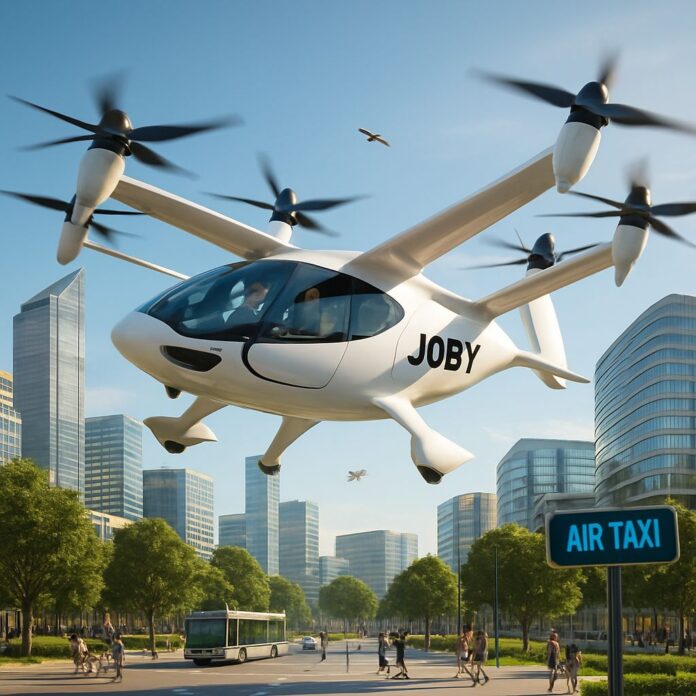

- The Joby Aviation S4 is a five-seat electric VTOL aircraft that uses six tilting propellers to take off vertically and cruise efficiently at up to 200 mph — no runway required.
- It is 100 times quieter than a conventional helicopter at takeoff and landing, making it genuinely viable for dense urban environments where noise is a dealbreaker.
- Backed by Uber Elevate and the U.S. Air Force’s Agility Prime program, the S4 has serious institutional momentum behind its path to commercial deployment.
- The first crewed eVTOL flight in New York City history was completed by the Joby S4 on November 12, 2023 — a milestone that signals this technology is no longer theoretical.
- FAA type certification is actively in progress, and understanding where that process stands reveals exactly how close — or far — urban air taxis really are from your morning commute.
The Joby S4 Is Changing How Cities Move
Urban traffic isn’t getting better — it’s getting worse, and the only real solution may be to stop thinking about the ground entirely. The Joby Aviation S4 is one of the most advanced electric vertical takeoff and landing (eVTOL) aircraft ever built, and it’s designed specifically to move people through cities faster, quieter, and cleaner than anything that’s come before it. For anyone trying to understand where urban transit is actually headed, the S4 is the aircraft to watch.
Joby Aviation, founded by CEO JoeBen Bevirt, has spent over a decade engineering what they believe is the answer to urban congestion. The company’s work, and a broader look at the future of aerial urban mobility, is explored in depth at eVTOL News, one of the leading resources tracking this fast-moving industry. What’s happening with the S4 right now is not a concept — it’s a pre-production prototype actively undergoing FAA certification.
What Makes the S4 Different From a Helicopter
Helicopters have moved people through city skies for decades, but they come with serious limitations — extreme noise, high operating costs, heavy maintenance demands, and direct fuel emissions. The Joby S4 was engineered to eliminate every one of those problems. It’s not an iteration on helicopter technology. It’s a replacement for it.
The core difference lies in how the S4 generates lift and forward thrust. Instead of a single large overhead rotor, the aircraft uses a distributed electric propulsion system — six tilting propellers spread across both its fixed high-wing and its swept-forward V-tail. This architecture gives the S4 redundancy, efficiency, and a noise profile that is simply incomparable to traditional rotorcraft.
- Top cruise speed of 200 mph
- Range of approximately 150 miles per charge
- 100x quieter than a helicopter at takeoff and landing
- Zero direct emissions from fully electric propulsion
- Capable of vertical takeoff and landing with no runway required
Six Tilting Propellers Replace Traditional Rotor Systems
The S4’s six propellers are not fixed in place — they tilt. During takeoff and landing, all six rotate to point upward, providing vertical lift across the full span of the aircraft. Once airborne, four of the propellers on the main wing tilt forward to generate cruise thrust, while the remaining two on the V-tail continue to assist with control and stability. This transition from vertical to horizontal flight is what makes the S4 both a true VTOL aircraft and an efficient fixed-wing cruiser.
This distributed propulsion design also dramatically improves safety. Because lift and thrust are spread across six independent motors rather than concentrated in a single rotor, the failure of any individual propeller does not result in loss of control. The system is inherently redundant — a design philosophy that sits at the core of JoeBen Bevirt’s approach to safety-first engineering.
100 Times Quieter Than a Helicopter at Takeoff and Landing
Noise is the single biggest barrier to deploying air taxis over cities. Residents near urban heliports have fought for years against the noise pollution that conventional rotorcraft create, and city regulators have taken notice. Joby’s own testing data shows the S4 produces noise levels approximately 100 times lower than a comparable helicopter during the most acoustically sensitive phases of flight — takeoff and landing. At cruise altitude, the aircraft is nearly inaudible from the ground.
Zero Direct Emissions From Fully Electric Propulsion
Every system on the S4 runs on electricity. There is no combustion engine, no jet fuel, and no direct exhaust. For cities already struggling with air quality targets and carbon reduction commitments, this matters enormously. An electric air taxi network built on aircraft like the S4 integrates directly into a city’s broader sustainability goals rather than conflicting with them — something no fossil-fuel-powered aircraft can claim.
Inside the S4: Design and Passenger Experience
The S4 isn’t just an engineering achievement — it’s designed to be a vehicle people actually want to ride in. Joby has clearly thought about the passenger experience as carefully as the propulsion system, building an aircraft that feels more like a premium cabin than a utility transport.
- 1 pilot + 4 passengers in a purpose-built cabin configuration
- Panoramic windows offering wide sightlines from every seat
- Low vibration thanks to electric motors with no combustion oscillation
- Tricycle retractable landing gear for clean aerodynamic lines in cruise
- Quiet cabin environment enabled by the aircraft’s dramatically reduced noise signature
Five-Seat Configuration With One Pilot and Four Passengers
The S4’s cabin seats five total — one pilot up front and four passengers in a purpose-designed rear cabin. The layout is compact but intentional, prioritizing the passenger experience within the weight and aerodynamic constraints of an electric aircraft. For urban air taxi operations, a four-passenger payload is commercially significant, allowing operators to spread trip costs across multiple riders the way a rideshare vehicle would.
Panoramic Windows and Luxury Interior Finishes
Joby designed the S4’s windows to give passengers a genuine view of the city below — not a porthole, but a wide, panoramic glass surface at every seat position. Combined with the near-silent electric drivetrain and minimal vibration of brushless motors, the interior experience is closer to a high-end executive aircraft than anything resembling a noisy helicopter cabin.
Tricycle Retractable Landing Gear and Aerodynamic Build
The S4 uses a tricycle landing gear configuration that retracts fully during cruise flight, reducing drag and improving the aircraft’s overall aerodynamic efficiency. This detail matters more than it might seem — in an electric aircraft where every watt-hour of battery energy is precious, minimizing parasitic drag directly extends range. The retractable gear reflects Joby’s commitment to engineering the S4 as a serious long-range air taxi, not just a short-hop novelty.
How the S4 Actually Flies
Understanding the S4’s flight mechanics helps explain why this aircraft is genuinely different from everything that came before it. The flight envelope covers three distinct phases — vertical takeoff, transition, and fixed-wing cruise — and the aircraft handles all three using a single integrated propulsion system with no moving parts other than the propellers themselves.
Fixed High-Wing and V-Tail Propeller Placement
Four of the S4’s six propellers are mounted along the fixed high-wing, and the remaining two sit on the distinctive swept-forward V-tail. This placement is not arbitrary — it distributes thrust and lift across the aircraft’s full span, improving stability in hover and reducing the aerodynamic complexity of transitioning to forward flight. The high-wing configuration also keeps the propellers clear of ground interference during takeoff and landing, which matters enormously for operations from compact urban vertiports.
Transition From Vertical Takeoff to Forward Flight
The transition phase — the moment the S4 shifts from hovering to flying forward — is where the engineering gets particularly impressive. As the aircraft gains altitude and forward speed, the four wing-mounted propellers begin tilting progressively forward, generating cruise thrust while the wings take over the job of providing lift. This happens smoothly and continuously, not as a sudden mechanical switch. The result is an aircraft that behaves like a multirotor at low speed and a fixed-wing plane at cruise — capturing the best performance characteristics of both.
S4 Flight Phase Breakdown
Flight Phase Propeller Behavior Primary Lift Source Vertical Takeoff & Landing All six point upward Propeller thrust Transition Wing props tilt progressively forward Combined prop + wing Cruise Wing props fully forward, tail props assist Fixed wing
This three-phase flight profile is what gives the S4 its exceptional range and efficiency. Hovering burns significantly more battery energy than fixed-wing cruise, so the faster the aircraft transitions out of hover and into forward flight, the less energy it consumes overall. Joby’s engineers have optimized the transition profile specifically to minimize this energy cost while keeping the maneuver smooth enough for passenger comfort.
The first public demonstration of this full flight envelope in an urban environment came on November 12, 2023, when the S4 (tail number N542BJ) completed a crewed exhibition flight from the downtown Manhattan heliport — the first eVTOL flight in New York City history. That flight wasn’t just symbolic. It was proof that the S4’s flight systems perform in real-world urban conditions, not just controlled test environments.
Joby’s Path to FAA Certification
Building a remarkable aircraft is one challenge. Getting it certified to carry paying passengers is another entirely. The FAA’s type certification process for a novel aircraft category like eVTOL is rigorous by design, and Joby has been navigating it more aggressively than any other company in the space.
FAA Type Certification Already in Progress
Joby Aviation entered into a G-1 issue paper agreement with the FAA — the formal starting point for type certification — making it one of the first eVTOL manufacturers to reach this stage. The FAA has established a specific certification framework for powered-lift aircraft, the category the S4 falls under, and Joby has been working through each stage of that framework with the pre-production S4 2.0 prototype. The company has also been granted authorization to conduct piloted flight testing under FAA oversight, which is a prerequisite for moving toward full certification.
Safety as the Top Priority According to CEO JoeBen Bevirt
JoeBen Bevirt has been consistent and public about one thing above all else: safety is not a marketing talking point for Joby, it’s the actual engineering constraint around which the S4 was designed. The distributed propulsion system, the redundant motor architecture, and the low-speed flight envelope all reflect a deliberate choice to build an aircraft that can tolerate component failure without catastrophic consequences. Bevirt has stated that the S4 was designed to be safer than driving — a bar that, if met and verifiable through certification data, would mark a fundamental shift in how regulators and the public think about urban air mobility.
Who Is Backing the Joby S4
Joby Aviation hasn’t built the S4 in isolation. The company has assembled a coalition of strategic partners that spans the private sector, the defense establishment, and the commercial aviation industry — giving the program a depth of institutional support that most aerospace startups could never access. For more insights, you can read about Joby S4 and its innovative journey.
Uber Elevate Partnership Signed December 2019
In December 2019, Joby Aviation and Uber signed a partnership agreement under the Uber Elevate urban air mobility initiative. The deal gave Joby access to Uber’s market development work, software infrastructure, and demand modeling for on-demand air taxi services — essentially a head start on the commercial deployment problem that every eVTOL company eventually has to solve.
The partnership went further than a simple commercial agreement. Joby ultimately acquired Uber Elevate in 2020, absorbing the entire division — its team, its technology assets, and its vision for a networked air taxi ecosystem — into Joby’s own operations. This acquisition positioned Joby not just as an aircraft manufacturer, but as a potential operator of urban air mobility services at scale.
What the Uber Elevate acquisition gave Joby most concretely was a framework for thinking about vertiport networks, intermodal integration with ground transport, and dynamic pricing for air taxi rides — the commercial infrastructure that has to exist before any eVTOL aircraft can generate revenue at meaningful scale.
U.S. Air Force Agility Prime Program Involvement
The U.S. Air Force’s Agility Prime program was created specifically to accelerate the development of commercial eVTOL aircraft by providing government contracts, testing resources, and operational data to leading manufacturers. Joby Aviation was selected as one of Agility Prime’s primary partners, receiving contracts that helped fund continued S4 development and flight testing. This relationship matters beyond the funding — it signals that the U.S. military sees operational utility in eVTOL technology and is willing to invest in maturing it.
The Agility Prime involvement also gave Joby access to military test facilities and regulatory pathways that accelerate the kind of flight envelope exploration that would otherwise take years longer under purely civilian FAA oversight. For a company trying to compress its timeline to commercial certification, that access is genuinely significant.
The Hybrid Turbine VTOL: Joby’s Next Step
While the S4 is Joby’s flagship aircraft, the company has also been developing hybrid turbine VTOL concepts that extend range beyond what current battery technology allows. The Joby SHy4, a technology demonstrator, explored how a turbine generator could charge onboard batteries mid-flight — effectively eliminating range anxiety for longer inter-city routes where a purely battery-electric aircraft would fall short. This hybrid approach represents a logical bridge technology for the period before battery energy density catches up with the demands of longer-range urban air mobility.
The practical implication for urban transit is significant. A hybrid turbine eVTOL could operate the same vertical takeoff and quiet electric cruise profile as the S4 within city limits, then switch to turbine-assisted range extension for connections between cities — say, Manhattan to Philadelphia or Los Angeles to San Diego. That would position Joby’s technology not just as a city-center shuttle, but as a genuine regional mobility solution capable of replacing short-haul flights that currently clog airports with inefficient 45-minute departures.
What Urban Air Taxis Could Cost Everyday Commuters
Joby has publicly stated its long-term goal of pricing air taxi rides competitively with ground-based rideshare services like Uber Black — targeting a per-mile cost that is accessible to everyday commuters, not just business travelers. The initial launch pricing will inevitably be higher while the fleet scales and operational costs are amortized, but the trajectory Joby has committed to points toward a service that could realistically compete with a premium ground taxi on heavily congested urban corridors where time savings justify a moderate price premium. The economics become particularly compelling when you factor in that a 45-minute gridlock commute replaced by an 8-minute air taxi ride represents a recoverable productivity gain that many urban professionals would pay meaningfully to access.
The Joby S4 Signals a Turning Point for City Travel
The November 2023 Manhattan flight wasn’t a stunt — it was a statement. Electric VTOLs are no longer a Silicon Valley whiteboard concept. They are certified-in-progress, investor-backed, military-tested aircraft that have flown over real cities carrying real people, and the S4 sits at the absolute leading edge of that reality. The question for urban transit planners, city governments, and everyday commuters is no longer if this technology arrives — it’s whether your city will be ready when it does.
Frequently Asked Questions
Electric VTOLs raise a lot of legitimate questions — about safety, cost, noise, autonomy, and timeline. Here are the most important ones answered directly, based on what Joby Aviation has publicly disclosed and what the FAA certification process currently reflects.
- How many passengers can the Joby S4 carry? — Five total: one pilot and four passengers.
- Is the S4 fully autonomous? — Not currently. It is piloted, with a path toward autonomy post-certification.
- How quiet is it? — Approximately 100 times quieter than a helicopter at takeoff and landing.
- When will it be commercially available? — FAA certification is in progress; no confirmed launch date has been publicly set.
- What was the Uber Elevate deal? — Joby acquired the entire Uber Elevate division in 2020 after an initial partnership signed in December 2019.
How many passengers can the Joby S4 carry?
The Joby S4 carries five people total — one pilot and four passengers. The cabin was designed specifically around this configuration to balance payload capacity with the weight and energy constraints of a fully electric propulsion system. Four revenue-generating passenger seats is a commercially meaningful number for an air taxi operator, allowing per-ride economics that can scale as fleet size increases.
It’s worth noting that the four-passenger payload also aligns with how Joby envisions the service operating — as a premium rideshare, not a charter. Multiple passengers sharing a single flight between two vertiport locations brings the per-person cost down significantly, which is central to Joby’s long-term affordability thesis.
Is the Joby S4 fully autonomous?
The S4 is not fully autonomous in its current pre-production configuration. It is piloted, with a human pilot operating the aircraft from the front seat. Joby has designed the aircraft’s flight control systems with a high degree of automation — automated hover stabilization, transition management, and flight envelope protection are all built in — but final command authority remains with the pilot during this phase of development.
The path toward autonomy is part of Joby’s longer-term roadmap, but the company has been deliberate about not leading with autonomy as a near-term feature. Gaining public trust and regulatory approval for a piloted eVTOL is already a significant undertaking; adding full autonomy to the certification scope simultaneously would dramatically complicate and extend the approval timeline.
From a regulatory perspective, the FAA’s powered-lift certification framework currently requires a human pilot, and any transition to autonomous operations would require a separate and additional certification process. Joby’s approach of launching with a pilot and iterating toward autonomy over time is the most pragmatic path available under existing U.S. aviation law.
Joby S4 Autonomy Roadmap
Phase Autonomy Level Current Status Phase 1 — Certification Piloted with automated flight envelope protection In progress (FAA type cert) Phase 2 — Commercial Launch Piloted operations with high automation assistance Post-certification target Phase 3 — Long-Term Roadmap Reduced crew / full autonomy Future regulatory approval required
How quiet is the Joby S4 compared to a helicopter?
The S4 is approximately 100 times quieter than a conventional helicopter during takeoff and landing — the two phases of flight that produce the most noise impact on urban communities. At cruise altitude, the aircraft is described as nearly inaudible from ground level. This noise performance is the direct result of using multiple small-diameter electric propellers spinning at lower RPM rather than a single large rotor spinning at high speed, which is the primary source of helicopter noise. For city residents and urban regulators, this difference is not marginal — it’s the difference between a technology that can realistically integrate into dense neighborhoods and one that cannot.
When will the Joby S4 be available for commercial use?
Joby Aviation has not publicly confirmed a specific commercial launch date. What is confirmed is that FAA type certification is actively in progress, that piloted flight testing under FAA oversight has been authorized, and that Joby has completed demonstrator flights including the landmark November 2023 crewed flight over Manhattan. The company has consistently indicated its intent to launch commercial air taxi services in the United States, with Toyota and other major investors backing that timeline with continued capital. The most accurate answer is that commercial operations are approaching, but the precise date remains tied to FAA certification milestones that have not been publicly scheduled.
What is the Uber Elevate partnership with Joby Aviation?
The Uber Elevate partnership began in December 2019 as a commercial collaboration, with Joby joining Uber’s urban air mobility network as a preferred air taxi partner. The arrangement gave Joby access to Uber’s rideshare platform infrastructure, demand data, and the operational framework Uber Elevate had spent years developing for on-demand air taxi services.
In 2020, Joby went further and acquired Uber Elevate outright — absorbing the division’s team, technology assets, and strategic vision into Joby’s own organization. This was a pivotal move that transformed Joby from purely an aircraft manufacturer into a company with the internal capability to design, operate, and scale an air taxi network.
The acquisition gave Joby immediate access to vertiport planning frameworks, intermodal integration concepts, and app-based booking infrastructure that would have taken years and significant capital to develop independently. It also brought on board a team of urban air mobility specialists whose entire focus had been solving the commercial deployment problem — the part of the equation that has nothing to do with aircraft engineering and everything to do with how people actually access and pay for a new form of transportation.
For the future of urban transit, the Uber Elevate acquisition is arguably as important as the S4 aircraft itself. The best eVTOL in the world is commercially worthless without the network infrastructure to deploy it at scale — and Joby is one of the very few companies in this space that has already built both sides of that equation. To explore more about how eVTOL technology is reshaping the future of city travel, eVTOL News remains the definitive resource for tracking every development in this rapidly evolving industry.