
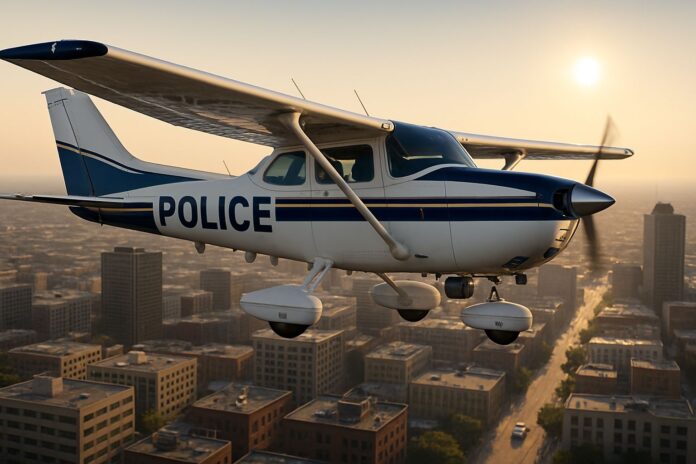

Article-At-A-Glance
- The Cessna 172 Skyhawk has been used for law enforcement aerial surveillance since 1973, making it one of the most proven platforms in police aviation history.
- Fixed-wing aircraft like the Skyhawk can cost a fraction of what police helicopters cost to purchase and operate hourly, making aerial surveillance accessible to smaller agencies.
- With infrared camera capability at 3,000 feet above ground level, the Skyhawk can track criminal activity without tipping off suspects on the ground.
- There are real operational limitations agencies need to understand before committing to a Cessna 172 surveillance program — especially in high-speed pursuit scenarios.
- Cavalcade of Wings provides detailed historical and technical documentation on law enforcement aircraft platforms like the Cessna 172 Skyhawk used in real police operations.
Most law enforcement agencies assume that effective aerial surveillance means expensive helicopters — but the Cessna 172 Skyhawk has been quietly proving that assumption wrong since 1973.
On January 16, 1973, the Albuquerque Police Department (APD) launched one of the earliest documented fixed-wing police surveillance programs in the United States, deploying a Cessna 172 Skyhawk designated N101PD — nicknamed the Sky Sentinel. That single aircraft reshaped how smaller agencies thought about putting eyes in the sky without draining their entire capital budget. For agencies researching real-world law enforcement aircraft history, Cavalcade of Wings provides detailed model documentation including the original APD Cessna 172 deployment.
The Skyhawk is an American four-seat, single-engine, high fixed-wing aircraft manufactured by Cessna Aircraft Company. First flown in 1955, it holds the record as the most produced aircraft in aviation history. That production volume matters for law enforcement agencies, because it directly affects parts availability, maintenance costs, and pilot training pipelines — all factors that make or break a sustainable surveillance program.
The Cessna 172 Skyhawk Has Been Watching Over Cities Since 1973
Before drones, before body cameras, and well before real-time GPS tracking, the APD was already running aerial surveillance missions over Albuquerque with a camera-equipped Skyhawk. The program was not a pilot project in the loosest sense — it was operationally serious, purpose-built, and specifically configured for police work from the ground up.
First Deployed by the Albuquerque Police Department
The APD’s Sky Sentinel wasn’t a standard off-the-shelf aircraft thrown into service. It was especially equipped with surveillance hardware and modified to meet short takeoff and landing (STOL) requirements, which allowed the aircraft to operate from smaller airstrips closer to patrol zones. The New Mexico State Police ran a similar Cessna 172 program for statewide police operations during the same era, which validated the platform’s versatility across both urban and rural jurisdictions.
Why Fixed-Wing Aircraft Made Sense for Police Work
The economics are the first reason. A police helicopter carries acquisition costs that routinely exceed $1 million, with hourly operating costs that can reach $400 or more depending on the platform. A Cessna 172, by contrast, enters the used aircraft market at a fraction of that price, and hourly operating costs stay substantially lower. For agencies without dedicated aviation unit budgets, that gap is the difference between having aerial support and having none at all.
Beyond cost, the STOL-equipped Skyhawk offered something operationally valuable: slower cruising speeds that kept subjects in camera frame longer during mobile surveillance. Helicopters are fast and maneuverable, but sustained slow-speed tracking at altitude is where fixed-wing aircraft earn their place in law enforcement aviation.
What Makes the Cessna 172 Skyhawk Suitable for Surveillance
Not every small aircraft would work for this mission. The Skyhawk has a specific combination of design features that align well with what law enforcement surveillance actually demands in the field. Discover how stability meets performance with the Cessna 172 Skyhawk for precision mapping.
High-Wing Design Gives Cameras a Clear, Unobstructed View
The Cessna 172’s high-wing configuration positions the wings above the fuselage, leaving the belly of the aircraft completely unobstructed. For downward-facing surveillance cameras — whether standard optical or infrared — this is a critical structural advantage. Low-wing aircraft force camera systems to work around landing gear fairings and wing structures, which can limit field-of-view angles and complicate mounting hardware. The Skyhawk eliminates that problem entirely.
Slow Cruising Speed Keeps Targets in Frame Longer
The Cessna 172 has a cruise speed of approximately 122 knots (140 mph). That’s slow enough to maintain extended observation of a moving vehicle or a specific location without constantly repositioning. When APD configured the Sky Sentinel with STOL modifications, that cruising capability dropped even further, giving operators more time on target per pass.
STOL Capability Allows Operations From Smaller Airstrips
Standard Cessna 172 aircraft already have relatively modest runway requirements, but STOL-modified versions push that envelope further. This matters operationally because law enforcement agencies aren’t always located near major airports. The ability to stage from a smaller municipal or private airstrip closer to the patrol area reduces transit time and puts the aircraft over the target zone faster.
The STOL modification also contributes to better maneuverability during active pursuit calls, where the aircraft may need to turn tightly to maintain visual contact with a fleeing vehicle below. This was specifically documented in the APD Sky Sentinel program as a key performance requirement.
The Real Costs of Running a Cessna 172 Surveillance Program
Cost is where the conversation gets specific — and where a lot of agencies either get serious about the Skyhawk or walk away. The numbers favor fixed-wing surveillance in nearly every budget category, but there are real expenses that need to be planned for from day one.
Purchase Price vs. Helicopter Acquisition Costs
Hourly Operating Costs That Agencies Need to Budget For
The Cessna 172 burns approximately 8 to 10 gallons of avgas per hour at cruise power settings. At current avgas prices, that translates to a fuel cost that remains significantly lower than the turbine fuel consumption of a police helicopter running at comparable operational hours. When you factor in scheduled maintenance intervals, airframe inspections, and avionics upkeep, the total hourly operating cost for a Cessna 172 surveillance platform still comes in well below helicopter alternatives.
Agencies running sustained surveillance programs need to budget for 100-hour and annual inspections, which are mandatory under FAA regulations for aircraft used in commercial or government operations. These inspections on a Cessna 172 are straightforward and well-supported by the general aviation maintenance community, meaning agencies are not locked into specialized maintenance contracts the way helicopter operators often are.
Camera and Surveillance Equipment Add-On Expenses
Surveillance Equipment Considerations for Cessna 172 Platforms
The Lancaster Sheriff’s Department infrared camera system was mounted to target criminal activity from as high as 3,000 feet above ground level — high enough that the aircraft is neither visible nor audible to subjects on the ground. Infrared camera systems capable of this performance typically range from mid-tier law enforcement packages to full EO/IR (electro-optical/infrared) turret systems. Key equipment categories agencies must budget for include:
- EO/IR Turret Camera Systems — Capable of daytime optical and nighttime infrared imaging from 3,000 feet AGL
- Mounting Hardware — Belly-mount or landing gear strut attachments designed specifically for Cessna 172 airframes
- In-Cockpit Display Systems — Real-time video feeds to the observer seat and ground command
- Ground Downlink Equipment — Live video transmission to patrol units and command centers on the ground
- Data Recording Systems — Onboard storage for evidentiary-grade recorded footage
One of the most important equipment decisions an agency makes is how the camera system mounts to the airframe. Eureka Earth by Civicus Media LLC developed a system that attaches directly to the landing gear strut of a Cessna Skyhawk, specifically designed to transform the aircraft into a surveillance and remote sensing platform without requiring major airframe modifications.
This approach keeps installation costs lower and maintains the aircraft’s airworthiness certification more cleanly than invasive belly-mount modifications. For agencies working within tight procurement budgets, the strut-mount approach represents a practical entry point into equipped aerial surveillance without a full custom integration contract. Learn more about how the Cessna 172 Skyhawk is used for precision mapping.
Ground downlink capability is non-negotiable for operational effectiveness. An aircraft that captures surveillance footage but cannot transmit it in real time to patrol units below loses most of its tactical value. Agencies need to budget for encrypted video downlink systems that meet law enforcement data security requirements, and ensure those systems are compatible with existing dispatch and command infrastructure on the ground.
The total equipment package — camera, mount, in-cockpit display, downlink, and recording — can represent a significant portion of a program’s startup cost. However, even a fully equipped Cessna 172 surveillance platform typically comes in well below the all-in cost of acquiring and equipping a comparable police helicopter.
Pilot Training and Certification Requirements
Pilots operating law enforcement surveillance missions in a Cessna 172 need at minimum a Private Pilot Certificate with appropriate ratings, though agencies running regular operations will typically require a Commercial Pilot Certificate for pilots being compensated for flight duties. Beyond licensing, pilots need specific familiarity with slow-speed surveillance flying techniques, coordination with ground units via radio, and airspace management around urban patrol zones — skills that go beyond standard flight training and require dedicated law enforcement aviation familiarization.
What the Cessna 172 Can and Cannot Do in the Field
Understanding the honest operational envelope of the Skyhawk is what separates a successful surveillance program from one that overpromises and underdelivers. The aircraft has genuine strengths that make it valuable for sustained law enforcement missions — and real limitations that agencies need to plan around from day one.
Infrared Camera Capability at 3,000 Feet Above Ground Level
The Lancaster Sheriff’s Department demonstrated what the platform can do when properly equipped: an infrared camera system operating from 3,000 feet AGL can identify and record criminal activity on the ground with the aircraft completely outside the awareness of suspects below. At that altitude, the Cessna 172 is effectively invisible and inaudible, which is a critical tactical advantage for covert surveillance operations where subject awareness would compromise the mission.
Up to 10 Hours of Daily Flight Coverage
The Cessna 172 has an endurance of approximately 4 to 5 hours per fuel load under normal operating conditions, which means agencies can realistically plan for extended coverage windows with mid-day refueling. With two crew rotations and standard refueling stops, a single Skyhawk can cover a patrol zone for up to 10 hours in a single operational day — a coverage window that represents genuine value for agencies monitoring high-crime areas or conducting extended surveillance operations.
Limitations in High-Speed Pursuit Scenarios
The Cessna 172 has a maximum speed of approximately 163 mph. That ceiling creates a real operational gap in high-speed vehicle pursuit scenarios, where fleeing vehicles on highways can approach or exceed speeds that challenge the aircraft’s ability to maintain continuous overhead coverage while also managing safe flight parameters.
The APD specifically addressed this limitation in their Sky Sentinel configuration by equipping the aircraft with STOL modifications that prioritized slow-speed tracking over high-speed capability. The operational philosophy behind the program was persistent observation rather than active pursuit — a doctrine that works well for surveillance but requires ground units to handle the actual interdiction.
Agencies that expect their aerial asset to function as a primary pursuit vehicle will find the Skyhawk inadequate for that role. But agencies that use the aircraft for what it does best — sustained, covert, high-altitude observation — will find the speed limitation largely irrelevant to their primary mission objectives.
How Law Enforcement Agencies Are Using the Skyhawk Right Now
The documented history of Cessna 172 law enforcement operations spans five decades and multiple agencies across the United States. The platform hasn’t survived this long in police aviation because of marketing — it has survived because agencies that deployed it found operational value that justified continued investment.
Two programs in particular stand out for what they reveal about how the Skyhawk performs across different jurisdictional contexts: the Lancaster Sheriff’s Department deployment in California and the New Mexico State Police statewide operations program that paralleled the original APD effort.
Lancaster Sheriff’s Department Program
The Lancaster Sheriff’s Department acquired a camera-equipped Cessna to support law enforcement operations in the Lancaster area, with the infrared camera system specifically configured to operate at 3,000 feet AGL. The program was designed to give ground deputies an aerial asset that could identify criminal activity in progress and provide real-time intelligence to units on the ground without alerting suspects to the presence of aerial surveillance overhead.
The Lancaster deployment demonstrated a key operational principle that smaller agencies should study carefully: the value of the aircraft isn’t in what it can do alone, but in how it multiplies the effectiveness of patrol units already on the ground. A single Skyhawk providing real-time overhead imagery to a patrol sergeant can coordinate multiple units simultaneously in ways that ground-only operations simply cannot replicate. For agencies interested in exploring aerial options, understanding commercial UAVs might offer additional insights into enhancing their operational capabilities.
New Mexico State Police Statewide Operations
The New Mexico State Police operated a Cessna 172 program that ran parallel to the APD’s Sky Sentinel deployment, extending fixed-wing aerial surveillance capability across a statewide jurisdiction that included both dense urban areas and vast rural stretches of New Mexico. The statewide application of the Skyhawk platform validated something important: the aircraft’s range and fuel efficiency made it practical not just for city patrol zones, but for covering the kind of large, sparsely populated territory that helicopter programs would find prohibitively expensive to monitor consistently.
Privacy Concerns Agencies Must Address Before Deployment
Deploying an aerial surveillance platform over a city is not just an operational decision — it is a public trust decision. Agencies that have moved forward with Cessna 172 surveillance programs without community engagement have consistently faced pushback that complicated or outright derailed their programs. Getting ahead of the privacy conversation before the aircraft ever leaves the ground is not optional; it is essential operational planning.
The core tension is straightforward: persistent aerial surveillance from 3,000 feet AGL gives law enforcement a capability that the public largely cannot see, detect, or easily verify the scope of. That asymmetry — where an agency knows exactly what the aircraft is doing and the public does not — is where trust erodes if agencies do not proactively establish transparency frameworks before deployment.
Public Pushback Against Constant Aerial Monitoring
Communities have raised consistent objections to aerial surveillance programs on the grounds that constant monitoring of public spaces — even from altitudes where individual identification is limited — creates a chilling effect on lawful behavior. Agencies that frame their programs as targeted, intelligence-led operations rather than blanket area monitoring tend to encounter less sustained opposition. The distinction between surveilling a known high-crime corridor during specific hours and running continuous coverage over an entire city is one that agencies need to communicate clearly and maintain operationally. For those interested in the technology behind such operations, the Cessna 172 Skyhawk offers a stable platform for precision mapping.
Data Retention Policies for Recorded Surveillance Footage
Every hour of infrared or optical footage captured from a Cessna 172 surveillance platform is potential evidence — and potential liability. Agencies must establish clear data retention policies that define how long footage is stored, who has access to it, under what legal authority footage can be reviewed, and how it is purged when no longer needed for active investigations. These policies need to be established before the first flight, documented in writing, and made available to the public in summary form as part of the program’s transparency framework.
Is the Cessna 172 the Right Call for Your Agency
For agencies with limited aviation budgets that need a proven, sustainable aerial surveillance platform, the Cessna 172 Skyhawk makes a compelling case that is hard to argue against on the numbers alone. Fifty years of documented law enforcement deployment, from the APD’s Sky Sentinel to the Lancaster Sheriff’s Department infrared program, demonstrate that this aircraft can deliver real operational value when it is configured correctly and integrated properly into ground unit operations.
The honest answer is that the Skyhawk is the right call for agencies that need persistent, covert, high-altitude observation capability and can build their aerial doctrine around that specific mission. It is the wrong call for agencies that expect a single aircraft to replace a helicopter’s full capabilities, or that need high-speed pursuit support as a primary mission requirement. For more insights on aerial surveillance, you can read about surveillance from a Skyhawk.
Before committing to a Cessna 172 surveillance program, every agency should work through a structured evaluation that covers budget, mission doctrine, maintenance capacity, and community engagement strategy simultaneously. The aircraft is only as effective as the program built around it.
- Budget Alignment: Confirm total program costs including acquisition, equipment, maintenance, and pilot compensation against available capital and operating budget lines
- Mission Doctrine: Define primary surveillance objectives before purchasing — covert area observation, pursuit support, or event monitoring each require different equipment configurations
- Maintenance Capacity: Identify a qualified A&P mechanic with Cessna 172 experience before the aircraft enters service, not after
- Pilot Pipeline: Determine whether agency personnel will be trained to pilot the platform or whether contracted aviation services will be used
- Legal Framework: Establish data retention policies, surveillance authorization protocols, and community transparency procedures before the first operational flight
- Ground Integration: Build radio coordination protocols between the aerial observer and patrol unit supervisors to ensure surveillance data translates into actionable ground response
Frequently Asked Questions
Law enforcement agencies evaluating the Cessna 172 Skyhawk as a surveillance platform consistently arrive at the same set of practical questions. The answers below draw directly from documented operational programs and verified aircraft performance data.
How high does the Cessna 172 fly during law enforcement surveillance operations?
The Cessna 172 typically operates at 3,000 feet above ground level during law enforcement surveillance missions. The Lancaster Sheriff’s Department specifically configured their infrared camera system to operate at this altitude, which places the aircraft well outside the visual and audible awareness range of subjects on the ground.
At 3,000 feet AGL, the aircraft is effectively invisible to the naked eye under normal lighting conditions and produces negligible engine noise at ground level. This altitude represents a practical balance between camera resolution capability, covert operation, and safe airspace management in urban environments where other air traffic may be present.
How does the Cessna 172 compare to a police helicopter for surveillance work?
The Cessna 172 outperforms a police helicopter in three key areas: acquisition cost, hourly operating cost, and fuel endurance. A helicopter’s acquisition cost routinely exceeds $1 million, while a mission-equipped Cessna 172 can be acquired and outfitted for a fraction of that investment. Hourly operating costs follow the same pattern, with the Skyhawk’s piston engine burning avgas at significantly lower cost than a turbine helicopter’s fuel consumption at comparable operational hours.
Where the helicopter wins is in speed, vertical maneuverability, and hover capability. A helicopter can respond faster, reposition more aggressively, and maintain a stationary overhead position that a fixed-wing aircraft physically cannot replicate. For agencies where rapid response and active pursuit support are primary mission requirements, the helicopter’s performance advantages may justify its higher cost. For agencies where sustained covert observation is the primary mission, the Skyhawk’s cost and endurance profile is the stronger operational choice.
What cameras are used on a Cessna 172 for law enforcement surveillance?
Law enforcement Cessna 172 platforms typically use EO/IR (electro-optical/infrared) turret camera systems capable of simultaneous daytime optical and nighttime infrared imaging. The Lancaster Sheriff’s Department’s program specifically documented infrared camera capability at 3,000 feet AGL, sufficient to identify criminal activity and record evidentiary-grade footage from that altitude. Eureka Earth by Civicus Media LLC developed a camera mounting system that attaches directly to the landing gear strut of the Skyhawk, specifically engineered to avoid major airframe modifications while maintaining full airworthiness certification.
In-cockpit display systems feed real-time video to the aerial observer, while ground downlink equipment transmits live imagery to patrol supervisors and command centers below. The complete camera and downlink package represents a significant equipment investment, but the total outfitted cost of a Cessna 172 surveillance platform remains substantially below the equivalent helicopter-based system.
How long can a Cessna 172 stay airborne during a surveillance mission?
The Cessna 172 carries enough fuel for approximately 4 to 5 hours of flight per fuel load under normal cruise power settings. With planned refueling stops and crew rotation, a single Skyhawk can realistically cover a patrol zone for up to 10 hours in a single operational day. This endurance profile makes the aircraft genuinely useful for extended surveillance operations, including monitoring known high-crime locations during specific time windows or providing sustained coverage during planned enforcement operations.
Agencies running multi-shift surveillance programs should plan mission profiles around the aircraft’s fuel endurance, staging refueling access at airstrips close to the patrol zone to minimize transit time. The STOL capability of modified Skyhawks expands the number of viable staging locations available to an agency, which directly improves operational flexibility and reduces the time between refueling and returning to the surveillance area.
What certifications do pilots need to fly law enforcement surveillance missions in a Cessna 172?
At minimum, pilots operating a Cessna 172 in law enforcement surveillance roles need a Private Pilot Certificate with a single-engine land rating. However, agencies compensating pilots for flight duties are required under FAA regulations to hold at minimum a Commercial Pilot Certificate, which requires a higher standard of flight training, aeronautical experience, and proficiency testing than the private certificate.
Beyond FAA certification, law enforcement surveillance pilots need specialized operational training that standard flight schools do not provide. This includes slow-speed observation flying techniques, radio coordination with ground patrol units, urban airspace management, and mission-specific protocols for maintaining covert coverage without compromising the tactical position of units below. Several organizations offer law enforcement aviation training programs specifically designed to bridge the gap between standard pilot certification and operational police aviation readiness.
Agencies building internal pilot programs from the ground up should budget for both initial certification training and ongoing proficiency requirements. FAA regulations mandate recurring flight reviews and instrument currency checks, and agencies using their aircraft for regular operational missions will want to establish internal standards that exceed the FAA minimums to ensure mission-ready pilot performance year-round. For agencies without internal aviation staff, contracted law enforcement aviation services represent a viable alternative that transfers the certification and currency management responsibility to an established aviation operator.