
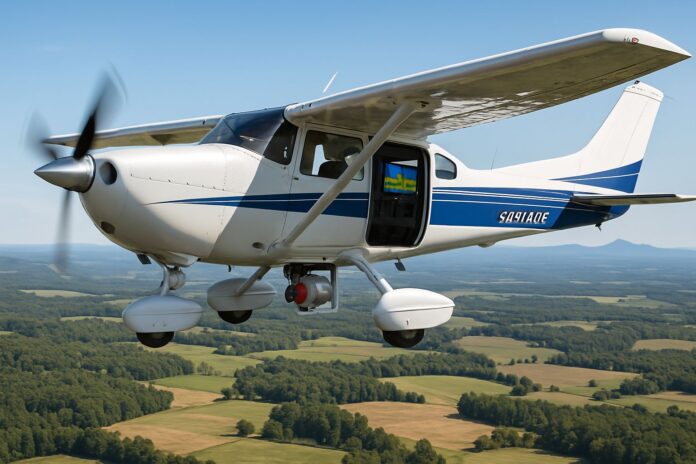

- The Cessna 182 Skylane’s high-wing design delivers unobstructed downward visibility, making it one of the most effective platforms for aerial photography, topographic mapping, and environmental surveys.
- With a 915 nautical mile range and 18,100-foot service ceiling, the Skylane covers vast survey areas in a single flight — including remote and high-altitude zones that ground crews simply cannot reach.
- The Garmin G1000 avionics suite and autopilot system allow survey operators to maintain precise, repeatable flight lines — a critical factor for accurate grid-based data collection.
- Payload management is the number one operational consideration when equipping a Cessna 182 for survey missions — understanding weight limits before loading sensors can make or break a mission.
- Airmart connects aviation professionals with quality aircraft like the Cessna 182 Skylane, helping surveyors find the right platform for demanding field operations.
Aerial surveying has never been more accessible — and the Cessna 182 Skylane is a big reason why.
The Skylane has been a fixture in general aviation since the 1950s, but its role in professional survey operations is where it genuinely earns its reputation. For survey teams needing a dependable, cost-effective fixed-wing platform, the 182 offers a combination of range, stability, and payload capacity that few light aircraft can match. Airmart regularly features Cessna 182 Skylanes in its inventory, connecting survey professionals with aircraft ready for real-world operational demands.
The Cessna 182 Skylane Is Built for Aerial Surveying
Not every aircraft is a capable survey platform — but the Cessna 182 Skylane was practically designed with observation in mind. Its structural layout, engine output, and range specifications align closely with what aerial survey missions actually demand in the field.
High-Wing Design Delivers Unobstructed Ground Visibility
The high-wing configuration of the Cessna 182 Skylane is not just an aesthetic choice — it is a functional advantage for survey operations. With the wings mounted above the fuselage, cameras and sensors mounted beneath the aircraft have a direct, unobstructed line of sight to the ground. This eliminates the wing-shadow interference that plagues low-wing aircraft during nadir (straight-down) imaging passes. For photogrammetry, LiDAR, and multispectral sensor payloads, this clean optical path directly improves data quality and reduces post-processing corrections. Discover how stability meets performance with the Cessna 172 Skyhawk for precision mapping.
230 HP Lycoming Engine Handles Demanding Survey Terrain
The Skylane’s Lycoming IO-540 engine produces 230 horsepower, giving the aircraft strong climb performance even when loaded with survey equipment and a second operator. This matters most when working over mountainous terrain or in high-density altitude conditions where underpowered aircraft struggle to maintain safe operating altitudes. Survey missions frequently require consistent altitude holds over varied topography, and the IO-540 delivers the power margin needed to do that without straining the airframe.
915 Nautical Mile Range Covers Large Survey Areas in One Flight
Fuel stops are one of the most disruptive elements of a survey mission — they break up flight lines, introduce repositioning errors, and add cost. The Cessna 182 Skylane’s 915 nautical mile range with standard tanks largely eliminates that problem for most regional survey contracts. A survey team can cover a substantial corridor, grid, or watershed area in a single sortie, returning with complete, continuous data rather than patched segments from multiple flights.
Why Traditional Surveying Methods Fall Short
Ground-based surveying remains essential for precise boundary and construction work, but it hits hard limitations the moment projects scale up in size or complexity. For an alternative approach, consider the Cessna 182 for aerial surveying solutions.
Ground Surveys Are Slow and Expensive on Large Sites
A ground crew equipped with total stations and GPS rovers can cover roughly 5 to 10 acres per day under good conditions. For a 500-acre infrastructure corridor or a 10,000-acre environmental assessment zone, that pace is simply not viable within typical project budgets or timelines. Aerial platforms like the Cessna 182 Skylane can capture the same area in hours, producing dense point clouds or orthomosaic imagery that ground teams would take weeks to generate.
Inaccessible Terrain Limits Data Collection Accuracy
Swamps, dense forest, steep ridgelines, and active industrial zones create physical barriers that prevent ground crews from collecting data at all. These data gaps force surveyors to interpolate — essentially guess — at critical terrain features, which introduces error into final deliverables. The Cessna 182 Skylane operates comfortably above all of these obstacles, collecting accurate, consistent data regardless of what lies beneath the flight path.
How the Cessna 182 Skylane Transforms Survey Operations
Switching from ground-based or drone-only operations to a fixed-wing manned platform like the Cessna 182 Skylane changes what is operationally possible — in terms of area coverage, data consistency, and overall mission efficiency.
Stable Flight Characteristics Improve Sensor and Camera Accuracy
The Cessna 182 Skylane is known for its docile, predictable handling — and that stability is a direct asset during survey missions. Sensor systems, especially LiDAR units and high-resolution mapping cameras, are sensitive to aircraft movement. Excessive roll, pitch, or yaw during a data collection pass introduces geometric distortion that requires intensive correction in post-processing. The Skylane’s inherent stability, combined with its slow stall speed of 49 knots, allows operators to fly precise, smooth transects at lower airspeeds — maximizing data quality on every pass.
Spacious Cabin Accommodates Survey Equipment and Operators
Unlike small sport aircraft or two-seat trainers, the Cessna 182 Skylane offers a four-seat cabin with meaningful usable space. Survey operators can configure the rear seats to accommodate a dedicated sensor operator, rack-mounted data acquisition systems, or both. The aircraft’s useful load — typically around 1,000 pounds depending on the specific variant — provides genuine flexibility when building out a mission-specific payload configuration without immediately hitting weight limits. Discover how Diehl Aviation is enhancing comfort and functionality by transforming aircraft interiors.
18,100-Foot Service Ceiling Expands Operational Range
The Cessna 182 Skylane’s certified service ceiling of 18,100 feet opens up survey territories that lower-performing aircraft simply cannot access. High-altitude corridors, mountain basin surveys, and elevated plateau mapping all become viable single-day missions rather than multi-day logistical challenges. This ceiling is especially valuable for survey contracts in the western United States, Canadian Rockies, or any region where terrain elevation alone can push operational altitudes well above 10,000 feet MSL.
Reliable Performance in Remote and High-Altitude Survey Zones
Reliability is not optional when a survey mission takes you 400 nautical miles from the nearest maintenance facility. The Cessna 182 Skylane’s Lycoming IO-540 engine has one of the strongest reliability records in general aviation, with a 2,000-hour TBO (Time Between Overhaul) that reflects its durability under sustained operational use. For remote survey work — think pipeline corridors through northern Canada or wildlife surveys over Alaskan wilderness — that dependability is the difference between a completed mission and a costly emergency diversion.
Garmin G1000 Avionics and Survey Mission Planning
Modern survey missions run on data — and the avionics suite aboard a properly equipped Cessna 182 Skylane makes that data accessible, actionable, and reliable from the moment the wheels leave the runway.
The Garmin G1000 glass cockpit, available in later Skylane variants, integrates navigation, engine monitoring, traffic awareness, and terrain mapping into a unified dual-screen display. For survey operations, this integration reduces pilot workload significantly, freeing the crew to focus on sensor management and data quality rather than manual navigation tasks.
Multi-Function Display Integrates Navigation and Survey Mapping
The G1000’s Multi-Function Display (MFD) can overlay flight plan routing directly onto moving map terrain data, allowing survey pilots to visually confirm they are tracking their planned transect lines in real time. When combined with external mission planning software — such as iFlightPlanner or survey-specific tools like CartoType — the MFD becomes a live operational reference that keeps the aircraft precisely on the data collection corridor. This matters most during grid surveys where lateral deviation of even 50 meters can create gaps or overlaps in the final deliverable.
The MFD also displays fuel range rings, which are particularly useful during long-range survey sorties where fuel management directly affects whether the crew can complete the final transect lines before diverting to refuel. Real-time fuel flow data from the IO-540 engine feeds directly into the G1000 system, giving operators a continuously updated picture of available range versus remaining survey area.
Autopilot System Maintains Consistent Flight Lines for Grid Surveys
The Garmin GFC 700 autopilot system, integrated with the G1000 suite in equipped Skylanes, is a genuine force multiplier for survey operations. Once a flight plan is loaded, the autopilot maintains heading, altitude, and track with a precision that manual flying simply cannot sustain over hours of repetitive transect passes. Consistent altitude holds — typically within ±50 feet — directly translate to consistent ground sample distance (GSD) in imagery, which is a core quality metric for photogrammetric survey deliverables.
Real-Time Weather Data Reduces Costly Mission Aborts
Weather is the single largest cause of survey mission delays and aborts. The G1000’s XM Weather integration delivers real-time NEXRAD radar, METARs, TAFs, and PIREPs directly to the cockpit display, allowing survey crews to make informed go/no-go decisions before committing to a four-hour transit to a remote survey area. For those interested in enhancing their flight experience, ForeFlight is the ultimate EFB for pilots.
Survey operations are particularly sensitive to cloud cover — even partial obscuration can render optical and multispectral data unusable. Having live weather data in the cockpit allows crews to identify breaks in cloud cover, reroute around developing cells, or adjust mission timing to capture the clear-sky windows that produce the highest-quality data. For pilots, tools like ForeFlight can enhance situational awareness and decision-making during such operations.
- NEXRAD radar overlay — identifies precipitation and convective activity along the survey corridor in real time
- METARs and TAFs — provide current and forecast conditions at nearby airports for fuel stop and diversion planning
- PIREPs (Pilot Reports) — deliver firsthand turbulence and icing reports from other aircraft in the survey area
- TFR alerts — flag temporary flight restrictions that could affect survey routing, especially near wildfire or military operations zones
- Winds aloft data — enables precise ground speed calculations that affect sensor trigger intervals and coverage overlap percentages
Together, these data layers give survey crews the situational awareness to protect both the aircraft and the mission — avoiding the costly scenario of arriving on site only to find unusable conditions after a lengthy transit.
Ideal Survey Applications for the Cessna 182 Skylane
The Cessna 182 Skylane is not a specialized survey aircraft in the way a purpose-built platform like the Cessna 208 Grand Caravan is — but that is precisely what makes it so versatile. Its combination of range, stability, payload flexibility, and operating cost makes it the right tool for a wide range of survey mission types.
From municipal land use assessments to remote environmental monitoring contracts, the Skylane handles mission profiles that would either overwhelm a small drone or be cost-prohibitive in a larger twin-engine platform. Understanding where it fits best helps survey teams make the most of the aircraft’s genuine strengths. For those interested in alternative aerial solutions, explore the Piper PA-28 Cherokee for exceptional sightseeing experiences.
Survey Application Key Sensor Type Typical Altitude AGL Skylane Advantage Topographic Mapping LiDAR / Photogrammetry 3,000 – 8,000 ft Stable platform, high ceiling Land Use Assessment Multispectral / RGB Camera 2,000 – 5,000 ft High-wing optics, long range Pipeline Corridor Survey Oblique Camera / LiDAR 1,500 – 4,000 ft 915 nm range, autopilot lines Environmental Monitoring Multispectral / Thermal IR 1,000 – 3,000 ft Slow cruise, cabin operator space Wildlife Survey Thermal IR / RGB Camera 500 – 1,500 ft Low stall speed, stable handling
Each of these mission types places different demands on the aircraft and its crew. The Skylane’s adaptability — its ability to carry different sensor configurations, fly at varied altitudes, and operate from short or unpaved strips near remote survey sites — is what keeps it relevant across all of them. For those interested in enhancing their aviation experience, ForeFlight is the ultimate EFB for pilots.
Topographic and Land Use Mapping
Topographic mapping is one of the most data-intensive survey applications, requiring dense, precisely georeferenced point clouds or imagery across large areas. The Cessna 182 Skylane’s combination of a stable flight profile and high service ceiling makes it well-suited for LiDAR and photogrammetric missions where consistent altitude above ground level (AGL) directly affects point density and image resolution. Survey crews typically fly these missions between 3,000 and 8,000 feet AGL, well within the Skylane’s comfortable operating envelope.
Land use mapping adds the complexity of multispectral data collection, where sensors capture imagery across multiple light wavelengths to identify vegetation health, land cover types, and surface moisture. The Skylane’s high-wing design keeps the sensor bay free of wing shadow interference across all spectral bands, which is a common quality issue on low-wing platforms during wide-angle collection passes.
Infrastructure and Pipeline Corridor Surveys
Pipeline and transmission line corridor surveys are linear missions — long, narrow data collection passes that can stretch hundreds of miles. This is where the Cessna 182 Skylane’s 915 nautical mile range delivers its most direct operational value. A single aircraft and crew can complete a 400-mile pipeline corridor survey in one sortie, collecting oblique and nadir imagery along the entire right-of-way without the fuel stop interruptions that shorter-range aircraft require.
The G1000 autopilot system keeps the aircraft precisely on the corridor centerline, which is critical for infrastructure surveys where the client needs complete, seamless coverage of a defined right-of-way. Deviation from the centerline can leave gaps in critical areas — valve stations, river crossings, road intersections — that require expensive re-fly missions to correct.
Environmental Monitoring and Wildlife Surveys
Environmental monitoring contracts often require repeated flights over the same area across different seasons — tracking vegetation change, water body extent, or habitat disturbance over time. The Cessna 182 Skylane’s operational accessibility and relatively low operating cost make repeat-mission environmental surveys economically viable in a way that larger, more expensive platforms are not. Survey teams can fly the same transect lines across quarterly or monthly intervals without the budget impact that a turbine-powered platform would impose.
Wildlife surveys add a unique operational requirement: the ability to fly slowly and low enough to visually identify and count animals, while carrying thermal infrared or high-resolution cameras for population assessment. The Skylane’s 49-knot stall speed and predictable low-speed handling characteristics make it one of the most capable fixed-wing platforms for this type of work, giving observers the time-on-target they need to collect reliable population data.
Operating Costs Versus Survey Mission Value
Operating a Cessna 182 Skylane for survey missions typically runs between $150 and $250 per flight hour in direct operating costs — covering fuel, oil, and routine maintenance reserves. When compared to turbine-powered survey platforms that can run $800 to $1,500 per hour, the Skylane’s cost structure makes it the financially rational choice for small-to-medium survey contracts where the data requirements do not demand a larger aircraft. For those looking into fractional ownership, NetJets offers a smart choice with its unique financial advantages.
The real measure of value, however, is cost per acre of survey coverage. At a typical survey speed of 120 knots and a sensor swath width of 1,500 feet at 3,000 feet AGL, a Skylane-equipped survey team can cover 8,000 to 12,000 acres per flight hour depending on overlap requirements. Against a per-acre contract rate of $2 to $5 for aerial mapping services — a standard industry range for fixed-wing photogrammetry — a single four-hour mission can generate $64,000 to $240,000 in billable deliverable coverage, making the Skylane’s operating cost a very small fraction of the mission’s commercial value.
What Surveying Professionals Should Know Before Flying the Skylane
Transitioning from ground-based or drone survey operations to a manned fixed-wing platform introduces a set of operational and regulatory considerations that are easy to underestimate. The Cessna 182 Skylane is a forgiving, capable aircraft — but getting the most out of it for survey work requires deliberate planning around weight, equipment configuration, and compliance. For those looking to enhance their aviation skills, exploring advanced technologies like AR and VR in aviation training can provide significant advantages.
The good news is that none of these considerations are barriers. They are manageable factors that, once understood, become part of a repeatable mission planning process that keeps operations safe, legal, and consistently productive.
Payload Considerations When Carrying Survey Equipment
The Cessna 182 Skylane has a maximum gross weight of 3,100 pounds with a useful load that typically lands around 1,000 pounds depending on the specific variant and fuel load. In practical terms, a standard mission configuration — pilot, sensor operator, survey camera or LiDAR unit, data acquisition computer, and full fuel — will consume most of that useful load quickly. Survey teams need to complete a detailed weight and balance calculation before every mission, accounting for the specific weight of each sensor system. A mid-size LiDAR unit like the Riegl miniVUX-1UAV weighs approximately 1.55 kg, but the mounting hardware, power systems, and cabling can add another 5 to 10 kg to the total sensor payload. Knowing these numbers before you get to the ramp prevents the frustrating — and unsafe — scenario of arriving at the aircraft with more equipment than the aircraft can legally carry.
Regulatory Requirements for Aerial Survey Operations
In the United States, commercial aerial survey operations conducted from a manned aircraft like the Cessna 182 Skylane fall under FAA Part 91 for the flight operations themselves, with survey data collection treated as an incidental function rather than a separate certification category. However, if the aircraft is operated for compensation — meaning a survey company is being paid for the data collected during the flight — the operation may need to comply with FAA Part 119 and Part 135 commercial operating rules, depending on how the service is structured. Survey professionals should consult directly with an aviation attorney or FAA-designated examiner to confirm the correct regulatory framework for their specific business model before conducting paid survey flights. Additionally, operations in controlled airspace, near airports, or within temporary flight restriction (TFR) zones require prior coordination and, in some cases, formal Letters of Authorization (LOA) from the relevant ARTCC facility.
The Cessna 182 Skylane Remains a Top Aerial Survey Platform
Decades after its introduction, the Cessna 182 Skylane continues to earn its place on active survey rosters worldwide — not out of nostalgia, but because its core performance envelope aligns almost perfectly with what small-to-medium aerial survey operations actually need. Stable handling, a high-wing sensor bay, genuine range, and manageable operating costs are not features that go out of style in this industry. For survey professionals evaluating fixed-wing platform options, the Skylane remains one of the most operationally rational choices available in the light aircraft category, and Airmart can help you find the right Skylane variant to match your specific mission requirements.
Frequently Asked Questions
Here are direct answers to the questions survey professionals most commonly ask when evaluating the Cessna 182 Skylane as an aerial data collection platform.
Can the Cessna 182 Skylane Carry LiDAR Equipment for Aerial Surveys?
Yes — the Cessna 182 Skylane can carry compact LiDAR systems within its usable payload envelope, provided the total weight and balance remains within certified limits. Lightweight systems like the Yellowscan Mapper or Riegl miniVUX series are well-suited to the Skylane’s payload capacity. These units are typically mounted on a vibration-dampened belly port or through a modified rear cabin window, and their power requirements can be met through the aircraft’s electrical system with a minor avionics modification. Heavier enterprise LiDAR systems exceeding 15 kg complete with mounting hardware may push the limits of the useful load when combined with full fuel and a two-person crew, making careful weight and balance planning essential before each mission.
What Is the Maximum Payload Capacity of the Cessna 182 Skylane?
The Cessna 182 Skylane’s useful load varies by model year and configuration, but the following figures represent the standard operational parameters that survey teams work within. For more information on related aircraft, check out the Cessna 172 Skyhawk for precision mapping.
Cessna 182 Variant Max Gross Weight Empty Weight (Approx.) Useful Load (Approx.) 182S Skylane 3,100 lbs 1,970 lbs 1,130 lbs 182T Skylane 3,100 lbs 1,970 lbs 1,130 lbs T182T Turbo Skylane 3,100 lbs 2,072 lbs 1,028 lbs 182Q Skylane 2,950 lbs 1,800 lbs 1,150 lbs
In a real-world survey configuration with two crew members averaging 170 lbs each, full fuel (92 gallons / 552 lbs), and a 30 lb sensor package, the remaining payload margin is approximately 218 lbs on a standard 182S. That margin is workable for most compact survey sensor systems but leaves little room for additional equipment without reducing fuel load. For those interested in precision mapping, the Cessna 172 Skyhawk offers a viable alternative.
Survey operators frequently fly with a reduced fuel load — carrying enough for the mission plus regulatory reserves — rather than full tanks, specifically to recover payload margin for heavier sensor configurations. A 50-gallon fuel load instead of full 92-gallon capacity frees up approximately 252 lbs of additional useful load, which can make the difference between a legal and an overweight departure when carrying a complete multi-sensor survey suite.
How Does the High-Wing Design Benefit Aerial Photography and Surveying?
The high-wing configuration places the fuselage and sensor ports directly beneath the aircraft’s center of lift, giving downward-facing cameras and sensors a completely unobstructed field of view to the ground. On low-wing aircraft, the wings intrude into the sensor’s field of view during bank maneuvers and can cast shadows across wide-angle imagery during certain sun angles — both of which degrade data quality and require additional post-processing to correct. For those interested in aerial photography, the Piper PA-28 Cherokee offers another perspective on how aircraft design can enhance visual experiences.
For survey operations specifically, the high-wing design also means that sensor mounting points on the belly of the fuselage experience less aerodynamic interference from wing wake, which reduces vibration-induced image blur during data collection passes. This is particularly important for high-resolution photogrammetric cameras where even minor motion blur can reduce the usable resolution of the final orthoimage below client specification thresholds.
Is the Cessna 182 Skylane Suitable for Surveying in Mountainous Regions?
The Cessna 182 Skylane is well-suited to mountainous survey operations, but it requires careful mission planning that accounts for density altitude, terrain clearance, and emergency landing options along the survey corridor. The Turbo Skylane variant — the T182T — is particularly capable in this environment, maintaining full rated power output at altitudes where the naturally aspirated 182S begins to show measurable performance degradation above 8,000 feet MSL.
Mountain survey operations in the Cessna 182 Skylane demand specific preflight and in-flight protocols that differ meaningfully from flatland operations. Survey crews operating regularly in high-terrain environments should build the following into their standard operating procedures:
- Density altitude calculation — Always compute DA at the departure airport and at survey altitude before every mountain mission, not just on hot days
- Terrain clearance buffers — Maintain a minimum of 1,000 feet AGL above the highest terrain within 5 nautical miles of the planned flight path
- Mountain wave awareness — Pre-brief expected rotor turbulence zones on the lee side of ridgelines, which can affect sensor stability and crew safety
- Emergency landing site identification — Pre-plan forced landing options every 15 to 20 nautical miles along remote mountain corridors before departure
- Fuel reserves — Carry extended fuel reserves in mountain terrain where diversion airports may be 50 or more nautical miles from the survey area
- Weight reduction priority — In high-DA conditions, reducing payload weight takes priority over maximizing sensor suite completeness
The T182T’s turbocharged IO-540 engine maintains its 235-horsepower output up to its critical altitude, providing a meaningful performance buffer in the high-density altitude conditions that mountain surveys routinely encounter. This makes the turbo variant the preferred choice for survey contracts operating consistently above 8,000 feet MSL.
Survey operators who regularly work in mountainous regions also benefit from the Skylane’s established short-field performance — a ground roll of under 800 feet at sea level means the aircraft can access smaller grass or gravel strips near remote survey sites, reducing transit time and positioning costs significantly compared to aircraft that require longer paved runways.
What Certifications Are Required to Conduct Aerial Surveys in a Cessna 182 Skylane?
At minimum, the pilot in command of a Cessna 182 Skylane conducting aerial survey operations must hold an FAA Private Pilot Certificate with an Airplane Single-Engine Land (ASEL) rating and a current Third-Class Medical Certificate. However, if the survey operation is conducted for compensation or hire — which describes most professional survey contracts — the PIC must hold a Commercial Pilot Certificate with an ASEL rating and a current Second-Class Medical Certificate.
Beyond the pilot certification requirements, the aircraft itself must be operating under a valid Standard Airworthiness Certificate, with a current annual inspection completed within the preceding 12 calendar months. Any sensor mounting modifications made to the airframe — such as belly camera ports or external antenna installations — must be completed under an FAA-approved Supplemental Type Certificate (STC) or through a Field Approval process under FAA Form 337, ensuring the modification does not compromise the aircraft’s airworthiness status.
Survey operations conducted in controlled airspace require the aircraft to be equipped with an ADS-B Out transponder compliant with FAA 14 CFR Part 91.225, which has been mandatory for flight in most controlled airspace since January 1, 2020. Most late-model Cessna 182 Skylanes equipped with the Garmin G1000 avionics suite already meet this requirement through the GDL 88 or GTX 345 ADS-B transceiver, but operators of older Skylane variants should verify compliance before conducting survey missions in Class B, C, or D airspace.