
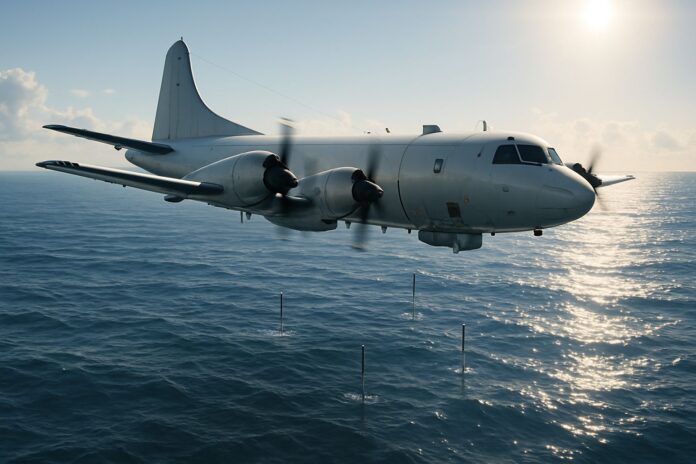

- The Lockheed Martin P-3 Orion is one of the most capable long-range maritime patrol aircraft ever built, offering over 12 hours of on-station endurance that makes it uniquely suited for large-scale oceanographic research missions.
- Originally designed as a Cold War anti-submarine warfare platform, the P-3 Orion has evolved into a multi-role science workhorse — most notably as NOAA’s WP-3D “Hurricane Hunter” variant used for atmospheric and ocean data collection.
- The aircraft’s four Allison T56 turboprop engines allow for low-altitude, low-speed flight over ocean surfaces — a capability that modern jet-powered successors like the Boeing P-8A Poseidon cannot fully replicate for certain research applications.
- With operators in 17 countries, the P-3 Orion has a proven global research and patrol footprint that few aircraft can match in terms of geographic coverage and mission versatility.
- Keep reading to discover how specific sensor systems onboard the P-3 Orion — from sonobuoys to Magnetic Anomaly Detection (MAD) — are being repurposed to unlock new frontiers in subsurface ocean science.
Few aircraft in history have done more ocean science than one originally built to hunt submarines.
The Lockheed Martin P-3 Orion has spent over six decades proving that endurance, range, and a sensor-packed fuselage can accomplish things no satellite or surface vessel can replicate. Whether it is mapping hurricane-force winds from inside a storm or deploying sonobuoys to probe the ocean’s depths, the P-3 Orion continues to be the aircraft that serious oceanographic researchers turn to. The Defense Post, a leading source of aerospace and defense analysis, has consistently highlighted the P-3 as one of the most operationally flexible maritime aircraft ever built — and the science community has taken notice.
The P-3 Orion Is Built for the Ocean
The P-3 Orion was never designed to be fast. It was designed to stay — hovering over vast stretches of ocean for hours, gathering data that short-duration aircraft simply cannot collect. That core design philosophy, born in military necessity, turns out to be exactly what oceanographic research demands.
From Cold War Hunter to Ocean Science Workhorse
Developed by Lockheed in the late 1950s as a replacement for the P-2 Neptune, the P-3 Orion entered US Navy service in 1962. Its original mission was singular and urgent: find and destroy Soviet submarines before they could threaten NATO supply lines. The aircraft did this exceptionally well, serving as the Navy’s primary anti-submarine warfare (ASW) platform through the entire Cold War period.
What the military had actually built — without fully realizing it at the time — was a near-perfect airborne ocean observation platform. The same qualities that made it lethal against submarines made it invaluable for science. Long loiter times, low-altitude flight capability, a large internal payload bay, and the ability to deploy and receive data from instruments dropped directly into the ocean are capabilities that translate directly from warfare to research.
By the time the Cold War ended, operators around the world had already begun exploring non-military applications. NOAA was among the first to recognize what the airframe could do, converting two P-3 Orions into the WP-3D variant — aircraft that would go on to fly directly into the eyes of Atlantic hurricanes and collect datasets that fundamentally changed how scientists model tropical cyclone behavior.
Key Transition Point: The P-3 Orion’s shift from anti-submarine warfare to oceanographic research was not an accident of history — it was the logical result of an airframe that was engineered from day one to operate over, and interact with, the ocean environment at low altitude for extended periods.
Why Endurance and Range Matter in Ocean Research
Ocean systems do not cooperate with short observation windows. A storm intensifies over hours. A thermocline shifts across hundreds of miles. A marine mammal migration follows patterns that require days of tracking to understand. The P-3 Orion’s ability to remain airborne for more than 12 hours per sortie — covering a combat radius of approximately 2,380 nautical miles — means researchers are not forced to make impossible choices about where to cut data collection short.
Core Technical Specs That Make the P-3 Orion a Research Powerhouse
Understanding why the P-3 Orion outperforms alternatives for ocean research starts with a clear look at its specifications. These are not abstract numbers — each figure has a direct implication for what scientists can accomplish on a mission. For those interested in other aircraft innovations, Cessna 172 Skyhawk offers precision mapping capabilities.
Specification Detail Research Relevance Powerplant 4 × Allison T56-A-14 turboprops, 4,600 shp each Enables slow, low-altitude flight over ocean surfaces Maximum Speed 411 knots (761 km/h) Transit speed to reach remote ocean areas quickly Patrol Speed ~206 knots (381 km/h) Optimal sensor sweep speed for data collection Service Ceiling 28,300 feet (8,625 m) Altitude flexibility for atmospheric profiling On-Station Endurance 12+ hours Extended observation of dynamic ocean phenomena Combat Radius ~2,380 nautical miles Access to remote ocean regions without refueling Crew Capacity Up to 21 personnel Large science teams with specialized operators Weapons/Payload Bay Internal bay + 10 underwing hardpoints Flexible instrument and sensor deployment options 12+ Hours On Station: What That Means for Data Collection
Twelve hours of on-station time is not just a logistical convenience — it is a scientific multiplier. A research aircraft that can loiter over a target area for half a day allows scientists to observe the full diurnal cycle of ocean surface temperature changes, track how a storm system evolves from formation to intensification, or follow acoustic signals from a sonobuoy field across an entire tidal cycle. Compare that to a platform with a 4-hour loiter window, and the data quality difference is not proportional — it is transformational.
Four Allison T56 Turboprop Engines and Low-Altitude Flight Capability
The four Allison T56-A-14 turboprop engines are central to what makes the P-3 Orion uniquely suited to ocean research. Turboprops deliver high fuel efficiency at low speeds and low altitudes — the exact flight profile needed to get sensors close to the ocean surface without burning through fuel reserves that would cut a mission short. The P-3 can safely operate at altitudes as low as a few hundred feet above sea level, bringing instruments into direct proximity with the phenomena being studied. Jet-powered alternatives simply cannot afford to fly at those altitudes and speeds for extended periods without an unacceptable fuel cost.
Onboard Sensor Integration: The Real Scientific Advantage
The P-3 Orion was designed from the ground up to be a sensor platform. Its large, unpressurized internal weapons bay can be converted to carry scientific instruments, drop sondes, or house data recording systems. The aircraft’s 10 underwing hardpoints — originally designed for torpedoes and depth charges — serve equally well as mounting points for oceanographic sensor pods, air sampling systems, or remote sensing equipment.
The fuselage itself is designed to support multiple operator stations, meaning that a research-configured P-3 can have dedicated scientists monitoring different data streams simultaneously during a single flight. This is not a retrofit workaround — it is the aircraft functioning exactly as its designers intended, just with different instruments in the seats and bays.
The Science the P-3 Orion Makes Possible
The sensor suite that made the P-3 Orion deadly in military service translates directly into scientific capability. What was once used to find and destroy submarines is now used to probe, map, and understand ocean systems at a level of detail that no other airborne platform consistently delivers. Learn how Parrot, the French innovator in commercial UAVs, is also making waves in scientific exploration.
Ocean Surface Mapping and Surveillance
The P-3 Orion’s low-altitude flight profile makes it one of the most effective platforms for high-resolution ocean surface mapping ever put into operational service. Flying at altitudes as low as a few hundred feet, the aircraft can carry side-looking airborne radar (SLAR) systems, synthetic aperture radar (SAR) pods, and electro-optical sensors that capture sea surface temperature gradients, wave height patterns, oil slick boundaries, and ocean current boundaries with exceptional clarity.
Surface mapping from the P-3 is not a passive exercise. Scientists onboard can actively direct the aircraft to reposition over features of interest — an anomalous upwelling zone, a phytoplankton bloom boundary, or a freshwater discharge plume from a river system — and collect multiple data passes within a single sortie. That level of real-time responsiveness is something no satellite overpass schedule can match, making it a valuable tool for commercial UAVs enthusiasts.
The aircraft has also been used extensively for ice edge mapping in polar regions, where its ability to fly low and slow over fragmented sea ice gives glaciologists and physical oceanographers data on ice concentration, thickness estimation, and melt pond distribution that passive sensors at altitude cannot resolve. The combination of range, endurance, and low-altitude capability means the P-3 can cover an entire regional ice system in a single mission.
Atmospheric and Hurricane Data Collection: The NOAA WP-3D Role
NOAA’s two WP-3D Orion aircraft — named Miss Piggy and Kermit — are the most recognized science-configured P-3s in the world. These aircraft fly directly into the eyewalls of Atlantic hurricanes, collecting in-situ wind speed, pressure, temperature, and humidity data that cannot be gathered any other way. The WP-3D carries a Tail Doppler Radar system capable of mapping three-dimensional wind fields inside a storm, along with stepped-frequency microwave radiometers that measure ocean surface wind speeds beneath the aircraft in real time. This data feeds directly into the hurricane intensity forecast models used by the National Hurricane Center.
Sonobuoy Deployment for Subsurface Ocean Monitoring
One of the P-3 Orion’s most powerful — and least discussed — research capabilities is its sonobuoy system. Originally designed to detect submarine acoustic signatures, sonobuoys are self-contained hydrophone systems dropped from the aircraft that transmit underwater acoustic data back to onboard receivers in real time. For oceanographic research, this means the P-3 can deploy a field of acoustic sensors across hundreds of square miles of ocean in a matter of hours, collecting data on ambient ocean noise, marine mammal vocalizations, internal wave activity, and even seismic events propagating through the ocean floor — all without a single surface vessel in the water.
Magnetic Anomaly Detection Applied to Geological Research
The Magnetic Anomaly Detection (MAD) boom — the distinctive tail-mounted sensor arm visible on most P-3 variants — was originally designed to detect the magnetic signature of a submerged submarine’s steel hull. Applied to geological research, the same system becomes an airborne magnetometer capable of mapping seafloor crustal structure, identifying buried fault systems, locating subsurface mineral concentrations, and charting the boundaries of tectonic plate formations. Survey-grade magnetic data collected by a P-3 flying systematic grid patterns over an ocean basin can produce geological maps of a quality that would take surface research vessels years to replicate.
NOAA’s WP-3D Orion: The Research-Specific Variant
The WP-3D Orion represents the most extensively science-modified version of the P-3 airframe in active operation. NOAA operates two of these aircraft out of MacDill Air Force Base in Tampa, Florida, and they are among the most scientifically productive aircraft on the planet, flying not only hurricane missions but also climate research, air quality studies, and oceanographic survey flights throughout the year.
What separates the WP-3D from a standard P-3 is not just the instrumentation — it is the entire philosophy of how the aircraft is configured. Every station that once housed a tactical systems operator has been redesigned around a specific scientific function, creating what is effectively a flying laboratory with coordinated, simultaneous data collection across multiple disciplines during a single flight. For those interested in other specialized aircraft, the Cessna 172 Skyhawk offers precision mapping capabilities.
How NOAA Modified the P-3 for Atmospheric and Ocean Science
The WP-3D modifications go well beyond adding a few sensors to an existing military airframe. NOAA’s aircraft feature a lower fuselage radome housing a C-band lower fuselage radar for storm mapping, the Tail Doppler Radar system for three-dimensional wind field analysis, multiple air sampling inlets along the fuselage for atmospheric chemistry work, and a GPS dropsonde system that deploys instrument packages capable of profiling atmospheric temperature, pressure, humidity, and wind speed from flight altitude down to the ocean surface. The aircraft also carries specialized ocean surface remote sensing equipment, including the stepped-frequency microwave radiometer that measures near-surface wind speeds with a precision that satellite-borne instruments cannot match at storm scale.
The interior is configured with dedicated workstations for meteorologists, oceanographers, and instrument operators. Data from all onboard systems is integrated in real time, allowing the science team to make flight path decisions based on live data feeds — steering the aircraft toward the most scientifically productive areas of a storm or ocean feature while the mission is still in progress.
What Scientists and Students Experience Onboard
Flying on a WP-3D Orion is not a passive research experience. Embry-Riddle Aeronautical University students who have participated in NOAA flight programs describe an environment where every person onboard has a defined scientific role, the aircraft is in constant motion relative to the phenomena being studied, and data is flowing from multiple systems simultaneously. Turbulence inside a hurricane eyewall is a genuine physical challenge — the aircraft can experience vertical accelerations that make sustained instrument operation demanding. Scientists working these missions develop a specific skill set that combines domain expertise with the ability to function effectively in a physically dynamic environment.
For researchers new to airborne oceanography, the WP-3D experience fundamentally changes the way they conceptualize ocean-atmosphere interaction. Seeing a hurricane’s eyewall structure from inside the storm — with real-time radar imagery on the workstation screen and the physical reality of the storm visible through the aircraft windows — creates a scientific intuition that no classroom or simulation can replicate.
Global Reach: 21 Operators in 17 Countries
The P-3 Orion has been operated by 21 different nations across every major ocean basin on Earth. From the Norwegian coastline to the South China Sea, from the North Atlantic to the southern Pacific, the P-3 has collected oceanographic and atmospheric data across virtually every marine environment the planet offers. This global operational footprint means that research partnerships built around the P-3 platform can draw on a vast international network of operators, datasets, and institutional experience — an asset that makes collaborative multinational ocean research programs significantly more practical to organize and execute.
The P-3 Orion vs. Modern Research Aircraft Alternatives
The most common question posed when discussing the P-3 Orion’s research role is whether newer aircraft — particularly the Boeing P-8A Poseidon, which the US Navy has adopted as the P-3’s direct military successor — offer superior capabilities for scientific missions. The answer is more nuanced than a simple generational comparison suggests, and for many oceanographic research applications, the P-3 Orion retains clear and specific advantages that have not been replicated by its replacements.
The P-8A Poseidon is a highly capable maritime patrol aircraft derived from the Boeing 737-800ERX commercial airframe. It is faster, flies higher, and carries more advanced digital systems than the P-3C it replaced. However, its jet powerplant and commercial airframe heritage impose real constraints on the low-altitude, low-speed flight profiles that oceanographic research frequently demands. The P-8A’s minimum safe operating altitude and fuel consumption at low speed make extended low-level ocean surface survey work significantly less practical than it is for the turboprop-powered P-3. For research applications that require sustained flight at a few hundred feet above the ocean surface — ice mapping, surface wave measurement, low-altitude sonobuoy field operations — the P-3 Orion’s design is simply better matched to the task.
What the P-3 Still Does Better Than Newer Platforms
The P-3 Orion’s turboprop configuration is not a legacy limitation — it is a deliberate engineering advantage for low-altitude maritime work. The four Allison T56 engines deliver exceptional fuel efficiency at patrol speeds between 150 and 206 knots, allowing the aircraft to maintain a stable, slow flight profile directly above the ocean surface for hours without the fuel penalty that jet-powered alternatives incur at similar altitudes and speeds. This makes the P-3 uniquely effective for tasks like sonobuoy field management, low-altitude radar surface mapping, and ice edge surveys — missions where the aircraft needs to stay low, stay slow, and stay on station for as long as the science requires. For those interested in other aircraft designed for precision work, the Cessna 172 Skyhawk offers exceptional stability for precision mapping.
Beyond the propulsion advantage, the P-3’s large internal payload bay and 10 underwing hardpoints give it a physical instrument-carrying flexibility that purpose-built jet platforms struggle to match. The airframe was designed from the outset to be reconfigured for different mission profiles, and decades of operational use have produced a mature ecosystem of sensor integrations, data systems, and mission equipment packages that researchers can draw on without starting from scratch. When a research institution needs to add a new sensor system to a P-3, they are working with an airframe that has accommodated hundreds of such modifications over its service life.
Where Successor Aircraft Like the P-8A Poseidon Fall Short for Research
The Boeing P-8A Poseidon excels at what it was designed for — high-altitude, high-speed maritime surveillance using advanced radar and signals intelligence systems. But its 737-derived airframe imposes a set of constraints that make it a less natural fit for the hands-on, low-altitude, instrument-intensive work that defines serious oceanographic field research. The P-8A’s optimum cruise altitude is significantly higher than the P-3’s patrol altitude, and its jet engines consume fuel at low altitude at rates that compress the effective on-station time available for surface-proximity data collection. For researchers who need their aircraft in direct physical proximity to the ocean environment — not observing it from 25,000 feet — the P-3 Orion remains the more capable tool.
The P-3 Orion Remains the Gold Standard for Airborne Ocean Research
More than six decades after its first flight, the Lockheed Martin P-3 Orion continues to define what an effective airborne oceanographic research platform looks like. Its combination of 12-plus hours of on-station endurance, turboprop-enabled low-altitude flight, a mission-flexible payload system, and a global operational network makes it an asset that the research community has not been able to replace — not because nothing newer exists, but because nothing newer does everything the P-3 does as well and as efficiently for ocean science specifically. For oceanographic researchers planning long-range survey campaigns, atmospheric field studies, or subsurface acoustic monitoring programs, the P-3 Orion is not a historical artifact. It is the aircraft the mission calls for.
Frequently Asked Questions
The P-3 Orion generates consistent questions from researchers encountering it for the first time as a science platform. The answers below address the most common points of confusion and provide the technical context needed to evaluate the aircraft accurately for research planning purposes.
What Makes the P-3 Orion Suitable for Oceanographic Research?
The P-3 Orion is suitable for oceanographic research because of a specific combination of characteristics that most other aircraft do not share simultaneously: extended on-station endurance exceeding 12 hours, low-altitude turboprop flight capability, a large reconfigurable payload bay, multiple underwing hardpoints for instrument mounting, and a crew capacity that supports large science teams operating multiple data systems in parallel during a single flight.
These qualities did not emerge from a research design process — they were built into the airframe for military anti-submarine warfare requirements. The fact that those requirements so closely mirror what oceanographic research demands is what makes the P-3 such a naturally effective science platform. The aircraft was built to find things in and under the ocean from low altitude over long durations, and that is precisely what ocean researchers need to do.
Research Capability Summary — P-3 Orion:
📍 On-Station Endurance: 12+ hours per sortie
📍 Operational Radius: ~2,380 nautical miles
📍 Minimum Operating Altitude: A few hundred feet above sea level
📍 Payload Flexibility: Internal bay + 10 underwing hardpoints
📍 Science Crew Capacity: Up to 21 personnel onboard
📍 Sensor Compatibility: Sonobuoys, MAD, SAR, radar, dropsondes, air samplers
📍 Global Operators: 21 operators across 17 countries. Learn more about the Lockheed Martin P-3 Orion.No single competing platform currently available to the research community combines all of these attributes in one airframe at comparable operating cost. That is why institutions from NOAA to NASA continue to operate P-3 variants for active science missions decades after the aircraft’s initial military introduction. Learn more about how Diehl Aviation is enhancing comfort and functionality by transforming aircraft interiors.
How Long Can the P-3 Orion Stay Airborne During a Research Mission?
The P-3 Orion can remain airborne for more than 12 hours per sortie under standard fuel loading, with on-station patrol time varying based on transit distance to the research area and the specific flight profile flown during data collection. At its maximum patrol speed of approximately 206 knots, the aircraft can cover enormous ocean areas while maintaining sensor sweeps — and when the mission calls for tight loitering over a specific feature, it can reduce speed further and remain on station for the duration needed.
For research planning purposes, the practical on-station time available after transit to a research area 500 nautical miles from base would typically exceed 8 hours — enough time to complete multiple systematic survey lines over a substantial ocean region, deploy and manage a sonobuoy field, conduct repeated passes over a storm feature, or collect a full diurnal data cycle from a fixed geographic position. Very few research aircraft offer this combination of range and sustained loiter time.
The endurance advantage compounds when the P-3 is compared directly to shorter-duration platforms. A research aircraft with a 4-hour loiter window forces scientists to choose between geographic coverage and temporal depth. The P-3 eliminates that trade-off for most mission types, allowing researchers to collect both broad-area survey data and sustained time-series observations within a single flight — a capability that fundamentally changes what is scientifically achievable per mission sortie. Learn more about how stability meets performance in aircraft designed for precision mapping.
What Is the Difference Between the Standard P-3 Orion and the NOAA WP-3D Variant?
The standard P-3C Orion is a military maritime patrol and anti-submarine warfare aircraft configured with tactical sensors including surface search radar, sonobuoy deployment and processing systems, Magnetic Anomaly Detection equipment, and weapons systems. The NOAA WP-3D Orion is a purpose-modified science variant that removes military weapons systems entirely and replaces tactical operator stations with dedicated scientific workstations, adds atmospheric chemistry sampling inlets, integrates Tail Doppler Radar and lower fuselage C-band radar for storm mapping, and incorporates GPS dropsonde systems for atmospheric profiling from altitude to the ocean surface. For those interested in how aircraft interiors are adapted for specific roles, you might find it insightful to learn how Diehl Aviation is enhancing comfort and functionality by transforming aircraft interiors.
The WP-3D also carries a stepped-frequency microwave radiometer for ocean surface wind speed measurement and is configured to support simultaneous multi-investigator data collection across meteorological, oceanographic, and atmospheric chemistry disciplines during a single flight. While the military P-3C is optimized for finding and prosecuting submarine contacts, the WP-3D is optimized for collecting publication-quality scientific data across multiple Earth science domains — making it one of the most scientifically productive individual aircraft currently in active operation anywhere in the world.
Can the P-3 Orion Collect Data Below the Ocean Surface?
Yes — through its sonobuoy system. The P-3 Orion can deploy sonobuoys, which are self-contained hydrophone packages that transmit subsurface acoustic data back to onboard receivers after being dropped into the water from the aircraft. A research-configured P-3 can deploy dozens of sonobuoys in a single sortie, creating a distributed acoustic sensor field spanning hundreds of square miles of ocean. Data collected includes ambient underwater noise levels, marine mammal vocalizations, internal wave signatures, and acoustic propagation characteristics of different water masses — all transmitted in real time to scientist workstations onboard the aircraft while it continues to fly. The Magnetic Anomaly Detection system adds a complementary subsurface sensing capability, measuring variations in the Earth’s magnetic field that reflect geological structures beneath the seafloor.
Is the P-3 Orion Still in Active Use for Scientific Research Today?
Yes. NOAA operates two WP-3D Orion aircraft — Miss Piggy (N42RF) and Kermit (N43RF) — out of MacDill Air Force Base in Tampa, Florida. These aircraft conduct active science missions throughout the year, including Atlantic hurricane season penetrations for the Hurricane Hunter program, winter storm research flights, air quality and atmospheric chemistry campaigns, and oceanographic survey missions.
NASA also operates a P-3B Orion through its Airborne Science Program at Wallops Flight Facility in Virginia. NASA’s P-3B has been used for Earth science campaigns including glacier and ice sheet surveys in Greenland and Antarctica as part of the Operation IceBridge program, ocean surface altimetry validation flights, and coastal ecosystem mapping missions.
Beyond US government operators, several allied nations continue to fly P-3 variants in configurations that support dual military-science mission profiles. Countries including Norway, Japan, Australia, and Canada have operated or continue to operate P-3 fleets that contribute to international ocean and atmospheric monitoring programs, extending the aircraft’s scientific reach across every major ocean basin.
The P-3 Orion is not a museum piece or a transitional stopgap — it is an active, mission-flying research tool that continues to produce peer-reviewed science, feed operational forecast models, and train the next generation of airborne oceanographers. For researchers looking to understand or engage with airborne ocean science at its most capable level, the P-3 Orion remains the platform that defines the field. The Defense Post provides in-depth analysis and coverage of platforms like the P-3 Orion for those looking to stay at the forefront of maritime aerospace and its applications in ocean research.