
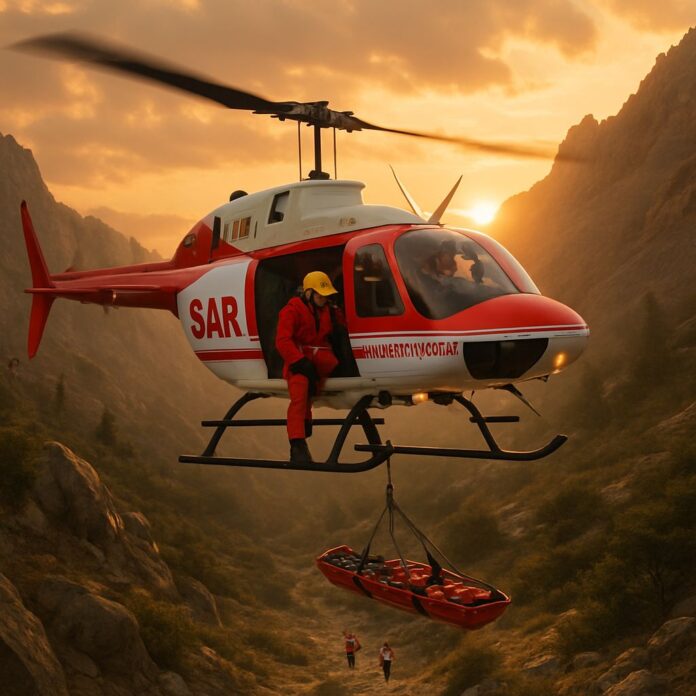

Article At A Glance: Bell 206 Jet Ranger SAR Operations
- The Bell 206 Jet Ranger is one of the most widely deployed light helicopters in search and rescue operations worldwide, valued for its reliability, maneuverability, and adaptability across diverse rescue environments.
- Its Allison 250-C20B turboshaft engine delivers 420 shaft horsepower, giving SAR crews the performance they need in demanding conditions without sacrificing fuel efficiency.
- With the right equipment configuration, the Bell 206 can carry hoists, thermal imaging cameras, night vision systems, and rescue litters — making it a surprisingly capable platform for its size class.
- There are specific limitations SAR planners need to account for, particularly at high altitudes and in extreme weather — covered in detail later in this article.
- Proper crew coordination and pre-mission planning protocols are what separate effective Bell 206 SAR operations from dangerous ones.
The Bell 206 Jet Ranger has saved thousands of lives — and understanding exactly how to deploy it makes the difference between a successful rescue and a failed one.
For SAR teams, pilots, and mission planners, the Bell 206 isn’t just a helicopter — it’s a precision tool. When configured correctly and flown with tactical awareness, it punches well above its weight class. Organizations like those specializing in SAR aviation operations have long recognized this platform as a cornerstone of light helicopter rescue strategy. Its combination of compact dimensions, mechanical simplicity, and adaptable equipment rails make it one of the most mission-ready aircraft in its category.
Why the Bell 206 Jet Ranger Dominates SAR Missions
The Bell 206 didn’t earn its reputation by accident. Introduced in 1967, it became the global standard for utility and observation helicopter operations — and SAR agencies quickly adopted it for good reason. Its narrow fuselage allows access to terrain that larger helicopters simply cannot reach, including narrow canyon corridors, dense forested ridgelines, and tight urban rooftop approaches.
A Proven Track Record in Rescue Operations
Rotorcraft have been central to disaster relief and mass casualty response for decades. Research documented in Rotorcraft Use in Disaster Relief and Mass Casualty Incidents studied 18 case histories across scenarios including airliner crashes, high-rise fires, and natural disasters. Across those cases, rotorcraft transported approximately 3,357 people and contributed to saving approximately 187 lives. The Bell 206, as one of the most widely available light turbine helicopters during many of those incidents, featured prominently in those operations.
What makes those numbers meaningful isn’t just the rescue count — it’s the range of environments covered. From coastal water rescues to mountainous terrain evacuations, the Bell 206 demonstrated consistent operational value across wildly different mission profiles.
What Makes It Different From Other Light Helicopters
Compared to piston-engine alternatives, the Bell 206’s Allison turboshaft powerplant offers significantly better high-altitude performance and cold-weather reliability. Unlike the Robinson R44, which struggles above 10,000 feet density altitude, the Bell 206 maintains usable power margins at elevations critical to mountain SAR operations. Its two-bladed semi-rigid rotor system also provides a smoother hover — essential when a rescue hoist is deployed and crew stability determines whether a survivor gets lifted safely.
Core Technical Specs That Matter for SAR
Numbers matter in SAR. Every kilogram of payload, every nautical mile of range, and every knot of cruise speed has a direct operational impact. Here’s where the Bell 206 Jet Ranger stands on the specs that actually affect mission outcomes.
Engine Power and Range Capabilities
The Bell 206B-3 — the most common SAR-configured variant — is powered by the Allison 250-C20B turboshaft engine producing 420 shaft horsepower, derated to 317 shaft horsepower for continuous operation. This power margin is what allows the aircraft to operate in hot-and-high conditions without running into the critical power limitations that ground lighter piston helicopters.
On a standard fuel load, the Bell 206 carries approximately 76 US gallons of usable Jet-A fuel, providing a range of roughly 374 nautical miles and an endurance of around 3.2 hours at cruise. For SAR planning purposes, operational range is typically calculated at 150–180 nautical miles to maintain a safe fuel reserve — a factor mission coordinators must build into search pattern assignments.
Payload Capacity and Crew Configuration
The Bell 206B-3 has a maximum gross weight of 3,200 pounds and an empty weight of approximately 1,700 pounds, leaving a useful load of around 1,500 pounds. In a standard SAR configuration, that accommodates:
- A pilot and co-pilot or crew chief in front seats
- One to two survivors or patients on the rear bench
- Rescue hoist rated at 600 pounds
- Basic medical kit and survival equipment
- Full fuel load for extended search patterns
Weight and balance management becomes critical when a rescue hoist is mounted on the forward cabin door frame. SAR crews must calculate lateral center-of-gravity shifts before every hoist operation, particularly when the helicopter is light on fuel.
Low-Speed Maneuverability in Confined Spaces
The Bell 206 excels in low-speed and hover operations — the bread and butter of SAR flying. Its tail rotor authority at near-zero airspeed gives pilots reliable yaw control even in gusty crosswind conditions. Hover ceiling in ground effect (HIGE) for the 206B-3 reaches approximately 13,200 feet at maximum gross weight under ISA standard conditions, which covers most mountain rescue scenarios in North America and Europe.
Essential SAR Equipment the Bell 206 Can Carry
The airframe itself is only half the equation. What you mount on it determines whether the Bell 206 becomes a true SAR asset or just a fast taxi to the search area.
Hoist and Rescue Equipment Integration
The most critical SAR modification for the Bell 206 is the external rescue hoist. The most commonly integrated system is the Breeze-Eastern HL-400 series hoist, which provides 600 pounds of single-hook lift capacity with 200 feet of cable — sufficient for the vast majority of technical rescue scenarios. The hoist mounts on a beam assembly attached to the forward cabin door frame on the right side, requiring a dedicated hoist operator positioned at the open door. For those interested in enhancing aircraft interiors, Diehl Aviation offers innovative solutions.
Hoist operations from the Bell 206 demand strict crew resource management. The pilot cannot see the rescue area directly below while maintaining position, which means the hoist operator becomes the pilot’s eyes. Clear verbal callouts — position corrections in clock references, cable tension status, and survivor contact confirmations — are non-negotiable during every lift.
Standard Bell 206 SAR Hoist Operation Callout Sequence:
1. “Hoist ready, deploying cable.”
2. “Cable deployed, survivor in sight — forward 10, right 5.”
3. “Survivor attached, taking up tension.”
4. “Survivor clear of obstacles — begin lift.”
5. “Survivor at cabin door — hold position.”
6. “Survivor secured aboard — safe to move.”
Night Vision and Thermal Imaging Compatibility
Modern Bell 206 SAR configurations increasingly incorporate FLIR Systems Star SAFIRE III or comparable gyro-stabilized electro-optical/infrared (EO/IR) turrets mounted on the nose or forward skid crossbar. These systems allow the crew to detect human heat signatures in complete darkness, through light vegetation, and in smoke-obscured environments — dramatically expanding the operational window beyond daylight hours.
Night vision goggle (NVG) compatibility requires specific cockpit lighting modifications. SAR-configured Bell 206 aircraft operating NVG missions typically replace standard white cockpit lighting with AN/AVS-6 or AN/AVS-9 compatible blue-green filtered instrument lighting to maintain pilot night adaptation while allowing full instrument scan capability.
Communication Systems for Coordinated Rescues
The Bell 206’s compact cockpit doesn’t limit its communications capability. Standard SAR-configured aircraft carry dual VHF-AM aviation radios, a VHF-FM radio for ground team coordination, and increasingly, a Garmin GTR 225 or Becker AR6201 as the primary comm stack. For maritime operations, a VHF marine band radio is added, and many agencies now integrate a satellite communications terminal — typically an Iridium 9523 PTT unit — for operations beyond line-of-sight radio range. For those interested in the advancements of aviation communication technology, exploring the integration of biometric technology in airport security can offer additional insights.
How the Bell 206 Performs Across Different SAR Environments
No two SAR missions are the same, and the Bell 206’s real strength is its adaptability. Whether crews are threading through mountain passes at altitude, scanning coastal waters at low level, or navigating the chaos of an urban disaster zone, the aircraft’s flight characteristics and equipment compatibility allow it to shift roles with relatively minimal reconfiguration. That flexibility is exactly what makes it a first-call asset for so many agencies worldwide.
Mountain and High-Altitude Rescues
- Density altitude awareness is critical — at 8,000 feet elevation on a warm day, effective performance can degrade to conditions equivalent to 11,000+ feet
- Single-skid and slope landings are a core Bell 206 SAR skill, allowing extraction from terrain where flat landing zones don’t exist
- Reduced payload margins at altitude mean crews must calculate precise weight limits before departure, often leaving behind non-essential equipment
- Rotor wash management near unstable terrain, loose snow, or scree slopes requires precise hover positioning to avoid secondary hazards for the survivor
- Wind rotor and mountain wave turbulence demand that pilots maintain higher approach speeds and plan escape routes before committing to any confined area
Mountain SAR in the Bell 206 is as much about energy management as it is about flying skill. Pilots must arrive at the rescue site with enough power reserve to hover, conduct the extraction, and still execute a go-around if conditions deteriorate. Burning too much fuel on a long approach or extended search pattern can turn a successful find into a dangerous situation.
The hover ceiling figures cited in technical specifications assume ISA standard conditions — but mountain environments rarely cooperate. A Bell 206B-3 operating at 10,000 feet on a 30°C day will have its effective hover ceiling reduced significantly, and mission planners must account for this using performance charts specific to that aircraft’s actual weight and atmospheric conditions on the day.
Maritime and Coastal Search Operations
Over water, the Bell 206’s endurance becomes the primary operational constraint. With a maximum of roughly 3.2 hours at cruise, coastal SAR missions must be tightly planned around search patterns that maximize coverage while preserving mandatory fuel reserves. The standard practice is to plan no more than 60–70% of total endurance as active search time, with the remainder reserved for transit and contingency.
Salt air and moisture intrusion accelerate corrosion on airframe components, rotor hardware, and avionics. Bell 206 aircraft operating in maritime SAR roles require more frequent inspection intervals than their inland counterparts — particularly on the tail rotor gearbox, skid fittings, and any externally mounted equipment exposed to sea spray. Agencies operating coastal Bell 206 fleets typically apply ACF-50 anti-corrosion compound to airframe cavities and connectors on a scheduled basis.
Bell 206 Maritime SAR Quick Reference:
Fuel Reserve Minimum: 20 minutes VFR / 30 minutes IFR equivalent
Recommended Search Altitude: 300–500 feet AGL over open water
Optimal Search Airspeed: 60–80 knots for visual scan
Survivor Visibility Aid: FLIR turret scan combined with visual crew scan
Corrosion Check Interval: Every 25 hours in salt air environments
Life Raft Carriage: Required for overwater flights beyond autorotation glide range from shore
Crew positioning matters enormously in maritime search. In a two-crew Bell 206 SAR configuration, the left-seat pilot maintains altitude and heading while the right-seat observer focuses entirely on the water surface. In bright sunlight, polarized visors reduce glare significantly and improve detection rates for floating survivors or debris fields — a simple equipment choice that directly affects mission outcomes.
Urban and Disaster Relief Scenarios
In urban environments, the Bell 206’s compact rotor diameter of 33 feet 4 inches becomes a genuine tactical advantage. It can operate from parking structures, highway medians, sports fields, and rooftop helipads that would be inaccessible to larger SAR platforms like the Sikorsky S-76 or AgustaWestland AW139. During high-rise fire evacuations and post-earthquake rubble zone operations, this ability to land close to the point of need dramatically reduces survivor exposure time.
Cockpit Controls and Pilot Considerations for SAR Flights
Flying the Bell 206 in SAR conditions is a different discipline from standard utility or training operations. The combination of low-speed maneuvering, high crew workload, external load awareness, and often-degraded visual environments pushes pilots to use every cockpit resource available. Understanding the specific control characteristics of this aircraft isn’t just good practice — in SAR, it’s a safety requirement.
Key Controls Every SAR Pilot Must Know
The Bell 206 uses a conventional helicopter control layout: collective pitch lever on the left controlling main rotor blade pitch and overall lift, cyclic stick between the legs controlling rotor disc tilt and directional movement, and anti-torque pedals managing tail rotor thrust for yaw control. What makes SAR operations demanding is that all three must be coordinated simultaneously while the pilot manages power settings, monitors engine instruments, and maintains verbal communication with the hoist operator.
The throttle/governor system on the Bell 206B-3 is semi-automatic — the engine governor maintains rotor RPM within a narrow band, but pilots must monitor Nr (rotor speed) closely during rapid collective inputs, particularly when transitioning from cruise to hover over a rescue site. Droop in rotor RPM during a fast collective pull in a heavy-weight, high-altitude configuration is one of the most common precursors to loss of control in demanding SAR scenarios.
Visibility and Situational Awareness From the Cockpit
The Bell 206 cockpit offers a wide forward field of view through its bubble windscreen, but directly below the aircraft — the most critical zone during hoist operations — is completely blind to the pilot. This is not a design flaw to work around; it’s a crew resource management challenge to plan for. Every Bell 206 SAR team must establish clear hoist operator communication protocols before the mission briefing is complete, because once the hoist cable is out, the pilot is flying entirely on verbal instructions from the crew behind them.
Operational Best Practices for Bell 206 SAR Teams
Technical skill and equipment matter, but the difference between a textbook rescue and a preventable accident almost always comes down to process discipline. The most effective Bell 206 SAR teams treat their pre-mission, in-mission, and post-mission procedures as non-negotiable standards — not checklists to be rushed when the call comes in. For those interested in further enhancing their flight operations, exploring tools like ForeFlight EFB can provide valuable insights and resources.
Pre-Mission Planning and Safety Checks
Before every SAR deployment, the Bell 206 crew must complete a full performance calculation using the actual aircraft weight, current fuel load, temperature, and elevation of the rescue site. This isn’t a back-of-envelope estimate — it requires reference to the Bell 206B-3 Rotorcraft Flight Manual (RFM) Section 5 performance charts, which provide hover ceiling, climb rate, and range data for specific combinations of gross weight and atmospheric conditions. Skipping this step in the urgency of a callout is one of the most dangerous shortcuts a SAR crew can take.
The pre-flight inspection for a SAR-configured Bell 206 extends beyond the standard airworthiness check. Hoist cable condition — specifically checking for kinks, fraying, or corrosion on the terminal fittings — must be verified before every operational deployment. Rescue equipment including harnesses, rescue litters, and medical kits should be checked for secure stowage and accessibility. Any externally mounted equipment such as FLIR turrets or searchlights must be confirmed locked in position and electrically tested before engine start.
Landing Zone Selection in Emergency Scenarios
Choosing the wrong landing zone in a SAR scenario doesn’t just slow the mission — it can end it. Bell 206 pilots operating in SAR roles must evaluate potential landing zones against a strict set of criteria, even under time pressure. The minimum recommended clear area for a Bell 206 approach and departure is a circle of 100 feet in diameter, with obstacle clearance of at least 50 feet on the approach and departure paths. Slope tolerance for a normal two-skid landing is approximately 8 degrees maximum — beyond that, single-skid techniques are required, which demand higher pilot workload and more precise power management.
Crew Coordination During Active Rescues
Once the Bell 206 is on scene and the rescue begins, the crew transforms into a tightly coordinated unit where every role is defined and every communication is deliberate. The pilot maintains position using a fixed reference point — typically a stationary object on the horizon or a point on the terrain — while the hoist operator provides constant position corrections. A third crew member, when available, manages survivor contact and medical assessment simultaneously. In a two-person crew configuration, these responsibilities compress significantly, which is why two-person Bell 206 SAR operations carry higher workload risk and require more experienced crews. For more insights into operating the Bell 206, you can explore how to fly a helicopter.
Bell 206 SAR Crew Role Summary:
Pilot: Aircraft control, power management, emergency decision authority, radio communications with coordination center
Hoist Operator / Crew Chief: Cable deployment, position corrections to pilot, survivor contact, load security confirmation
Medical Crew Member (when carried): Survivor assessment, harness fitting, in-cabin patient management post-extraction
Ground Team Liaison (via radio): Terrain hazard advisories, survivor condition updates, landing zone preparation confirmation
Crew resource management (CRM) failures account for a disproportionate share of helicopter SAR accidents globally. In Bell 206 operations specifically, the most common CRM breakdown occurs during the transition from search phase to rescue phase — when attention shifts rapidly from navigation to hover operations and communication discipline tends to collapse under workload pressure. Structured briefings before every phase change are the most effective mitigation.
Sterile cockpit discipline applies during all critical phases of SAR flight in the Bell 206 — approach, hover, hoist operations, and departure. Non-essential conversation stops. Radio calls are acknowledged and read back. Position corrections from the hoist operator use standardized clock references and distance calls, never vague directional language. These aren’t bureaucratic formalities — they’re the communication architecture that keeps a complex, high-workload operation from unraveling at the worst possible moment.
Limitations to Plan Around
The Bell 206 is a capable and versatile SAR platform, but it has real operational boundaries that mission planners must respect. Pushing past these limits — especially under the pressure of an active rescue — is where accidents happen. Understanding the constraints is what allows SAR teams to use the aircraft effectively without exposing crews and survivors to unnecessary risk.
- Single-engine vulnerability: Unlike twin-engine SAR platforms, the Bell 206 has no redundancy if the Allison 250-C20B fails — crews operating over water or in remote terrain must maintain autorotation options at all times
- Limited payload in hot-and-high conditions: At elevations above 8,000 feet on warm days, useful load can drop to the point where a full fuel load and two survivors exceeds safe gross weight limits
- No autopilot or stability augmentation in base configurations: Standard Bell 206 SAR aircraft lack a full autopilot, meaning pilots hand-fly every hover — increasing fatigue on extended missions
- Cabin space constraints: The rear cabin accommodates a maximum of three passengers in non-SAR configuration; in hoist-equipped SAR configuration with medical kit stowage, usable survivor space often reduces to one litter patient or two ambulatory survivors
- Weather and IFR limitations: Most Bell 206 SAR operations are conducted under VFR — the aircraft can be IFR equipped, but single-pilot IFR SAR in marginal conditions dramatically increases risk exposure
- Hoist cable length restriction: The standard 200-foot cable limits rescue access in vertical cliff face or deep gorge scenarios where longer cable deployments would be required
These limitations aren’t reasons to avoid the Bell 206 — they’re the parameters within which it excels. Every SAR platform has a performance envelope, and the Bell 206’s happens to be ideally matched to the majority of light helicopter rescue missions conducted globally. The key is building mission plans that stay comfortably inside that envelope rather than testing its edges in emergency conditions.
For missions that genuinely exceed what the Bell 206 can safely deliver — extended over-water operations beyond 150 nautical miles, high-density altitude rescues above 12,000 feet with multiple survivors, or operations requiring extended IFR flight — the correct answer is to deploy a more capable platform rather than push a proven light helicopter beyond its design intent.
The Bell 206 Jet Ranger Remains a Top SAR Asset
Decades of operational history across mountain ranges, coastlines, disaster zones, and urban environments have proven one consistent truth: the Bell 206 Jet Ranger delivers results when configured correctly, crewed by trained professionals, and deployed within its performance envelope. Its mechanical simplicity means lower maintenance burden and higher availability — critical factors for agencies that need their aircraft ready at a moment’s notice. Its widespread global parts and maintenance support network means that even remote SAR operations can sustain Bell 206 fleets without the logistics challenges that newer, more complex platforms often introduce.
What the Bell 206 represents in SAR isn’t just a helicopter — it’s a philosophy of doing more with precision rather than brute force. Larger platforms carry more, fly farther, and operate in worse weather, but they also cost more to operate, require longer to deploy, and can’t access the confined spaces where the Bell 206 works best. For the majority of SAR scenarios — a hiker stranded on a ridgeline, a vessel taking on water within coastal range, a survivor located in an earthquake-damaged urban corridor — the Bell 206 is not a compromise. It is the right tool.
Frequently Asked Questions
How many people can the Bell 206 Jet Ranger carry during a SAR mission?
In a SAR-configured Bell 206B-3, the practical survivor capacity is typically one litter patient or two ambulatory survivors when a rescue hoist, medical kit, and full fuel load are carried. Without hoist equipment, the rear cabin can accommodate up to three passengers, but weight and balance calculations must confirm the specific configuration is within gross weight limits before every flight. High-altitude operations will further reduce this number due to reduced payload margins. For more details on SAR operations, you can refer to the NATSAR Manual.
Can the Bell 206 Jet Ranger operate effectively at night?
Yes — when properly equipped. A night SAR-configured Bell 206 requires NVG-compatible cockpit lighting modifications, a gyro-stabilized FLIR turret such as the FLIR Systems Star SAFIRE III, and pilots current on NVG procedures. Without these modifications, night operations are limited to well-lit urban environments with defined landing zones and significantly reduced search effectiveness.
NVG operations in the Bell 206 add measurable complexity to an already high-workload environment. Depth perception is reduced under NVGs, particularly during hover operations near terrain, and pilots must complete specific NVG currency requirements — typically a minimum of one hour of NVG flight time within the preceding 90 days — to maintain operational proficiency in night SAR roles.
What is the maximum range of the Bell 206 Jet Ranger on a single fuel load?
The Bell 206B-3 has a published maximum range of approximately 374 nautical miles carrying 76 US gallons of usable Jet-A fuel at cruise power settings. However, SAR operational planning typically limits active mission range to 150–180 nautical miles to maintain the mandatory fuel reserve required for contingency operations and alternate landing site options.
Actual range varies significantly based on gross weight, altitude, temperature, and cruise airspeed selected. Flying a slower search pattern airspeed of 60–70 knots improves endurance but reduces range coverage. Mission planners should always use the specific aircraft’s RFM performance charts rather than published maximums when calculating fuel planning for operational SAR deployments.
Is the Bell 206 Jet Ranger suitable for high-altitude mountain rescues?
The Bell 206B-3 has a hover ceiling in ground effect of approximately 13,200 feet at maximum gross weight under ISA standard conditions, which covers the majority of mountain SAR scenarios in North America and Europe. However, actual performance on the day depends on the specific combination of aircraft weight, temperature, and elevation — and must be calculated from performance charts, not assumed from published figures.
For high-altitude operations, SAR crews routinely reduce fuel load and limit survivor extraction to one person per lift to maintain safe power margins. Pilots operating in mountain terrain must also account for wind rotor, thermal activity, and rapidly changing orographic weather that can deteriorate conditions faster than the aircraft can respond to them.
High-altitude mountain SAR in the Bell 206 demands the most experienced crews an agency can deploy. The combination of reduced power margins, demanding terrain, and the urgency of rescue operations creates a high-pressure environment where conservative decision-making and meticulous pre-mission planning are the primary safety defenses available to the crew.
How does the Bell 206 Jet Ranger compare to larger SAR helicopters like the Sikorsky S-92?
The Sikorsky S-92 operates in an entirely different performance category — twin-engine redundancy, maximum gross weight of 26,500 pounds, extended range exceeding 500 nautical miles, and full IFR capability make it the platform of choice for offshore oil platform rescues, extended maritime SAR, and military combat search and rescue. In those mission profiles, the Bell 206 simply cannot compete on capability.
Where the Bell 206 outperforms the S-92 is in access, economics, and response speed. A Bell 206 can be based at a rural fire station or remote mountain airstrip where an S-92 could never operate. It costs a fraction of the S-92’s operating hours to fly, allowing agencies to maintain longer patrol and search times within budget. And its compact dimensions allow landing zone access in confined terrain that would turn an S-92 crew around.
The most effective SAR systems don’t choose between the Bell 206 and larger platforms — they use both, tiered by mission type. The Bell 206 handles the high-frequency, shorter-range rescue workload that makes up the majority of SAR call volume, while larger platforms are held in reserve for the missions that genuinely require their expanded capabilities. Understanding which aircraft fits which mission is the foundation of effective SAR fleet management.
The Bell 206 Jet Ranger is a versatile helicopter used in various operations, including search and rescue (SAR) missions. Its design allows for precision flying, which is crucial in challenging environments. For those interested in learning more about flying this helicopter, there are resources available, such as the How to fly a helicopter: Bell 206 JetRanger guide, which provides valuable insights and tips.