
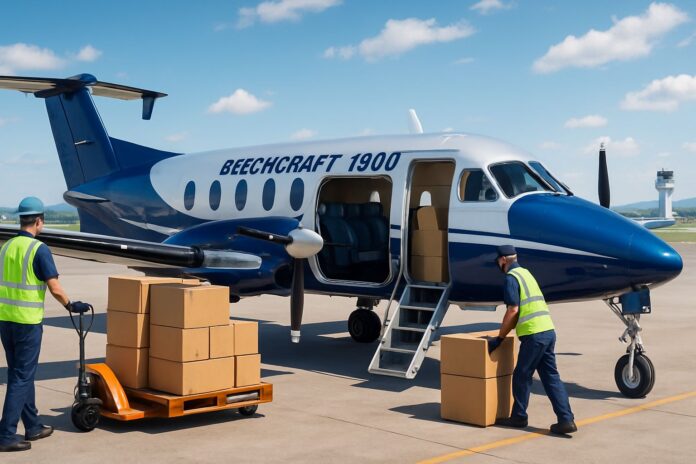

Article At-A-Glance
- The Beechcraft 1900 is the best-selling 19-passenger turboprop in history, with 695 units built — and it was designed from the start to handle both cargo and passenger operations.
- Regional operators running separate cargo and passenger fleets face significant cost inefficiencies that a single combi-capable aircraft like the Beechcraft 1900 can eliminate.
- With a cruising speed of 280 knots, a range of over 1,000 nautical miles, and a convertible cabin, the 1900 punches well above its weight class for dual-purpose operations.
- There’s one specific cabin feature of the Beechcraft 1900D that gives it a serious edge over competing turboprops in combi configurations — more on that below.
- Trilogy Aviation Group specializes in aircraft like the Beechcraft 1900, offering operators expert guidance on maximizing efficiency for regional cargo and passenger routes.
The Beechcraft 1900: Built for Double Duty
Most regional aircraft force operators to make a choice: carry people or carry freight. The Beechcraft 1900 was engineered to make that choice unnecessary.
First introduced in 1984 and entering service in 1985, the Beechcraft 1900 was developed by Beechcraft — then a division of Raytheon — as a pressurized, twin-engine turboprop regional airliner capable of serving routes that larger jets simply couldn’t touch. It draws its design lineage from the Beechcraft King Air and Super King Air series, inheriting their robust turboprop performance and pressurized cabin architecture, but scales up passenger capacity to a full 19-seat configuration. That combination of heritage engineering and expanded capacity made it the best-selling 19-passenger airliner ever built, with 695 aircraft produced before production ended in October 2002.
For operators looking to maximize aircraft utilization on thin regional routes, Trilogy Aviation Group provides expert guidance on platforms like the Beechcraft 1900, helping charter and cargo operators make smarter fleet decisions.
What separates the 1900 from other turboprops in its class is its adaptability. The aircraft was designed with multiple operational configurations in mind — pure passenger, pure cargo, and critically, combination or “combi” operations where both passengers and freight share the same flight. This flexibility is not an afterthought; it’s baked into the airframe design and cabin architecture from the ground up.
The Real Cost Problem with Running Separate Cargo and Passenger Aircraft
Regional aviation is a margin-thin business. Operators flying point-to-point routes between smaller markets face a constant battle between route demand, aircraft utilization, and operating costs. Running two separate aircraft types — one for freight, one for passengers — compounds every one of those pressures.
Maintaining two fleet types means two sets of maintenance programs, two pilot type ratings, two parts inventories, and two insurance structures. For a small regional operator, that overhead can be the difference between a viable route and an abandoned one.
Why Operators Struggle to Justify Two Fleet Types
The economics of regional aviation demand that every flight hour generate maximum revenue. When an operator deploys a dedicated freighter on a route with inconsistent cargo demand, or positions a passenger aircraft with empty seats because freight revenue wasn’t factored in, those are direct losses. Specialized aircraft are inflexible by nature — a pure freighter generates zero passenger revenue, and a passenger-only configuration leaves uncaptured cargo yield on the table every single flight. The Beechcraft 1900’s combi capability directly addresses this by allowing operators to fill the aircraft with whatever mix of revenue — passengers, freight, or both — best fits the day’s demand.
How Deadhead Flights Drain Regional Operator Budgets
A deadhead flight — one where an aircraft repositions without revenue payload — is a cost with no return. In regional networks, these happen constantly when operators use single-purpose aircraft that need to be in a specific location for their next assignment. Every deadhead burns fuel, accumulates airframe hours, and consumes maintenance cycles without generating a dollar of revenue. An aircraft like the Beechcraft 1900 that can pivot between cargo and passenger roles on short notice dramatically reduces the need for these empty repositioning flights, because the aircraft can almost always carry something revenue-generating, regardless of the route direction.
How the Beechcraft 1900 Solves the Cargo-Passenger Dilemma
The Beechcraft 1900 doesn’t just tolerate dual-role operations — it’s structurally and mechanically optimized for them. The aircraft’s design allows operators to reconfigure the cabin based on mission requirements, shifting between full passenger, full freight, and mixed loads with purpose-built flexibility.
This isn’t about cramming cargo into a passenger cabin or squeezing seats into a freighter. The 1900’s airframe dimensions, door configurations, and structural load ratings were developed specifically to support genuine combi operations at the regional level.
The Convertible Cabin That Changes Everything
The key to the Beechcraft 1900’s dual-role capability is its convertible cabin system. Operators can configure the aircraft as a full 19-seat passenger transport, a dedicated freighter, or a combi variant carrying passengers in the rear and cargo in the forward section — or vice versa. The 1900C variant introduced a large cargo door on the rear port side, a direct response to operator demand for genuine freight capability without sacrificing passenger utility. For insights into how Diehl Aviation is enhancing aircraft interiors, explore their innovative approaches.
The 1900D, introduced in 1991 after a substantial Beechcraft redesign, took cabin utility even further. Its signature feature is a stand-up cabin with a height of approximately 57.5 inches — unusually tall for a 19-passenger turboprop — which meaningfully improves the ergonomics of loading and unloading cargo as well as passenger boarding comfort. The wider interior also allows for more practical cargo stacking and securing arrangements than competing aircraft in the same class.
Reconfiguring the cabin between roles is designed to be operationally practical, not a heavy maintenance event. This means an operator can fly morning passengers into a regional hub, reload with freight, and return on the same aircraft the same day — a scheduling efficiency that single-purpose aircraft simply cannot match.
- Full passenger config: Up to 19 seats with pressurized, comfortable cabin
- Full cargo config: Maximum freight capacity with seats removed
- Combi config: Mixed passenger and cargo in a single flight
- 1900C large cargo door: Rear port-side access for efficient freight loading
- 1900D stand-up cabin: ~57.5-inch interior height improves cargo handling and passenger comfort
Cargo Volume and Payload Capacity That Punches Above Its Weight
Configuration Beechcraft 1900D Spec Max Passenger Seats 19 Luggage / Cargo Volume 122 cu. ft. Cruising Speed 280 knots Range 1,040 nautical miles Cabin Height (1900D) ~57.5 inches Engine Type Pratt & Whitney PT6A turboprop (twin) Purchase Price (used) ~$4,995,000
With 122 cubic feet of combined cabin and baggage cargo volume in standard configuration, the Beechcraft 1900D delivers freight capacity that competes meaningfully with dedicated light freighters in its weight class. When the cabin is cleared for a full cargo configuration, that usable space increases substantially, allowing operators to carry bulk freight, time-sensitive shipments, or outsized cargo that simply won’t fit in the belly of a larger regional jet.
The aircraft’s payload capacity — balanced against its twin Pratt & Whitney PT6A turboprop engines — gives operators genuine flexibility to load the aircraft efficiently without the fuel burn penalty that comes with heavier jet alternatives. This weight-to-capacity ratio is one of the core reasons the 1900 remains competitive for cargo operations decades after its initial production run ended.
For freight-forward operators, the combination of the large cargo door on the 1900C variant and the stand-up cabin on the 1900D means loading is faster, safer, and less labor-intensive than comparable aircraft. Faster ground turns directly translate to more available flight hours per aircraft per day — a critical metric for any cargo operation trying to maximize asset utilization.
It’s also worth noting that the Beechcraft 1900’s cargo capability extends beyond the main cabin. The aircraft features dedicated underfloor baggage and cargo compartments that remain accessible regardless of the main cabin configuration, giving combi operators additional freight volume even when seats are installed.
Twin Turboprop Engines Built for Short-Haul Reliability
The Beechcraft 1900 is powered by two Pratt & Whitney Canada PT6A turboprop engines — one of the most proven powerplants in regional aviation history. The PT6A’s reputation for reliability, ease of maintenance, and consistent performance in varied operating environments is a major reason the Beechcraft 1900 became the platform of choice for operators running demanding regional schedules.
Twin-engine configuration is particularly important for cargo and combi operations, where flight cancellations due to mechanical issues carry both direct cost penalties and downstream supply chain consequences. A single engine turboprop might offer lower operating costs in pure fuel terms, but the redundancy of the PT6A twin setup provides a level of dispatch reliability that freight-dependent operators and time-sensitive passenger routes demand.
The engines also perform consistently across a wide range of airfield elevations and temperatures — a critical factor for operators accessing remote or high-altitude destinations where thinner air reduces the performance margins of less capable aircraft. The PT6A-powered 1900 handles these environments with a level of dependability that has made it a fixture in markets across Africa, North America, the Pacific islands, and Latin America.
- Engine: Pratt & Whitney Canada PT6A turboprop (twin)
- Key advantage: Exceptional dispatch reliability for both cargo and passenger schedules
- Operating environment: Proven in high-altitude, high-temperature, and remote airfield conditions
- Maintenance: Widely supported global PT6A service network reduces AOG risk
- Redundancy: Twin-engine design provides critical backup for freight-dependent routes
The global PT6A service and parts network is another operational advantage that shouldn’t be underestimated. For operators in remote markets, having access to a well-supported engine type with a broad network of maintenance providers reduces aircraft-on-ground (AOG) risk — the scenario every cargo and regional passenger operator dreads most.
Performance Specs That Make Combi Operations Possible
Numbers don’t lie, and the Beechcraft 1900’s performance figures tell a clear story about why this aircraft works so well in dual-role operations where schedule reliability and route flexibility are non-negotiable. For pilots looking for an enhanced flight experience, check out why ForeFlight is the ultimate EFB for pilots.
Cruising Speed of 280 Knots Keeps Schedules Tight
At a cruising speed of 280 knots, the Beechcraft 1900 moves faster than most competing turboprops in its class. For cargo operators, speed directly affects delivery windows — a faster aircraft means tighter freight schedules, more daily rotations, and better on-time performance for time-sensitive shipments. For passenger operations, 280 knots translates to competitive block times on regional routes that keep travelers choosing turboprop connections over ground alternatives. When you’re running a combi operation where both freight clients and ticketed passengers depend on the same aircraft, that speed margin provides scheduling confidence that slower alternatives simply can’t match.
Range of Over 1,000 Nautical Miles Covers Regional Routes
The Beechcraft 1900D carries an operational range of 1,040 nautical miles — enough to connect regional hubs across significant geographic distances without technical stops that add time, cost, and complexity to both cargo and passenger itineraries. This range is particularly valuable in markets like the Pacific islands, sub-Saharan Africa, and remote North American communities where routes regularly span distances that push the limits of shorter-range turboprops.
Crucially, that 1,040-nautical-mile range figure holds up under realistic payload conditions. Operators don’t have to choose between carrying a full revenue load and making the destination — the aircraft’s fuel efficiency and engine performance allow meaningful payload to be carried across the full operational range, which is exactly the kind of real-world performance that matters when you’re signing cargo contracts and selling passenger seats simultaneously.
Short Runway Access Opens Up Remote Destinations
One of the Beechcraft 1900’s most commercially valuable performance characteristics is its ability to operate from short, unprepared, or gravel-surfaced runways that are common across the remote markets it serves. Many of the destinations that generate the most demand for combi operations — mining communities, island airports, frontier towns — simply don’t have the runway infrastructure to handle regional jets. The 1900’s short-field performance keeps these destinations commercially accessible, allowing operators to build route networks that larger, faster aircraft could never serve. That access isn’t just a convenience; in many markets, it’s the entire business case.
Why Regional Operators Trust the Beechcraft 1900
Trust in aviation is earned through consistent performance across thousands of hours and hundreds of operators in demanding conditions. The Beechcraft 1900 has built that trust over nearly four decades of continuous regional service across some of the world’s most challenging operating environments.
695 aircraft produced and a track record spanning commercial airlines, charter operators, military transport units, and dedicated freight carriers gives the 1900 a breadth of operational validation that newer or less widely deployed aircraft simply haven’t accumulated. When an operator selects the Beechcraft 1900, they’re buying into a platform with a known maintenance profile, a proven parts supply chain, and a global community of experienced pilots and technicians who understand the aircraft deeply.
- Proven platform: 695 aircraft built, decades of operational data across diverse operators
- Global support network: Widely available parts, trained technicians, and experienced pilots worldwide
- Multi-sector validation: Trusted by commercial airlines, charter operators, military units, and cargo carriers
- Maintenance predictability: Well-understood maintenance profile reduces unplanned cost surprises
- Resale market depth: Active secondary market provides fleet flexibility and asset liquidity
The aircraft’s operational longevity is also a direct indicator of how well it holds up under sustained use. Regional turboprops in combi service accumulate airframe hours quickly — often running multiple rotations daily across demanding routes. The 1900’s structural integrity and the durability of its PT6A powerplants mean operators aren’t constantly dealing with unscheduled maintenance events that disrupt cargo and passenger schedules. For those interested in how modern aviation technology is transforming the industry, Indra’s use of AR and VR technology offers a glimpse into the future of aviation training.
Airlines across North America, Africa, and the Pacific have operated Beechcraft 1900 fleets for well over 20 years, with some operators continuing to fly original production aircraft that have been maintained and upgraded to remain competitive. That longevity speaks directly to the aircraft’s core engineering quality and the depth of support infrastructure that surrounds it.
Low Operating Costs Compared to Jet Alternatives
The cost comparison between the Beechcraft 1900 and regional jet alternatives is stark for operators running thin-margin regional routes. Turboprop operating economics — lower fuel burn per seat mile, reduced airport fees at smaller facilities, and a less complex maintenance structure than jet powerplants — give the 1900 a structural cost advantage on routes where passenger and cargo volumes don’t justify the higher seat counts and operating costs of 50-seat or 70-seat regional jets. For combi operators specifically, the ability to mix cargo and passenger revenue on a cost-efficient airframe means routes that would be unprofitable under a jet economics model can generate sustainable returns with the Beechcraft 1900.
Modern Avionics Upgrades Keep the Fleet Competitive
Production may have ended in 2002, but the Beechcraft 1900 fleet hasn’t stood still. Numerous avionics upgrade packages are available and widely adopted across the active fleet, bringing glass cockpit displays, modern navigation systems, and updated communications equipment that meet current airspace requirements and improve single-pilot or two-pilot crew workload management. These upgrades extend the operational relevance of the platform significantly — an upgraded 1900D cockpit can be configured to meet the operational requirements of modern controlled airspace while retaining all the performance and flexibility characteristics that made the aircraft popular in the first place. For operators, this means the 1900 remains a viable and compliant platform well into the coming decades without requiring fleet replacement. For those interested in avionics, ForeFlight is the ultimate EFB for pilots seeking to enhance their flight experience.
Passenger Experience on a Cargo-Capable Aircraft
One of the common misconceptions about combi aircraft is that passenger comfort is sacrificed in the name of cargo utility. On the Beechcraft 1900, that trade-off simply doesn’t exist in the way critics assume — the aircraft’s design genuinely supports a quality passenger experience even in mixed-configuration operations.
Pressurized Cabin Comfort at Higher Altitudes
Pressurization is a feature that separates the Beechcraft 1900 from unpressurized turboprops that compete in the same market segment, and it makes a meaningful difference to passenger comfort on longer regional legs. Flying pressurized means the aircraft can cruise at higher altitudes where air is smoother and fuel burn is more efficient, while maintaining a comfortable cabin environment for passengers — critical for routes where weather or terrain requires altitude flexibility.
For combi operations specifically, pressurization matters because it expands the viable cargo types the aircraft can carry. Temperature-sensitive freight, pharmaceutical shipments, and certain perishables that require controlled atmospheric conditions can be transported in the pressurized cabin alongside passengers or in a dedicated forward cargo section, opening up higher-value freight categories that unpressurized alternatives simply can’t accommodate. The pressurized environment also protects cargo from the moisture and temperature extremes that affect unpressurized holds at altitude.
Stand-Up Cabin and 19-Seat Configuration
The 1900D’s stand-up cabin is genuinely one of its most underrated operational advantages. At approximately 57.5 inches of interior height, it’s tall enough for most passengers to walk upright — an unusual luxury in the 19-seat turboprop category that meaningfully changes the boarding experience. More practically for combi operations, that extra headroom makes loading and positioning cargo in the forward cabin section significantly faster and safer for ground crews. Faster turns mean more revenue hours per aircraft per day, and in regional aviation, that arithmetic matters enormously.
The 19-seat capacity also hits a commercially important threshold. In many regional markets, 19 seats represents the maximum passenger load that can be operated under less restrictive certification rules, which reduces compliance overhead for smaller operators. When those same operators combine partial passenger loads with forward cabin cargo, they capture revenue from two streams simultaneously — without the regulatory complexity of stepping up to a larger aircraft category. It’s a configuration that makes particular sense for routes where consistent 19-seat passenger demand doesn’t exist, but where mixed loads of 8 to 12 passengers plus freight can fill the aircraft profitably on nearly every rotation. For operators looking to enhance comfort and functionality, Diehl Aviation’s innovations in aircraft interiors could provide additional benefits.
The Beechcraft 1900 Remains the Smart Combi Choice for Regional Aviation
Four decades after its introduction, the Beechcraft 1900 continues to operate revenue flights across some of the world’s most demanding regional routes — and its staying power isn’t nostalgia. It’s the result of an aircraft design that solved a real operational problem with genuine engineering rather than compromise.
No other turboprop in the 19-seat class combines the 1900’s pressurized cabin, stand-up interior, large cargo door access, twin PT6A reliability, 280-knot cruise speed, and 1,040-nautical-mile range in a single airframe. Competing aircraft in this segment offer some of these capabilities, but none package all of them together at the operating cost profile the Beechcraft 1900 delivers. For operators who need to run cargo in the morning and passengers in the afternoon — or both simultaneously — that complete package is what closes the business case.
The secondary market for Beechcraft 1900 aircraft remains active precisely because demand for this kind of operational flexibility hasn’t diminished. Remote communities, island networks, frontier resource operations, and thin-route regional carriers all share the same core problem: they need an aircraft that can carry whatever generates revenue on any given day. The Beechcraft 1900 answers that need more completely than any alternative in its class.
- Pressurized cabin supports both passenger comfort and temperature-sensitive cargo
- Stand-up 1900D interior (~57.5 inches) improves cargo handling efficiency and passenger boarding
- Large cargo door on the 1900C enables fast, practical freight loading
- Twin PT6A engines deliver proven reliability across remote and high-altitude operations
- 280-knot cruise speed keeps both freight schedules and passenger block times competitive
- 1,040 nm range covers demanding regional routes without payload compromise
- 19-seat capacity hits regulatory and commercial thresholds that work for thin-route operators
- Active secondary market provides fleet access and asset liquidity for growing operators
Frequently Asked Questions
Regional operators evaluating the Beechcraft 1900 for cargo, passenger, or combined operations often come with the same core questions. The answers below cut through the generalities and address what actually matters for fleet and route decisions. For those interested in aviation training, see how Indra is redefining aviation training with realistic scenarios using AR and VR technology.
Whether you’re running a startup regional carrier, expanding an existing freight network, or evaluating aircraft for a remote community air service, these are the specifics worth understanding before making a platform commitment.
Can the Beechcraft 1900 carry both passengers and cargo at the same time?
Yes — this is one of the Beechcraft 1900’s defining operational capabilities. The aircraft supports genuine combi configurations where passengers occupy the rear cabin section while cargo is loaded in the forward section, or arranged in whatever split best fits the day’s payload requirements. The 1900C variant’s large rear cargo door facilitates this kind of mixed loading efficiently. Operators can configure the split based on manifest demand, and the pressurized cabin environment protects both passengers and freight across the full flight profile.
How much cargo can a Beechcraft 1900 carry?
In standard configuration, the Beechcraft 1900D offers 122 cubic feet of combined cabin and baggage cargo volume. In a full cargo configuration with seats removed, usable cargo space increases substantially. The aircraft also features underfloor baggage compartments that provide additional freight volume independently of the main cabin configuration, giving combi operators extra capacity even when passenger seats are installed. The twin PT6A engines support meaningful payload across the full operational range, so operators aren’t forced to choose between a full freight load and reaching the destination. For those interested in modern aircraft interiors, Diehl Aviation is enhancing comfort and functionality by transforming aircraft interiors.
What makes the Beechcraft 1900 better than other regional turboprops for combi operations?
The combination of features that makes the Beechcraft 1900 superior for combi operations isn’t available in any single competing aircraft in the 19-seat class. The pressurized cabin allows temperature-sensitive and high-value cargo to be carried alongside passengers. The 1900D’s stand-up cabin height of approximately 57.5 inches makes cargo loading significantly more practical than in competing turboprops with lower interiors. The large cargo door on the 1900C enables fast, efficient freight access. And the twin PT6A powerplants provide the dispatch reliability that combi operations — where both freight clients and passengers depend on the same aircraft — demand. No competing turboprop in this weight class packages all of these capabilities together at a comparable operating cost.
Is the Beechcraft 1900 still in production?
Production of the Beechcraft 1900 ended in October 2002, when Raytheon responded to market shifts favoring larger 50- to 90-seat regional jets by closing the production line. However, the end of production has not meaningfully limited the aircraft’s operational availability or long-term utility. With 695 aircraft built across the production run, the active fleet remains substantial, and a healthy secondary market keeps well-maintained examples available to operators at accessible price points.
The 1900’s ongoing operational relevance is supported by several factors that offset the end of new production:
- A deep global parts and spares supply chain accumulated over decades of widespread operation
- Multiple avionics upgrade packages available to bring cockpits to modern glass panel and navigation standards
- A broad network of MRO providers with deep Beechcraft 1900 type experience across key operating regions
- Strong resale and lease market activity that provides fleet access without new-aircraft capital requirements
- Structural longevity of the airframe that supports continued high-cycle operations well beyond original design expectations when properly maintained
For operators in remote or thin-route markets, the end of production is a secondary concern compared to the platform’s actual operational performance and support ecosystem. A well-maintained Beechcraft 1900 with updated avionics remains a fully competitive regional combi aircraft by any practical measure.
The active fleet operating across Africa, North America, the Pacific, and Latin America includes aircraft that have been in continuous service for over 25 years — a direct testament to both the design’s durability and the depth of the maintenance infrastructure supporting it.
What types of operators use the Beechcraft 1900 for combined cargo and passenger services?
The range of operators running Beechcraft 1900 combi configurations spans virtually every segment of regional aviation. Small and medium regional airlines use the aircraft to serve thin routes where mixed passenger and freight loads are the only way to make a rotation economically viable. Charter operators deploy the 1900 for flexible charter operations that shift between passenger charters, freight charters, and mixed loads depending on client demand and scheduling requirements.
Remote community air services — particularly in Alaska, northern Canada, Pacific island chains, and rural Africa — rely on the Beechcraft 1900’s combi capability to deliver essential supplies, mail, and freight alongside the passengers who depend on those same flights for access to medical care, business travel, and connection to broader transportation networks. In these markets, the combi configuration isn’t a commercial optimization — it’s a community service infrastructure necessity.
Resource extraction operators serving mining, oil, and forestry camps also use the 1900 extensively in combi configurations, rotating crew members on passenger seats while simultaneously transporting equipment components, tools, and supplies in the cargo section. The short-field performance that allows the aircraft to access remote airstrips makes this sector particularly well-suited to the Beechcraft 1900’s capabilities.
The Beechcraft 1900 is a versatile aircraft, known for its ability to efficiently combine cargo and passenger services. Its design is optimized for short-haul flights, making it a popular choice among regional airlines. The aircraft’s spacious cabin can accommodate up to 19 passengers, while still allowing ample space for cargo. For more detailed specifications, you can explore the Beechcraft 1900 on Trilogy Aviation Group’s website.