

- Toray Industries has led aerospace composite materials for over 40 years, supplying carbon fiber and composite systems to programs like the Boeing 787 Dreamliner, Airbus A350, and NASA’s Perseverance Mars Rover.
- Toray’s dual material advantage — producing both thermoset prepregs and Cetex® thermoplastic composites — gives aerospace engineers more design flexibility than virtually any other supplier in the world.
- Vertical integration is Toray’s secret weapon: through subsidiaries like Toray Advanced Composites and Toray Composite Materials America, the company controls every stage of the composite supply chain from raw carbon fiber to finished prepreg.
- Torayca® carbon fibers are the global benchmark for high-performance fiber, offering an unmatched combination of tensile strength, stiffness, and weight reduction across aerospace, defense, and space applications.
- Toray is already shaping the next generation of flight — investing in eVTOL, urban air mobility, and space exploration composites while pushing sustainability as a core R&D priority.
Toray Industries Dominates Aerospace Composites — Here’s Why
When Boeing engineered the 787 Dreamliner to be over 50% composite by weight, one supplier sat at the center of that achievement: Toray Industries.
Toray isn’t just a materials supplier — it’s the architectural foundation of modern aerospace manufacturing. Since the 1980s, the company has systematically built one of the most comprehensive and vertically integrated composite ecosystems in the world. That includes everything from raw Torayca® carbon fiber production to finished prepreg systems engineered specifically for primary flight structures, interior panels, and next-generation propulsion housings. Toray Advanced Composites sits at the forefront of this ecosystem, driving material innovation across both thermoplastic and thermoset platforms for the most demanding aerospace programs on the planet.
What separates Toray from competitors like Hexcel and Teijin isn’t just the quality of a single product line — it’s the breadth of engineering capability backed by four decades of real-world aerospace validation. The numbers, the programs, and the materials speak for themselves.
What Makes Toray’s Carbon Fiber Superior for Aerospace
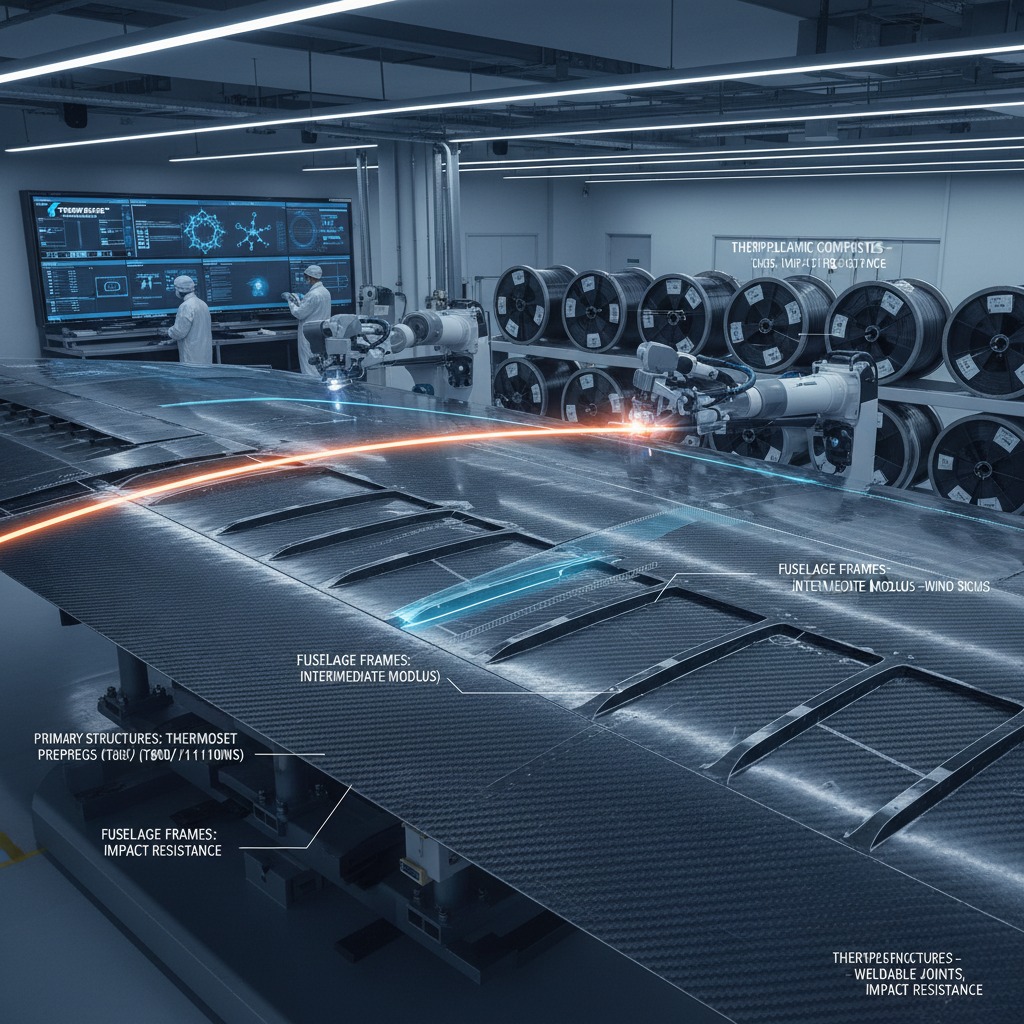
Carbon fiber performance isn’t just about tensile strength on a spec sheet. In aerospace, it’s about consistent, repeatable mechanical properties at scale — across thousands of parts, on multiple production lines, across multiple continents.
The Science Behind Toray’s High-Strength Carbon Fiber
Torayca® carbon fibers are produced through a tightly controlled polyacrylonitrile (PAN) precursor process, where precise oxidation and carbonization temperatures determine the final fiber microstructure. This manufacturing precision is what gives Toray fibers their exceptional consistency — critical for aerospace structures where material variability can have catastrophic consequences.
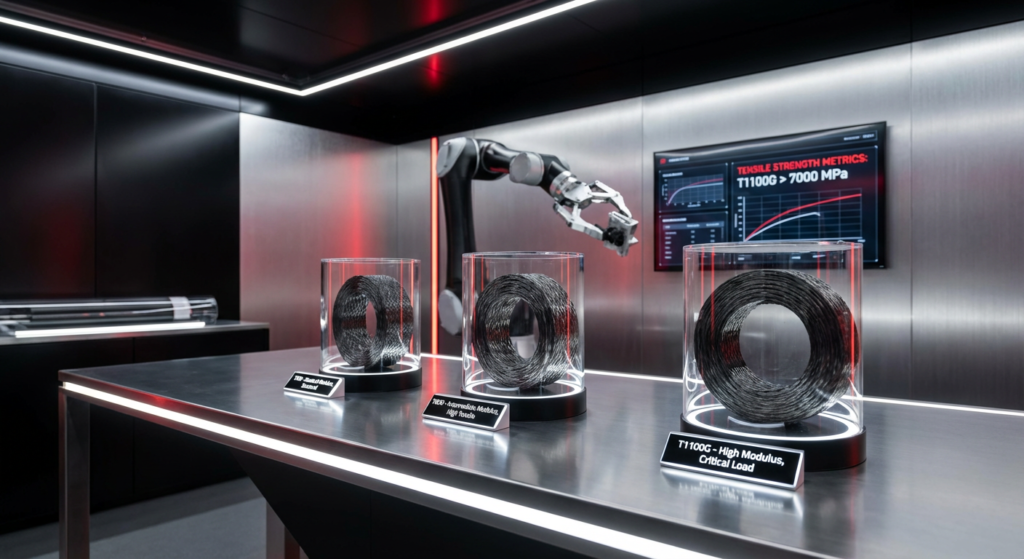
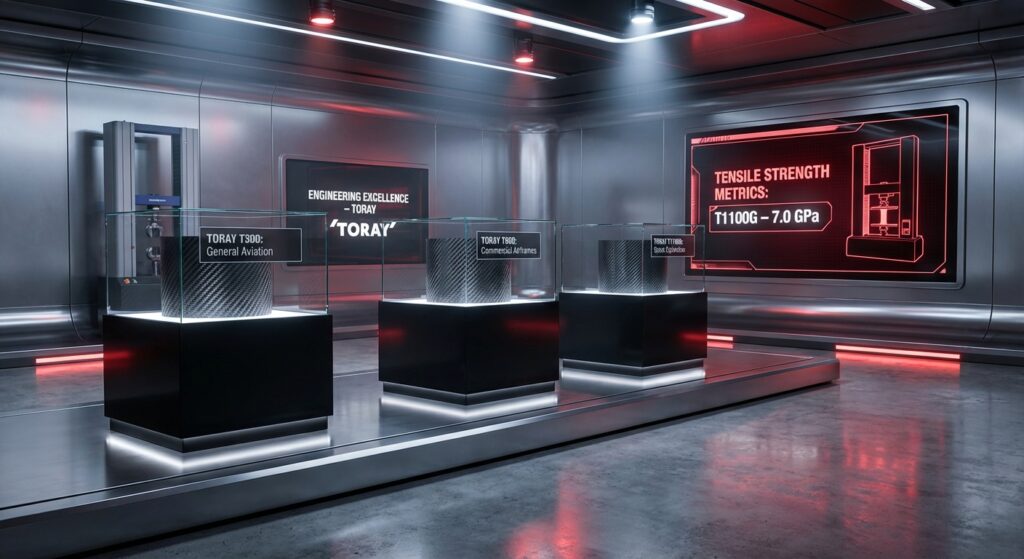
Toray offers carbon fibers spanning standard modulus, intermediate modulus, high modulus, and ultra-high modulus grades. Each grade is engineered for a specific structural role. Standard modulus fibers like T300 deliver the foundational strength-to-weight ratio that made carbon fiber composites commercially viable in aerospace. Higher-performance grades like T800 and T1100G push tensile strength beyond 7,000 MPa — performance levels that aluminum, titanium, and legacy steel alloys simply cannot match at equivalent weight. For more on how composites are shaping modern industry, discover Cytec Solvay Group’s impact.
Thermoset vs. Thermoplastic: Toray’s Dual Material Advantage
Most composite suppliers specialize in either thermoset or thermoplastic systems. Toray dominates both. This dual capability isn’t a marketing talking point — it’s a genuine engineering advantage for aerospace OEMs that need to select the right material architecture for each structural application.
Thermoset prepregs, which cure through an irreversible chemical reaction, offer exceptional stiffness and dimensional stability for primary structures like wing skins, fuselage frames, and empennage components. Thermoplastic composites, on the other hand, can be reheated and reformed, enabling faster automated processing, weldable joints without fasteners, and better impact resistance — critical advantages as aerospace manufacturers push toward higher production rates and reduced assembly costs.
Torayca® Carbon Fiber: The Industry Benchmark
Torayca® isn’t just a product name — it’s the standard against which competing carbon fiber systems are measured across global aerospace qualification programs.
- T300: The foundational aerospace-grade fiber; widely used in secondary structures and interior components
- T700S: High tensile strength fiber used in pressure vessels, sporting equipment, and structural aerospace components
- T800H / T800S: Intermediate modulus fiber used extensively in commercial aircraft primary structures
- T1100G: Ultra-high tensile strength grade pushing beyond 7,000 MPa — among the highest in commercial production
- M55J / M60J: High and ultra-high modulus fibers for space structures requiring extreme stiffness with minimal mass
The breadth of this fiber portfolio means aerospace engineers aren’t forced to compromise. Whether designing a lightweight satellite boom, a high-cycle commercial aircraft wing, or a reusable launch vehicle fairing, there is a Torayca® grade engineered precisely for that load case.
Toray’s Aerospace Product Portfolio
Beyond raw carbon fiber, Toray’s real competitive depth shows in its finished composite material systems — each formulated to address specific manufacturing processes and performance requirements across aerospace platforms.
Cetex® Thermoplastic Composites
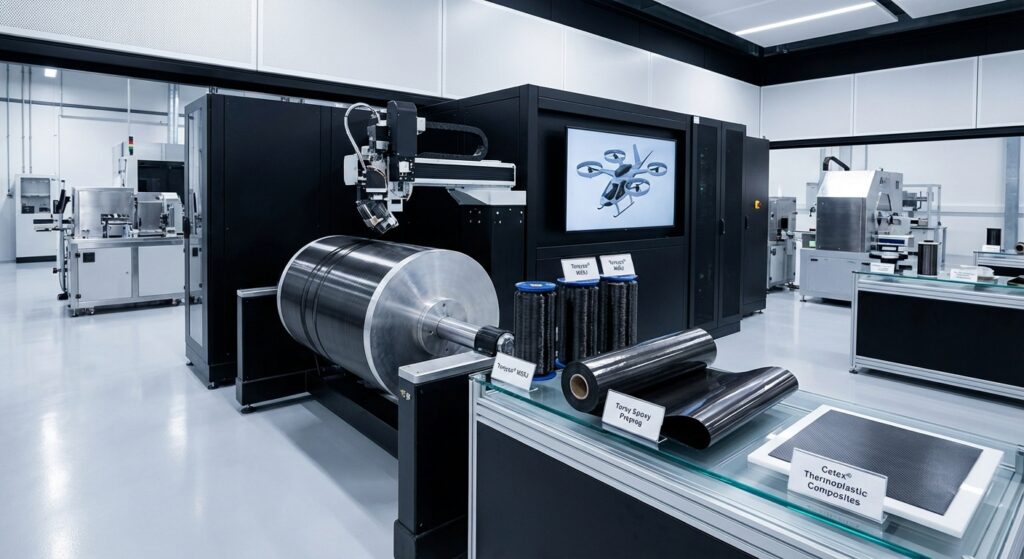
Cetex® is Toray’s flagship thermoplastic composite product line, manufactured by Toray Advanced Composites. These materials combine high-performance reinforcing fibers — including carbon and glass — with engineering thermoplastic matrices including PEEK, PPS, PEI, and PAEK. The result is a family of composite laminates with exceptional toughness, chemical resistance, and processability.
What makes Cetex® particularly compelling for aerospace production is its compatibility with automated manufacturing methods. Cetex® thermoplastic tapes and laminates can be processed using automated fiber placement (AFP), press forming, and resistance or induction welding — significantly reducing cycle times compared to traditional autoclave-cured thermoset systems. For high-rate production programs where every minute of manufacturing time translates to millions in program cost, that efficiency matters enormously, much like Diehl Aviation’s enhancements in aircraft interiors.
Cetex® materials are already qualified and flying on commercial aerospace platforms, demonstrating the real-world performance validation that procurement teams and airworthiness authorities require before a material enters a flight-critical structure.
Thermoset Prepregs and Epoxy Tooling Materials
Toray’s thermoset prepreg portfolio covers a wide range of resin systems — epoxy, bismaleimide (BMI), and cyanate ester — matched to fiber types and areal weights optimized for specific layup processes. These systems are designed for autoclave cure, out-of-autoclave (OOA) processing, and resin transfer molding (RTM), giving manufacturers flexibility in how they process high-performance structures.
The epoxy tooling prepreg range is equally critical. In aerospace composite manufacturing, the tool is just as important as the part — dimensional accuracy during cure directly determines the final part geometry and fit. Toray’s tooling prepregs are formulated to match the coefficient of thermal expansion (CTE) of the parts being produced, minimizing spring-back and distortion through cure cycles. Discover how Diehl Aviation is enhancing comfort and functionality by transforming aircraft interiors.
Surfacing Films for Aerospace-Grade Finishing
Surfacing films are the finishing layer applied to composite structures to achieve smooth, paint-ready aerodynamic surfaces without additional material weight. Toray’s surfacing film systems are engineered for compatibility with primary structural prepregs, co-curing during the autoclave cycle to eliminate secondary bonding steps and reduce total part count — a simple but significant manufacturing efficiency gain on high-volume aerospace programs.
40+ Years of Aerospace Innovation
Four decades of sustained technical leadership in one of the world’s most demanding industries isn’t accidental — it’s the result of deliberate, compounding investment in materials science, manufacturing capability, and aerospace-specific qualification programs.
Toray’s Entry Into Aerospace Composites in the 1980s
Toray’s aerospace composites journey began in earnest in the 1980s, when carbon fiber was transitioning from an exotic research material into a viable structural option for commercial aviation. Toray recognized early that aerospace would become the highest-value application for advanced carbon fiber — and invested accordingly in fiber manufacturing capacity, resin development, and the long-cycle qualification programs that aerospace entry requires.
Key Milestones That Cemented Toray’s Market Position
The milestone that changed everything was Toray’s selection as the primary carbon fiber supplier for the Boeing 787 Dreamliner program. The 787 was the first commercial aircraft designed with composite materials as the primary structural material — not a secondary or supplementary choice. Toray’s T800 carbon fiber and associated prepreg systems became the backbone of the 787’s fuselage barrels, wing skins, and empennage, validating at commercial scale what the company had been developing for decades.
From that platform, Toray’s aerospace credentials compounded rapidly. Qualification on the Airbus A350 XWB followed, cementing the company’s position as the preferred carbon fiber supplier for the two dominant commercial aircraft OEMs simultaneously — a position no other single supplier has matched. Each major program win brought further manufacturing scale, deeper engineering relationships with airframe OEMs, and wider qualification data packages that make switching to alternative suppliers increasingly difficult and costly for aerospace customers.
Toray’s Role in the World’s Most Critical Aerospace Programs
The true measure of an aerospace materials supplier isn’t what it claims in a brochure — it’s which programs trust its materials to keep people alive at 35,000 feet, or to survive the vacuum of space. By that measure, Toray’s track record is unmatched.
From the world’s highest-volume commercial aircraft programs to classified defense platforms and interplanetary exploration vehicles, Toray composite materials are flying — and performing — in the most demanding environments humans have ever engineered for.
Boeing and Airbus: Supplying the Commercial Aviation Backbone
The Boeing 787 Dreamliner consumes composite materials at a scale that redefined what aerospace supply chains look like. With over 50% of the airframe by weight built from carbon fiber reinforced polymer, and Toray supplying the primary structural fiber and prepreg systems, a single 787 delivery represents thousands of kilograms of Toray material in flight. The Airbus A350 XWB tells a similar story — composite-intensive by design, with Toray materials qualifying for primary load-bearing structure on both widebody platforms that now carry hundreds of millions of passengers annually.
Military Aircraft: From the Dassault Rafale to Advanced Defense Programs
Defense aerospace demands even higher performance margins than commercial aviation — higher operating temperatures, greater fatigue cycles under combat maneuvering loads, and often stricter radar cross-section requirements that favor composite over metallic construction. Toray’s carbon fiber systems have been qualified for military platforms including the Dassault Rafale, one of Europe’s most capable multirole combat aircraft, where composite materials reduce structural weight while contributing to the aircraft’s agility and low-observable characteristics. The demanding qualification standards of military programs — which exceed even commercial airworthiness requirements in many structural categories — make Toray’s proven track record in this space particularly significant.
NASA’s Perseverance Rover: Toray Composites on Mars
Perhaps no application better illustrates the absolute performance ceiling of Toray’s composite materials than NASA’s Mars 2020 Perseverance Rover mission. Composite components utilizing Toray materials were incorporated into the rover’s structure — materials that had to survive launch loads, the thermal shock of deep space transit, the violent deceleration of Mars atmospheric entry, and then operate reliably on the Martian surface in temperature swings exceeding 100°C.
That’s not a qualification test in a laboratory. That’s the harshest real-world validation environment that exists. The fact that Toray composite materials are operating on the surface of Mars right now is a data point that no competitor can replicate.
eVTOL, Drones, and the Next Generation of Flight

The emerging urban air mobility sector — electric vertical takeoff and landing (eVTOL) aircraft, autonomous cargo drones, and advanced air taxis — is placing entirely new demands on composite material systems. These platforms require extreme mass efficiency, high-rate manufacturing compatibility, and in many cases the ability to be processed through automated methods that traditional aerospace prepreg systems weren’t designed for. Toray’s Cetex® thermoplastic composites are ideally positioned for this market, offering the automated processability and weldable joint capability that eVTOL manufacturers need to hit the production rates their business models require.
Vertical Integration: Toray’s Biggest Competitive Advantage
Most composite suppliers operate at one layer of the value chain — either making fiber, or making resin systems, or converting those materials into finished prepregs. Toray does all of it. That vertical integration isn’t just an operational efficiency story — it’s a fundamental engineering advantage that directly benefits aerospace customers.
When the fiber manufacturer, the resin chemist, and the prepreg converter all sit within the same corporate structure, material optimization happens at every interface simultaneously. Toray engineers can tune fiber surface chemistry specifically to improve adhesion with proprietary resin formulations — something that’s simply not possible when fiber and resin come from separate, competing suppliers working with limited visibility into each other’s systems. Discover how Diehl Aviation is enhancing comfort and functionality by transforming aircraft interiors, which complements Toray’s innovations in materials.
How Toray Advanced Composites and Composite Materials America Strengthen the Supply Chain
Toray Advanced Composites (TAC), headquartered in the United States, serves as the primary development and production center for Toray’s thermoplastic Cetex® product line and a broad range of thermoset prepreg systems. TAC’s engineering teams work directly with aerospace OEMs and Tier 1 suppliers on material qualification, process development, and design allowables generation — the intensive technical work that gets a new material from development into a certified flight structure.
Toray Composite Materials America (TCMA) complements TAC by focusing on carbon fiber prepreg manufacturing for the North American aerospace market, operating large-scale prepreg production lines that supply the high-volume demands of commercial aircraft programs. Together, TAC and TCMA form an integrated North American composite materials platform that provides aerospace customers with both the technical depth for advanced development work and the manufacturing scale for high-rate production supply.
Why Vertical Integration Matters for Aerospace Program Success
Aerospace qualification timelines are measured in years, not months. When an OEM selects a composite material system for a new flight structure, they’re committing to a supplier relationship that will span the entire production life of that aircraft — potentially 30 to 40 years. Supply chain stability isn’t a preference in that context; it’s a program requirement. For instance, companies like Parrot, the French innovator in commercial UAVs, demonstrate the importance of stable and reliable supply chains in aerospace.
Toray’s vertical integration directly addresses this risk. Because Toray controls its own precursor fiber production, carbonization capacity, resin synthesis, and prepreg conversion, the company is insulated from the supply chain disruptions that affect suppliers dependent on external material sources. During the global supply chain dislocations of the early 2020s, that structural resilience was not a theoretical advantage — it was a live operational differentiator.
Beyond supply security, vertical integration enables Toray to offer aerospace customers a single-source technical accountability that distributed supply chains cannot match. When a material performance question arises during a certification campaign — and it always does — having one engineering organization that understands the complete material system from fiber precursor to cured laminate dramatically accelerates problem resolution. That speed translates directly into program schedule protection, which in commercial aerospace terms means hundreds of millions of dollars in delivery milestone value. Discover how innovative composite solutions are impacting modern industry.
Toray’s Global Footprint in Aerospace Composites
Aerospace is a global industry, and the materials that enable it need to be manufactured, qualified, and supported globally. Toray’s geographic footprint — spanning Japan, the United States, and Europe — is deliberately structured to place manufacturing capability and technical support close to the major aerospace production centers it serves.
This isn’t simply a matter of logistics efficiency. Aerospace material qualification is jurisdiction-specific in many respects, with FAA, EASA, and JCAB each maintaining distinct certification frameworks. Having regional engineering and manufacturing operations means Toray can support customers through the specific regulatory qualification pathways applicable to their programs, rather than forcing a single global standard onto locally complex certification requirements.
Operations Across Asia, North America, and Europe
Toray’s Japanese operations form the technological core of the enterprise — the origin point for Torayca® fiber development, advanced resin chemistry research, and the fundamental materials science that underpins every downstream product. North American operations through Toray Advanced Composites and Toray Composite Materials America serve the world’s largest single aerospace market, with manufacturing capacity scaled to the demands of Boeing’s commercial production programs and the dense cluster of defense primes concentrated in the United States. In Europe, Toray Carbon Fibers Europe brings over 40 years of continuous aerospace fiber manufacturing experience to the Airbus supply chain and the broader European aerospace and defense industrial base — providing the regional manufacturing presence and EASA-familiar qualification support that European OEMs and their regulatory frameworks require.
Toray Carbon Fibers Europe: 40 Years Serving the European Market
Toray Carbon Fibers Europe (CFE) has been manufacturing aerospace-grade Torayca® carbon fibers for the European market for over four decades — a continuous operational presence that reflects both the maturity of Toray’s European commitment and the depth of its integration into the Airbus supply chain. Based in France, CFE offers the most comprehensive range of carbon fibers available in the European market, supporting programs from large commercial transports to regional jets, business aviation, helicopters, and defense platforms.
Beyond supplying established manufacturers, Toray Carbon Fibers Europe has explicitly positioned itself as a partner to the next generation of aerospace innovators — the startups and new entrants developing eVTOL aircraft, hydrogen propulsion systems, and next-generation space launch vehicles. That forward orientation, backed by 40 years of European qualification history, makes CFE a uniquely capable resource for both legacy OEMs navigating material upgrades and new entrants establishing their first composite material qualification programs.
How Toray Stacks Up Against Hexcel, Teijin, and Syensqo
The 2025 Aerospace Composites Industry Company Evaluation Report identifies Toray Industries, Syensqo, and Hexcel as the three leading companies in the aerospace composites space — each competing across lightweight materials, global expansion, and sustainability innovation. Here’s how Toray’s position compares:
| Capability | Toray Industries | Hexcel | Teijin | Syensqo |
|---|---|---|---|---|
| Carbon Fiber Production | Fully integrated (PAN precursor to finished fiber) | Integrated | Integrated | Resin-focused; no fiber production |
| Thermoplastic Composites | Cetex® — broad PEEK/PPS/PAEK portfolio | Limited thermoplastic offering | Thermoplastic capability via Toho Tenax | Strong thermoplastic resin systems |
| Thermoset Prepregs | Extensive — epoxy, BMI, cyanate ester | Extensive HexPly® portfolio | Limited compared to Toray | Cycom® and MTM® prepreg systems |
| Aerospace Program Presence | 787, A350, Rafale, NASA Perseverance | 787, A350, F-35 | Commercial and defense programs | A350, military rotorcraft |
| Global Manufacturing | Japan, USA, Europe | USA, Europe | Japan, USA, Europe | USA, Europe, Asia |
| Vertical Integration Depth | Precursor → fiber → resin → prepreg | Fiber → prepreg | Fiber → prepreg | Resin → prepreg |
Hexcel is Toray’s most direct competitor in thermoset prepreg systems for commercial aviation, with a similarly deep qualification history on the 787 and A350 platforms. Where Toray maintains a decisive advantage is in the combination of vertically integrated fiber production and a mature thermoplastic composites platform through Cetex® — a dual capability that Hexcel has not matched at equivalent scale. Teijin competes effectively in carbon fiber through its Toho Tenax brand, but lacks Toray’s breadth of finished composite material systems. Syensqo brings strong resin chemistry expertise — particularly in high-temperature thermoset systems — but without an integrated fiber business, depends on external fiber supply in a way that Toray structurally does not.
The Future of Toray in Aerospace Composites
The aerospace materials market is entering a period of structural change driven by three converging forces: the push toward higher aircraft production rates at Boeing and Airbus, the emergence of entirely new vehicle categories in urban air mobility and commercial space, and mounting pressure across the aviation industry to reduce the environmental footprint of both aircraft manufacturing and operation. Toray’s R&D investment profile and product development roadmap are directly aligned with all three vectors. Learn more about how Diehl Aviation is enhancing comfort and functionality by transforming aircraft interiors.
What’s particularly significant about Toray’s forward position is that the company isn’t pivoting toward these opportunities from a standing start — it’s accelerating into them from a position of established technical infrastructure and deep customer relationships that competitors would take decades to replicate.
Sustainability and Lightweighting as Core R&D Priorities
Every kilogram removed from an aircraft structure translates directly into fuel burn reduction over the aircraft’s operational life — a number that accumulates to thousands of tonnes of CO₂ avoided across a large commercial fleet. That physical reality makes lightweighting not just a performance goal but an environmental imperative, and it continues to drive demand for higher-performance carbon fiber grades that deliver greater stiffness and strength per unit weight than previous generations. Toray’s ongoing fiber development — pushing tensile strength and modulus simultaneously in grades like T1100G — directly addresses this demand. Beyond fiber performance, Toray is investing in resin systems and manufacturing processes that reduce the energy intensity of composite part production itself, including out-of-autoclave cure systems that eliminate the enormous energy consumption of traditional autoclave processing for large aerospace structures.
Emerging Markets: Space Exploration and Urban Air Mobility
Commercial space launch is the fastest-growing new market for high-performance composite materials, driven by the proliferation of reusable launch vehicle programs and the satellite constellation buildout that is transforming global communications infrastructure. Launch vehicle structures — fairings, interstage sections, propellant tank skirts, and in some architectures the propellant tanks themselves — demand composite materials that perform at extreme load levels, survive cryogenic and high-temperature environments simultaneously, and can be manufactured at production rates that were considered impossible for aerospace composites just a decade ago.
- High-modulus fibers like Torayca® M55J and M60J are essential for space structures where stiffness under load matters more than ultimate tensile strength
- Cryogenic compatibility of Toray’s epoxy prepreg systems enables their use in liquid oxygen and liquid hydrogen tank structures on launch vehicles
- Cetex® thermoplastic composites are attracting interest from eVTOL manufacturers for structural components that benefit from automated forming and thermoplastic welding
- Out-of-autoclave prepreg systems from Toray enable cost-effective composite manufacturing for smaller space and UAM programs that cannot justify autoclave capital investment
- Ultra-high tensile strength fibers support the mass fraction optimization critical to reusable launch vehicles, where every gram saved in structure translates to payload capacity delivered to orbit
Urban air mobility presents a different but equally compelling opportunity. eVTOL aircraft are being designed for production rates that dwarf anything in traditional aerospace — some developers are projecting annual production volumes in the thousands of vehicles, closer to automotive rates than aerospace rates. That manufacturing scale requirement fundamentally changes the material and process selection calculus, strongly favoring thermoplastic composite systems like Cetex® that are compatible with high-speed automated processing over traditional hand-laid thermoset prepregs that require skilled labor and long autoclave cycle times.
Toray’s position at the intersection of established aerospace qualification credibility and thermoplastic composite manufacturing capability makes it arguably the best-positioned incumbent supplier to capture a dominant share of the eVTOL structural materials market as the sector scales from prototype to production.
Toray’s Leadership Is Built on Proof, Not Promises
Every aerospace materials supplier offers performance data in a technical data sheet. What separates Toray is the accumulated weight of real-world validation across four decades, across every major commercial aircraft platform, across military aviation, and across space exploration — including an operational presence on the surface of another planet. That is not a portfolio that any competitor can replicate through a press release or an acquisition announcement. It is built through sustained, compounding technical investment and the willingness to submit materials to the most demanding qualification regimes that engineering has devised.
For aerospace engineers, procurement professionals, and program managers evaluating composite material suppliers for their next platform, the question isn’t whether Toray’s materials perform — the 787 fleet, the A350 fleet, and the Perseverance Rover have already answered that. The real question is whether any alternative supplier offers equivalent technical depth, supply chain resilience, and global qualification support. Based on the evidence, the answer remains no.
Frequently Asked Questions
What type of carbon fiber does Toray supply for aerospace applications?
Toray supplies Torayca® carbon fibers across a comprehensive range of grades for aerospace applications. These include standard modulus fibers such as T300 and T700S, intermediate modulus fibers including T800H and T800S, high modulus grades, and ultra-high tensile strength fibers such as T1100G, which achieves tensile strength exceeding 7,000 MPa. High and ultra-high modulus grades including M55J and M60J serve space structure applications where stiffness is the primary design driver.
In addition to raw carbon fiber, Toray supplies finished composite material systems including thermoset prepregs in epoxy, bismaleimide, and cyanate ester resin systems, and Cetex® thermoplastic composite laminates and tapes incorporating PEEK, PPS, PEI, and PAEK matrix materials. The combination of fiber and finished composite system capability makes Toray a uniquely comprehensive source for aerospace composite material needs across the full range of structural applications.
Which aircraft programs use Toray composite materials?
- Boeing 787 Dreamliner — Toray T800 carbon fiber and prepreg systems are used in primary fuselage, wing, and empennage structures, which together constitute over 50% of the airframe by weight
- Airbus A350 XWB — Toray composite materials are qualified for primary structural applications on Airbus’s most composite-intensive widebody commercial aircraft
- Dassault Rafale — Toray carbon fiber systems support the structural composite content of France’s premier multirole combat aircraft
- NASA Mars 2020 Perseverance Rover — Composite components incorporating Toray materials are currently operating on the Martian surface
- Multiple additional commercial, business aviation, and defense platforms — Toray materials appear across a wide range of additional aerospace programs through both direct qualification and Tier 1 supplier integration
The common thread across all of these programs is the requirement for materials that meet the most demanding structural performance, environmental durability, and quality consistency standards that aviation and space certification imposes. Toray’s presence across this breadth of programs reflects both the technical performance of its material systems and the depth of its qualification data packages — which represent decades of testing, analysis, and flight validation that new entrants cannot rapidly replicate. For more information on Toray’s advancements in the aerospace composites industry, visit this detailed report.
What is the difference between Toray Advanced Composites and Toray Composite Materials America?
Toray Advanced Composites (TAC) is focused on the development and production of thermoplastic Cetex® composite systems and a range of thermoset prepregs, working closely with aerospace OEMs and Tier 1 suppliers on material qualification and process development. Toray Composite Materials America (TCMA) operates large-scale carbon fiber prepreg manufacturing lines serving the high-volume demands of commercial aerospace programs, particularly the North American aerospace market centered on Boeing’s commercial production programs. Both companies operate as part of Toray’s vertically integrated North American composite materials platform, with complementary technical and manufacturing roles that together provide aerospace customers with both advanced development capability and high-rate production supply. For more on innovative composite solutions, discover Cytec Solvay Group’s impact on modern industry.
Has Toray’s carbon fiber been used in space exploration?
Yes. Composite components incorporating Toray materials were used in NASA’s Mars 2020 Perseverance Rover, which successfully landed on Mars in February 2021 and continues to operate on the Martian surface. This application represents one of the most demanding real-world validations of composite material performance ever achieved — requiring survival through launch loads, deep space thermal cycling, Mars atmospheric entry deceleration exceeding 7g, and continuous operation in the harsh Martian surface environment. Discover how Diehl Aviation is enhancing comfort and functionality in aerospace through innovative materials.
Beyond the Perseverance mission, Toray’s high modulus carbon fiber grades — particularly M55J and M60J — are widely used in satellite structures, telescope optical benches, and launch vehicle components where extreme stiffness with minimal mass is required. The coefficient of thermal expansion (CTE) control achievable with high modulus Torayca® fibers is critical for space optical structures that must maintain dimensional stability through temperature swings from cryogenic shadow to direct solar illumination.
The commercial space launch sector represents a growing application area for Toray composites, as reusable launch vehicle developers seek fiber and prepreg systems that combine the structural performance needed for primary load-bearing structure with manufacturing compatibility for the higher production rates that commercial space economics demand. Toray’s combination of ultra-high performance fiber grades and out-of-autoclave prepreg systems positions it well for this expanding market segment.
Toray Advanced Composites continues to push the boundaries of what’s possible in aerospace and space composite materials — if your program demands materials that perform where the margin for error is zero, exploring what Toray’s full composite system portfolio can offer is a logical first step.